


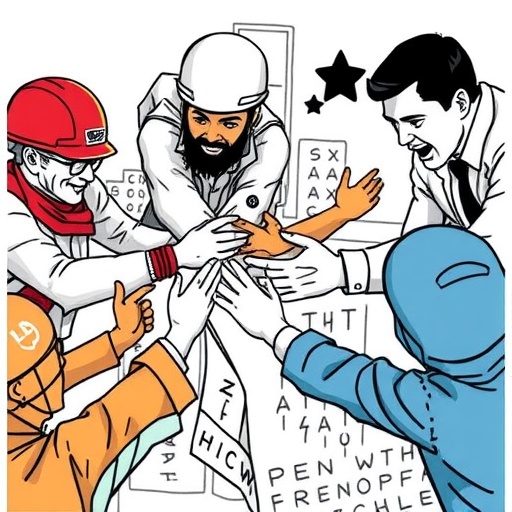
In an intriguing development within the realm of social psychology and behavioral neuroscience, new research reveals that humans demonstrate a heightened propensity for prosocial behavior in environments characterized by scarcity and limited opportunities. Published in the prestigious journal Nature Communications, this comprehensive study, conducted by a consortium of researchers from the University of Birmingham, Oxford University, and the University of East Anglia, challenges conventional wisdom about generosity and the conditions under which people decide to help others.
The core premise of this groundbreaking research is both intuitive and counterintuitive. Traditional perspectives often portray affluent or resource-rich contexts as the breeding ground for altruistic acts, under the assumption that individuals with more resources or better opportunities might have a greater capacity or willingness to help others. However, this new evidence suggests a converse dynamic: in “poor” or resource-scarce environments, individuals exhibit an increased frequency of prosocial decisions. This phenomenon points to a deeper, context-sensitive mechanism governing human kindness, rooted in the nature of choice environments themselves.
At the heart of this study lies a carefully designed experimental approach that simulates the kind of episodic decision-making people face in everyday life, particularly when balancing personal gratification against exerting effort to benefit others. Participants were exposed to two distinct environmental conditions—dubbed the “rich” and “poor” environments—each characterized by differing distributions of reward opportunities. The rich environment contained numerous high-value, readily attainable rewards, whereas the poor environment was dominated by low-value, uncertain prospects.
Central to the experiment was the task of interrupting a pleasurable activity, such as watching a movie, to engage in physically effortful acts that conferred monetary rewards to anonymous others. This was operationalized through actions like vigorously squeezing a hand grip or rapidly clicking multiple boxes on a computer interface, mimicking real-world scenarios in which helping others often entails tangible exertion and sacrifice. The design captured not just willingness but also the tangible cost associated with prosocial choices, bringing ecological validity to the findings.
The results were revelatory. Contrary to expectations that people in abundant contexts would act more generously, it was the participants navigating the poor environment who more frequently chose to halt their own enjoyment and commit effort to help others. This elevated prosocial behavior in challenging conditions indicates that scarcity may amplify empathy or heighten sensitivity to social needs, possibly as a survival or community-strengthening strategy. In contrast, plentiful environments, replete with desirable alternatives, seemed to promote a more selective or discriminating approach to generosity.
Dr. Todd Vogel, the study’s lead author from the University of Birmingham, emphasized the role of daily life’s implicit framing on decision-making processes. He explained that opportunities available in the environment profoundly shape an individual’s capacity and willingness to engage in helpful behavior. “Choices are not made in isolation,” Vogel notes, “but are deeply influenced by the context, the range and quality of options that surround us at any given moment.” This insight represents a pivotal advance in understanding the dynamic interplay between environment and social conduct.
Senior author Professor Patricia Lockwood further contextualized these findings within ongoing debates about socioeconomic influences on generosity. While previous studies yielded mixed results regarding the association between financial wellbeing and prosocial behavior, this study, by incorporating physical effort demands, reveals nuanced insights unattainable through self-report surveys or passive observations alone. It suggests that when generosity involves real exertion, environmental richness inversely correlates with helpfulness, challenging preconceived socioeconomic generalizations.
The implications of this work extend beyond academic curiosity, potentially influencing policies and interventions aimed at fostering social cohesion and community resilience. Recognizing that environments saturated with enticing, high-certainty rewards might dampen willingness to act altruistically offers novel avenues for enhancing prosocial engagement. Designing contexts that acknowledge decision fatigue and choice overload could be critical in promoting generosity across diverse populations.
Looking forward, the research team intends to explore how these findings translate to populations exhibiting atypical social behavior, such as adolescents with antisocial tendencies or adults with psychopathic traits. There is a hypothesis that modifying environmental affordances—the structure and quality of choices presented—may recalibrate these individuals’ willingness to engage in prosocial acts. This approach heralds exciting prospects for rehabilitative strategies and behavioral interventions that prioritize context manipulation.
The study also invites deeper questions about the neural mechanisms underpinning environmental sensitivity in social decision-making. Behavioral neuroscience frameworks suggest that scarcity and abundance might differentially activate brain regions associated with effort valuation, reward anticipation, and social cognition. Future neuroimaging research could elucidate how these cognitive and affective processes interact to shape generosity, moving the field toward integrative models that span from social psychology to neurobiology.
In sum, this research challenges simplistic narratives about when and why humans are inclined to help others by emphasizing the significance of environmental context and effortful decision-making. It underscores a sophisticated adaptability in human social behavior, conditioned by the structure of available choices and the energetic costs involved. By highlighting the unexpected generosity that arises under scarcity, it enriches our understanding of human prosociality’s evolutionary and psychological foundations, promising to influence both theoretical discourse and real-world social initiatives.
News Publication Date: 9-Feb-2026
Web References: 10.1038/s41467-025-66880-9
Cite Scienmag News
Courtney Benton. (February 9, 2026). Helping Hands: How Challenging Environments Boost Human Cooperation. Scienmag. https://scienmag.com/helping-hands-how-challenging-environments-boost-human-cooperation/
Courtney Benton. "Helping Hands: How Challenging Environments Boost Human Cooperation." Scienmag, 9 February 2026, https://scienmag.com/helping-hands-how-challenging-environments-boost-human-cooperation/. Accessed 4 September 2026.
Courtney Benton. "Helping Hands: How Challenging Environments Boost Human Cooperation." Scienmag. February 9, 2026. https://scienmag.com/helping-hands-how-challenging-environments-boost-human-cooperation/


