


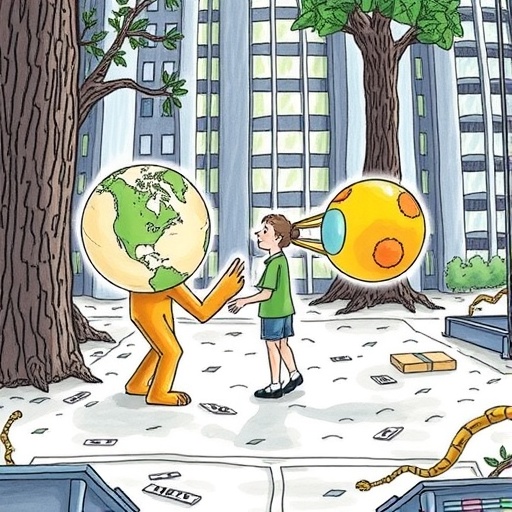
In a groundbreaking new study published in Nature Communications, researchers have unveiled compelling evidence that humans exhibit increased prosocial behavior when faced with challenging foraging environments. This innovative research by Vogel, Priestley, Cutler, and colleagues delves into the intricate relationship between resource availability and cooperative social interactions, revealing unexpected facets of human nature that unfold when survival conditions are harsh.
The study addresses a long-standing question in evolutionary anthropology and behavioral ecology: how do environmental pressures shape social behaviors? While it is well-understood that cooperation can enhance survival within groups, the dynamics of this cooperation under varying resource abundance have remained elusive. By meticulously analyzing human behavior in simulated foraging contexts, the researchers demonstrate that scarcity can actually foster generosity and collective resource sharing, challenging traditional assumptions about competition in tough times.
At the core of their methodology, the team employed controlled experimental paradigms that mimic foraging scenarios with varying degrees of resource richness. Participants were placed in conditions designed to represent either abundant or poor foraging environments. Their decisions regarding resource sharing, cooperation, and mutual aid were recorded and analyzed with precision. This approach allowed the researchers to isolate the effect of resource availability on prosocial tendencies, providing robust empirical support for their hypotheses.
The results were striking. In environments where resources were limited and foraging was challenging, participants consistently displayed a marked increase in prosocial actions compared to conditions where resources were plentiful. This heightened altruism manifested as more frequent sharing of food tokens, as well as greater willingness to cooperate with others even at a personal cost. Contrary to the intuitive notion that scarcity breeds selfishness, the findings indicate that hardship may instead galvanize social bonds.
The research team interprets these findings through the lens of evolutionary theory, proposing that humans have evolved adaptive mechanisms to enhance group cohesion during periods of stress. In times of scarcity, prosocial behavior can serve as a crucial survival strategy, ensuring that the group collectively endures by equitably distributing limited resources. This adaptive flexibility in social behavior underlines the complexity of human cooperation and its dependence on environmental context.
Social neuroscience perspectives also enrich the interpretation of these results. Neural pathways associated with empathy, trust, and reward processing may become more active or sensitized under conditions of scarcity, enhancing the propensity to engage in prosocial acts. Future neuroimaging studies could further elucidate the underlying brain mechanisms that facilitate this context-dependent behavioral shift, bridging biology and social science.
Beyond theoretical implications, this research offers practical insights with broader societal relevance. In an era marked by climate change, resource depletion, and economic inequality, understanding how humans respond to adversity on a social level has never been more crucial. The findings suggest that fostering community and collaboration may be especially effective in times of crisis, providing a hopeful counter-narrative to bleak projections of societal breakdown.
Moreover, the study opens new avenues for interdisciplinary research, linking anthropology, psychology, economics, and environmental science. By integrating experimental and computational models, scientists can better predict how communities might adapt their social strategies in response to future environmental challenges. This holistic approach underscores the importance of viewing human behavior through a multifaceted lens.
An intriguing aspect of the study lies in its experimental design, which incorporated both individual and group-level analyses. Participants’ decision-making patterns were modeled not only in isolation but also within the dynamics of group interactions. This dual perspective deepens our understanding of how personal incentives and collective goals interface under resource stress, highlighting the nuanced mechanisms driving social cooperation.
Critically, the researchers emphasize that increased prosociality under scarcity does not imply naïve altruism; rather, it is a strategic form of cooperation shaped by the anticipation of reciprocal benefits and long-term group survival. This subtlety enriches our understanding of human sociality beyond simplistic dichotomies of selfishness versus selflessness, positioning prosocial behavior as a pragmatic adaptation to environmental uncertainty.
The study’s implications extend to policy-making and community development, suggesting that interventions aimed at fostering social trust and resource sharing could be specially tailored to contexts of scarcity. Programs designed to build resilience in vulnerable communities might capitalize on the natural proclivity for cooperation that emerges in difficult times, thereby enhancing social capital and collective wellbeing.
In conclusion, Vogel and colleagues’ research represents a significant advance in our comprehension of human prosocial behavior amidst environmental challenges. It challenges preconceived notions about competition and scarcity and paints a more nuanced picture of human adaptability. By demonstrating that humans become more cooperative when resources are scarce, it invites a reevaluation of how societal structures and cultural norms might evolve under future pressures.
As the global community navigates increasingly precarious ecological and economic landscapes, insights from this study could prove invaluable in fostering solidarity and collaboration. This research not only deepens our scientific understanding but also inspires a vision of humanity capable of rising together through adversity, driven by intrinsic social bonds that flourish when they are needed most.
The intersection of evolutionary biology, social psychology, and environmental science showcased here serves as a model for future investigations into the resilience and versatility of human behavior. As we continue to explore how our ancestors adapted to challenging environments, these findings provide a hopeful outlook on the enduring strength of cooperation in shaping human destiny.
Ultimately, the work by Vogel et al. underscores that human sociality is not fixed but dynamically responsive to ecological contexts. This plasticity could be one of the keys to addressing contemporary global crises through collective action, making the study a beacon of interdisciplinary research with profound real-world ramifications.
Cite Scienmag News
Gavin Prescott. (February 9, 2026). Humans Show More Prosociality in Scarce Environments. Scienmag. https://scienmag.com/humans-show-more-prosociality-in-scarce-environments/
Gavin Prescott. "Humans Show More Prosociality in Scarce Environments." Scienmag, 9 February 2026, https://scienmag.com/humans-show-more-prosociality-in-scarce-environments/. Accessed 3 September 2026.
Gavin Prescott. "Humans Show More Prosociality in Scarce Environments." Scienmag. February 9, 2026. https://scienmag.com/humans-show-more-prosociality-in-scarce-environments/


