


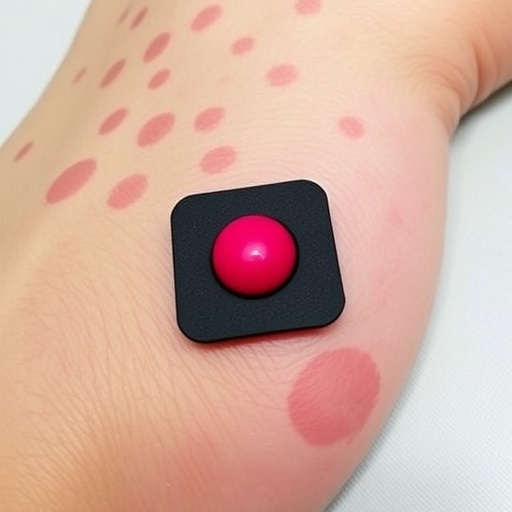
A groundbreaking advancement in psoriasis treatment has been unveiled through the recent publication in Acta Pharmaceutica Sinica B, highlighting the development of an innovative oxygen-boosted dual-section microneedle patch. This sophisticated biomedical device is designed to surmount the formidable challenges posed by psoriasis—a chronic inflammatory skin condition marked by epidermal thickening and a hypoxic inflammatory microenvironment. The unique architecture of the microneedle patch promises enhanced drug penetration and improved efficacy of photodynamic therapy, heralding a new era in therapeutic intervention for this stubborn ailment.
Psoriasis pathophysiology presents significant barriers to effective treatment, primarily due to the thickened epidermis which severely limits transdermal drug delivery. Moreover, the hypoxic conditions prevalent in psoriatic lesions contribute to an inflammatory milieu that undermines the effectiveness of conventional therapies, including photodynamic therapy (PDT). The introduction of this dual-section microneedle (MN) patch, termed S-PTP MN patch, systematically addresses these obstacles by integrating oxygen generation capabilities and ROS-responsive drug release into a singular, patient-friendly device capable of penetrating deep into the affected dermal layers.
The needle section of the S-PTP MN patch is meticulously engineered with PTP nanoparticles loaded with the corticosteroid triamcinolone acetonide (TA), a cornerstone anti-inflammatory medication in dermatology. These particles are enveloped within a reactive oxygen species (ROS)-responsive layer, enabling the drug to be released precisely in the oxidative microenvironment characteristic of psoriatic lesions. This targeted, stimulus-responsive mechanism provides a controlled and sustained release of TA over six days, ensuring continuous therapeutic activity while minimizing systemic exposure and associated side effects.
Complementing the active drug delivery, the base section of the patch incorporates sodium percarbonate (SPC) particles, a strategic inclusion that serves as an oxygen generator. Upon application, the SPC particles react to release oxygen locally within the hypoxic microenvironment of the psoriatic skin. The resultant oxygenation not only facilitates deeper penetration of the PTP nanoparticles but also significantly enhances the efficacy of photodynamic therapy, which is inherently oxygen-dependent. This dual-action platform therefore optimizes both drug delivery and PDT in a synergistic manner.
An in-depth investigation utilizing an imiquimod-induced psoriatic mouse model demonstrated compelling therapeutic outcomes following a single application of the S-PTP MN patch. Compared to conventional topical TA cream, the microneedle patch achieved superior results in attenuating clinical symptoms of psoriasis. Quantitative analyses revealed marked reductions in epidermal thickness and a pronounced decrease in pro-inflammatory cytokine expression, underscoring the patch’s potent anti-inflammatory effect and its capacity to modulate the psoriatic immune response effectively.
The technological innovation reflected in this work revolves around the integration of stimuli-responsive drug release with oxygen generation—a pioneering approach that mitigates the traditional limitations of topical psoriasis treatments. The ROS-responsive coating acts as a molecular trigger, ensuring drug liberation selectively in the disease microenvironment, thereby sparing healthy tissues. Meanwhile, the oxygen supply mitigates hypoxia-induced resistance, addressing a significant hurdle in achieving sustained therapeutic responses in psoriasis management.
Furthermore, the sustained release profile of triamcinolone acetonide from the PTP nanoparticles is a critical advancement that not only prolongs drug efficacy but also improves patient compliance by reducing the need for frequent applications. This temporal control over drug dosing aligns well with the chronic nature of psoriasis, providing a consistent anti-inflammatory effect that can mitigate flare-ups and maintain disease remission more effectively than conventional formulations.
The microneedle patch design itself offers tangible benefits in terms of patient comfort and usability. By circumventing the stratum corneum barrier through minimally invasive penetration, the patch ensures localized delivery directly to the epidermal and dermal layers where psoriatic pathology is active. This localized administration theoretically reduces systemic drug exposure and minimizes side effects commonly associated with systemic corticosteroid therapies, such as adrenal suppression or skin atrophy.
This innovative platform also holds potential to revolutionize photodynamic therapy for psoriasis. PDT efficacy is greatly contingent upon oxygen availability, an attribute severely compromised in psoriatic tissues due to chronic inflammation and vascular alterations. The localized oxygen release of the S-PTP MN patch effectively reoxygenates the lesion microenvironment, not only augmenting the photochemical reactions central to PDT but also promoting cellular repair mechanisms and further attenuating inflammatory cascades in psoriatic plaques.
The implications of this study extend beyond the immediate clinical benefits for psoriasis patients, representing a versatile strategy for enhancing transdermal drug delivery in other conditions characterized by thickened or impaired skin barriers and hypoxic environments. The dual-section microneedle array, combining responsive drug delivery with in situ oxygen generation, establishes a novel design paradigm that could be adapted for the treatment of diverse chronic inflammatory and ischemic skin disorders.
Moreover, the formulation’s demonstrated efficacy in preclinical models sets the stage for translational research aimed at human clinical trials. Considering the global burden of psoriasis and the limitations of current therapies, the S-PTP MN patch offers a promising, scalable approach that could substantially improve quality of life for patients while alleviating the healthcare costs associated with chronic disease management.
Finally, this study underscores the value of multidisciplinary collaboration, integrating materials science, pharmacology, and dermatology to develop cutting-edge solutions for complex diseases. The synergy between nanotechnology, responsive biomaterials, and targeted therapy heralds a future where personalized, on-demand treatments become the standard of care in dermatological practice and beyond.
News Publication Date: 2025
Web References:
- Acta Pharmaceutica Sinica B: https://www.sciencedirect.com/journal/acta-pharmaceutica-sinica-b
- DOI: http://dx.doi.org/10.1016/j.apsb.2025.09.037
Cite Scienmag News
Louis Brooks. (February 7, 2026). Oxygen-Enhanced Dual-Section Microneedle Patch Improves Drug Delivery and Boosts Photodynamic and Anti-Inflammatory Treatment for Psoriasis. Scienmag. https://scienmag.com/oxygen-enhanced-dual-section-microneedle-patch-improves-drug-delivery-and-boosts-photodynamic-and-anti-inflammatory-treatment-for-psoriasis/
Louis Brooks. "Oxygen-Enhanced Dual-Section Microneedle Patch Improves Drug Delivery and Boosts Photodynamic and Anti-Inflammatory Treatment for Psoriasis." Scienmag, 7 February 2026, https://scienmag.com/oxygen-enhanced-dual-section-microneedle-patch-improves-drug-delivery-and-boosts-photodynamic-and-anti-inflammatory-treatment-for-psoriasis/. Accessed 8 September 2026.
Louis Brooks. "Oxygen-Enhanced Dual-Section Microneedle Patch Improves Drug Delivery and Boosts Photodynamic and Anti-Inflammatory Treatment for Psoriasis." Scienmag. February 7, 2026. https://scienmag.com/oxygen-enhanced-dual-section-microneedle-patch-improves-drug-delivery-and-boosts-photodynamic-and-anti-inflammatory-treatment-for-psoriasis/


