


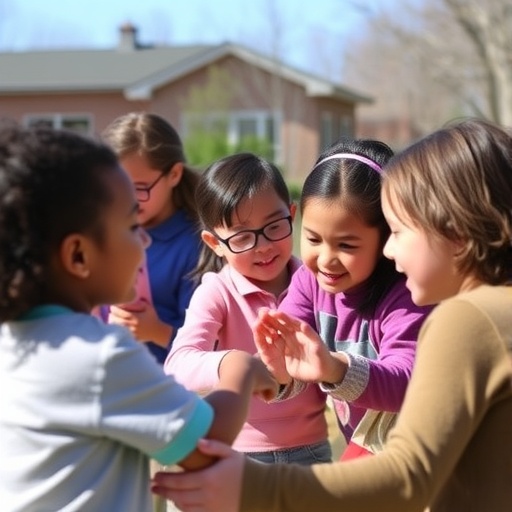
In a groundbreaking international study published in Science Advances, researchers from Boston College have unveiled how cooperation develops in children across diverse cultural landscapes. This research offers compelling evidence that cooperative behaviors such as fairness, trustworthiness, forgiveness, and honesty evolve in childhood, gradually aligning with the social norms of their respective communities. The study’s findings provide crucial insights into the universal and culture-specific aspects of cooperative conduct, emphasizing the complex interplay between individual development and social environment.
The research team, led by Associate Professor of Psychology Katherine McAuliffe, undertook an extensive cross-cultural investigation involving over 400 children aged between 5 and 13 years old from five distinct societies: urban United States, rural Uganda, Canada, Peru, and the hunter-horticulturalist Shuar community in Ecuador. The study’s aim was to disentangle how various cooperative behaviors emerge and are shaped by the cultural context during childhood, a pivotal period for social and moral development.
The researchers employed a carefully designed battery of four cooperative tasks to assess fairness, trustworthiness, forgiveness, and honesty among the participants. One notable example is the fairness test, which utilized a sophisticated wooden apparatus that enabled children to intuitively decide whether to accept or reject inequitable splits of candy between themselves and peers. These child-friendly experimental paradigms allowed for precise measurement of cooperative tendencies in a manner that transcended language and cultural barriers.
Central to the findings is the observation that young children universally display more self-interested behavior, a trend that reverses as they mature and internalize the norms prevalent in their societies. This developmental trajectory underscores a crucial relationship between age and normative conformity, revealing that cooperative behavior is not innate but rather honed by social learning and cultural immersion over time.
Despite these overarching similarities, the study highlights pronounced cross-cultural differences in the specific norms guiding cooperative behavior. For instance, the concept of what constitutes “fairness” varies markedly between cultures, reflecting divergent moral frameworks. Children demonstrated sensitivity to these culturally distinct norms, and their behavior adjusted accordingly as they aged, suggesting an adaptive mechanism to align with local social expectations.
The research further identified three predominant cooperative strategies that evolve with age and differ by culture: maximization, in which individuals seek to maximize personal gain; generic cooperation, characterized by a broad willingness to cooperate regardless of partner identity; and partner-contingent cooperation, where cooperative behavior depends on the nature of the social relationship. These varying strategies illustrate how cooperation is a dynamic construct, flexibly negotiated within social contexts.
A particularly striking revelation from the study concerns the role of forgiveness in cooperation. Past research predominantly focused on punitive responses to transgressions, often portraying punishment as a dominant social mechanism. However, McAuliffe and her colleagues found that, contrary to this assumption, both children and adults across the studied populations endorsed forgiveness over punishment. This finding challenges prevalent theoretical frameworks and calls for a reexamination of how normative enforcement operates in human societies.
The implications of these findings extend far beyond academic curiosity. Understanding how cooperative behavior and social norms develop is fundamental to appreciating the mechanisms behind human sociality and cultural evolution. The ability to cooperate effectively underpins societal cohesion, collective action, and ultimately the survival of human groups. As such, this research offers valuable perspectives on fostering cooperation in increasingly diverse and interconnected global communities.
Moreover, the study’s methodology signals a paradigm shift in cross-cultural psychology by integrating experimental techniques with rigorous normative assessments. This dual approach captures not only observed behavior but also the internalized community standards that guide such actions, providing a nuanced portrayal of how cooperation is both enacted and conceptualized in diverse societies.
McAuliffe’s lab is already building upon this foundation with new inquiries into how cooperative norms are transmitted from adults to children. Their forthcoming work seeks to elucidate whether children are more influenced by adult role models or peer behaviors in adopting fairness and trustworthiness. This next phase promises to unravel the proximal mechanisms through which cultural values and cooperative tendencies are perpetuated across generations.
Funding from the John Templeton Foundation enabled this ambitious project, reflecting a growing investment in understanding the biological and cultural foundations of human behavior. Such research bridges psychological science with anthropology, neuroscience, and evolutionary biology, marking an interdisciplinary approach to one of the most profound questions concerning human nature.
Ultimately, this study sets a high watermark for future research into the emergence of cooperation, mapping a complex landscape where cultural diversity and psychological development intersect. It invites scientists, educators, and policymakers to consider how fostering cooperation in childhood can be both culturally sensitive and universally advantageous, ensuring the sustained progress of societies worldwide.
Cite Scienmag News
Courtney Benton. (February 6, 2026). Boston College Researchers Report: Children’s Cooperative Behaviors Align with Community Norms During Middle Childhood. Scienmag. https://scienmag.com/boston-college-researchers-report-childrens-cooperative-behaviors-align-with-community-norms-during-middle-childhood/
Courtney Benton. "Boston College Researchers Report: Children’s Cooperative Behaviors Align with Community Norms During Middle Childhood." Scienmag, 6 February 2026, https://scienmag.com/boston-college-researchers-report-childrens-cooperative-behaviors-align-with-community-norms-during-middle-childhood/. Accessed 4 September 2026.
Courtney Benton. "Boston College Researchers Report: Children’s Cooperative Behaviors Align with Community Norms During Middle Childhood." Scienmag. February 6, 2026. https://scienmag.com/boston-college-researchers-report-childrens-cooperative-behaviors-align-with-community-norms-during-middle-childhood/


