


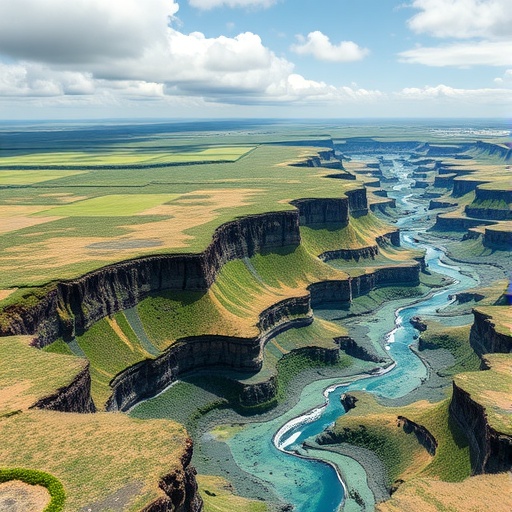
In an era marked by rapid environmental changes and increasing anthropogenic pressures, understanding the delicate balance and potential vulnerabilities of Earth’s landscapes and ecosystems has become more crucial than ever. A groundbreaking study published recently in Nature Communications pushes the boundaries of our predictive capabilities by offering a novel framework to anticipate instabilities in transient landforms and the interconnected ecosystems they support. This research, led by Smith, Morr, and Bookhagen and their colleagues, provides an essential lens through which we can foresee and potentially mitigate the cascading effects of environmental disruptions, ultimately aiding in global conservation and land management efforts.
Transient landforms, such as river deltas, mountain slopes, and coastal barriers, are constantly evolving under the influence of both natural forces and human activities. What makes these landscapes particularly fascinating—and perilous—is their inherent susceptibility to sudden shifts or instabilities. These abrupt changes can trigger a chain reaction throughout the broader ecosystem, undermining biodiversity, disrupting habitats, and impacting the services these environments provide to human populations. Until now, the challenge resided in the unpredictability of such events, which occur at varying temporal and spatial scales. This study confronts this challenge head-on by combining advanced modeling techniques with comprehensive ecological data to illuminate the underlying mechanisms governing these dynamics.
Central to this research is the integration of physical and ecological processes through a multi-dimensional modeling approach. The team synthesizes geomorphological data, hydrological flows, and biological interactions into a cohesive predictive model that captures the complex feedback loops existing between landscape evolution and ecosystem responses. This integrative strategy unearths previously obscured patterns of vulnerability, thereby enabling the identification of critical thresholds at which a system shifts from stability to instability. By simulating different environmental scenarios, the model offers unprecedented foresight into how transient landforms and their resident ecosystems might behave under various stress conditions, including climate change, deforestation, and land-use alterations.
One of the notable technical advancements introduced by the authors is the application of network theory to characterize ecosystem connectivity within transient landscapes. Where past models often treated landforms and ecosystems in isolation, this approach acknowledges the interconnectedness of ecological components through spatial networks. These networks are mapped out using data on species dispersal pathways, resource flows, and environmental gradients, enabling the detection of nodes or links that serve as critical linchpins for maintaining overall system stability. The ability to pinpoint these strategic ecological corridors or hubs has profound implications for targeted conservation strategies, ensuring that efforts focus on safeguarding elements that disproportionately impact ecosystem resilience.
Additionally, the research explores the influence of external forcing factors, such as extreme weather events, sediment supply variability, and human-induced land modifications, on transient landform stability. By incorporating stochastic elements representing these forcings, the model simulates realistic perturbations that often precipitate instability. These perturbations can initiate phase transitions within the landscape—sudden shifts from one geomorphic configuration or ecosystem state to another—that are challenging to reverse. Understanding these tipping points equips environmental managers with actionable insights to anticipate and potentially avoid catastrophic regime shifts that could have long-lasting ecological and socioeconomic consequences.
The study also delves into the temporal dynamics of landscape and ecosystem interactions. Traditional models tend to assume steady-state conditions or focus on equilibrium states, yet transient landforms are, by definition, non-equilibrium systems. Recognizing this, the authors employ time-series analyses combined with high-resolution remote sensing data to capture the evolving patterns of disturbance and recovery. This approach reveals cycles and feedbacks that inform resilience mechanisms, highlighting periods where landscapes and ecosystems are most susceptible to disruption versus phases when recovery or adaptation is more viable. Such insights are critical for designing temporal management interventions aligned with natural system rhythms.
Moreover, a significant portion of the study is dedicated to validating the predictive model against empirical observations from diverse environments, ranging from mountainous terrains experiencing rapid erosion to coastal systems vulnerable to sea-level rise. This validation process not only confirms the model’s robustness and generalizability but also identifies site-specific factors that modulate instability risks. By contextualizing the model’s results within real-world case studies, the researchers demonstrate how their framework can be operationalized in distinct biogeographical settings, making it a versatile tool for policymakers and conservation practitioners worldwide.
The implications of this research extend beyond academic understanding; they resonate with pressing global challenges such as climate adaptation, habitat conservation, and disaster risk reduction. With landscapes increasingly subjected to compound stressors, the ability to forecast and preempt ecological and geomorphological instabilities becomes indispensable. This study’s nuanced portrayal of transient landforms as dynamic entities deeply intertwined with ecological networks transforms how we conceptualize Earth’s surface processes. It urges a holistic perspective where geomorphology and ecology are inseparable facets of environmental stewardship.
Importantly, the research acknowledges limitations and avenues for future exploration. The authors discuss the inherent uncertainties associated with modeling complex natural systems, particularly when extrapolating predictions over extended timescales or unobserved scenarios. They advocate for ongoing integration of real-time monitoring data, machine learning advancements, and interdisciplinary collaboration to refine model accuracy. The study also emphasizes the need to incorporate human social dynamics more explicitly, recognizing that anthropogenic interventions can drastically alter both landforms and ecosystems in unforeseen ways. By framing these challenges transparently, the research invites a broader scientific dialogue aimed at continually enhancing predictive frameworks.
From a technological perspective, the combination of geomorphological analytics with ecosystem network modeling represents a pioneering computational feat. This hybrid modeling approach leverages spatial statistics, dynamic systems theory, and ecological network analysis within a performant simulation environment. The computational tools developed not only calculate probability thresholds for instability but also visualize potential future scenarios with high clarity. This facilitates communication of complex scientific insights to stakeholders, enabling data-driven decision-making that can adaptively manage landscapes under uncertainty and change.
Among the most impactful revelations from this work is the concept of “cascading instabilities,” where an initial localized geomorphic disturbance triggers a succession of ecological disruptions propagating through interconnected habitats. Such cascades can amplify the severity of impacts in ways previously underestimated. By quantifying these chain reactions within a comprehensive framework, the study provides early-warning indicators that can be integrated into environmental monitoring systems worldwide. Implementing these early-warning signals could revolutionize how governments and organizations prepare for and respond to environmental crises.
In addition to ecological and geomorphological insights, the research underscores the indispensable role of data integration from heterogeneous sources. Remote sensing, field surveys, ecological databases, and climate models are synthesized to create a multi-faceted picture of transient landforms and ecosystem interplays. This integrative data platform facilitates cross-disciplinary research inquiries, opening pathways for innovations in conservation biology, landscape ecology, and earth system science. The fusion of data and theory embodied in this study exemplifies the transformative potential of combining empirical evidence with cutting-edge computational modeling.
Beyond its scientific significance, this breakthrough research holds promise for societal applications such as land-use planning, habitat conservation prioritization, and infrastructure resilience. By identifying zones at heightened risk for sudden landscape instability, planners can avoid investments in vulnerable areas or implement adaptive designs that minimize ecological disruption. Conservation initiatives can be better targeted to maintain critical ecosystem connectivity and resistance to geomorphic challenges. Disaster preparedness strategies can incorporate model predictions to reduce vulnerabilities in flood-prone or erosion-sensitive regions, safeguarding human lives and livelihoods.
In synthesis, the study by Smith, Morr, Bookhagen, and colleagues represents a milestone in environmental science, transforming our capacity to predict and manage the intertwined fates of transient landforms and their ecosystems. As the climate crisis intensifies and landscapes face unprecedented pressures, this research provides a beacon of hope grounded in rigorous science and technological innovation. It calls on the global community to embrace integrative, anticipatory approaches to land and ecosystem management that can sustain biodiversity and human wellbeing in a rapidly changing world.
Looking ahead, the principles and tools developed here will likely catalyze advancements across multiple disciplines, fostering collaboration among geomorphologists, ecologists, hydrologists, data scientists, and policymakers. As these predictive frameworks mature and integrate additional socio-environmental dimensions, they will empower societies to navigate environmental uncertainties with greater confidence and foresight. This landmark work stands as a testament to the power of interdisciplinary science in confronting the complex challenges of the Anthropocene, paving the way for more resilient and sustainable futures.
Cite Scienmag News
Gavin Prescott. (February 6, 2026). Forecasting Instabilities in Changing Landforms and Ecosystems. Scienmag. https://scienmag.com/forecasting-instabilities-in-changing-landforms-and-ecosystems/
Gavin Prescott. "Forecasting Instabilities in Changing Landforms and Ecosystems." Scienmag, 6 February 2026, https://scienmag.com/forecasting-instabilities-in-changing-landforms-and-ecosystems/. Accessed 4 September 2026.
Gavin Prescott. "Forecasting Instabilities in Changing Landforms and Ecosystems." Scienmag. February 6, 2026. https://scienmag.com/forecasting-instabilities-in-changing-landforms-and-ecosystems/


