


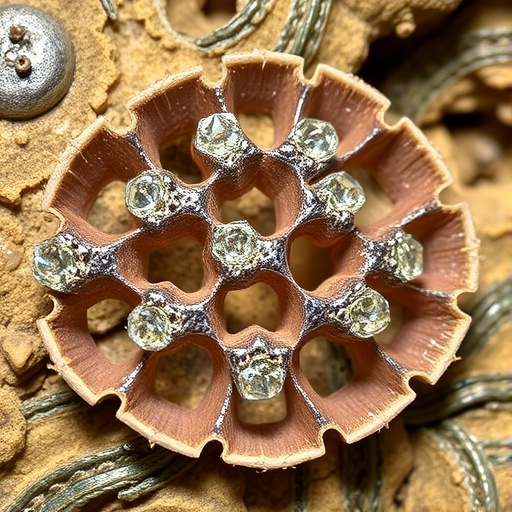
In a groundbreaking discovery that reshapes our understanding of ancient biomolecules and fossil preservation, an international research consortium led by Elizabeth Bailey, assistant professor of earth and planetary sciences at the University of Texas at San Antonio, has confirmed the presence of chitin in trilobite fossils dating back over 500 million years. This revelation challenges long-standing assumptions about the durability of organic polymers in the fossil record and provides significant new insights into Earth’s carbon sequestration processes over geological timescales.
Chitin, a complex polysaccharide and the primary organic constituent of modern crab shells, insect exoskeletons, and many other biological structures, has traditionally been thought to biodegrade or mineralize rapidly following an organism’s death. Historically, the scientific consensus maintained that chitin and similar biological polymers could not persist beyond a few million years under natural conditions. However, the detection of chitin in Cambrian trilobite fossils from the Carrara Formation, Western North America, documented in the journal PALAIOS, unequivocally demonstrates its remarkable longevity.
Bailey’s team employed state-of-the-art analytical techniques that significantly increased the sensitivity and specificity of molecular detection in geological specimens. Utilizing advanced spectroscopic and chemical assays, they were able to differentiate surviving chitin from mineral matrices and other fossilization byproducts. This meticulous methodological approach not only underscores the molecular fidelity preserved within these Cambrian fossils but also advocates for re-evaluating the survival potential of other biological polymers previously considered irretrievable in deep time.
The implications of these findings extend well beyond paleontology. Chitin’s unexpected persistence offers new perspectives on Earth’s long-term carbon cycle. Organic carbon locked within fossilized biomaterials plays an integral role in modulating atmospheric carbon dioxide over geological epochs. The preservation of chitin-rich composites within sedimentary rocks such as limestones, which are widespread and constitute significant geological reservoirs, could imply a previously underappreciated natural carbon sink contributing to the planet’s carbon budget.
“Our research contributes to a paradigm shift in understanding the chemical resilience of biomolecules and how organic carbon is preserved within Earth’s crust,” Bailey explained. “While ecosystems dominated by terrestrial plants and cellulose have traditionally garnered attention for carbon sequestration, chitin—which ranks as the second most abundant natural polymer after cellulose—also plays a crucial role. Our work highlights this often-overlooked pathway in the long-term storage of carbon.”
The study’s success owes much to Bailey’s interdisciplinary background, bringing together stratigraphy, geochemistry, and planetary science, to interpret how ancient biological materials interacted with geochemical cycles. Her impetus for focusing on the molecular longevity of chitin stems from broader planetary science questions, particularly concerning the survival of organic molecules on Earth and potentially other planetary bodies. Close collaboration with specialists in modern chitin analytics enabled the application of sophisticated modern laboratory techniques to fossils emblematic of early complex life.
Despite the limited sample size analyzed in this initial study, the demonstration of chitin’s survival over half a billion years opens compelling avenues for further research. Understanding the exact mechanisms—whether biochemical, physical, or environmental—that facilitate organic polymer preservation could revolutionize not only paleontological methodologies but also inform climate science by revealing natural analogs of carbon storage that have operated throughout Earth’s history.
Furthermore, the geological setting of these fossils, the Carrara Formation, offers unique conditions conducive to molecular preservation. The interplay of sediment composition, mineralization rates, and redox chemistry presumably creates microenvironments that slow the degradation pathways of chitin. Future work aims to decode these physicochemical settings in detail, potentially identifying other fossil sites where chitin and similar polymers might be unearthed.
Bailey’s current role at UT San Antonio allows her to expand this research through the Early Earth Lab, a cutting-edge facility focusing on planetary materials, including meteorites and ancient terrestrial rocks. The lab’s research strategy integrates computational modeling with experimental geochemistry to simulate early Earth environments and study the preservation of biomolecules amid complex planetary processes. These efforts could help interpret not only terrestrial fossil records but also the search for organic molecules on extraterrestrial bodies.
The discovery also enhances our understanding of how limestones function within the broader carbon cycle. These sedimentary rocks, extensively used in construction and ubiquitous in Earth’s crust, have traditionally been viewed primarily as inorganic carbon stores. However, the presence of chitin-bearing fossils in limestones positions these geological deposits as biogeochemical archives where organic carbon, often underestimated, contributes substantially to carbon sequestration through mineral-organic interactions.
This finding holds relevance for contemporary discussions about climate change mitigation. While biological carbon capture technologies and afforestation efforts are critical strategies, the natural geochemical sequestration pathways inherent in Earth’s sedimentary systems provide lessons and potential models for long-term carbon stability. Recognizing the persistence of biopolymers like chitin over geological time scales can enrich scientific frameworks aimed at optimizing carbon management strategies.
Prior to her tenure at UT San Antonio, Bailey conducted this research during her postdoctoral fellowship at the University of California, Santa Cruz, supported by the Heising-Simons Foundation’s prestigious 51 Pegasi b Fellowship in Planetary Astronomy. Her academic trajectory, which includes earning a doctorate in planetary science from Caltech, reflects a commitment to bridging laboratory investigation, field geology, and computational analysis to decipher Earth’s deep-time history.
In conclusion, the verification of ancient chitin in trilobite fossils not only reshapes fossil preservation paradigms but also enriches our understanding of Earth’s carbon reservoirs, potentially influencing geochemical models and climate policy frameworks. This discovery underscores the dynamic interplay between biology and geology over hundreds of millions of years, highlighting that even delicate organic molecules can endure beyond expectations and contribute to planetary-scale processes fundamental to life on Earth.
News Publication Date: February 6, 2026
Web References: https://pubs.geoscienceworld.org/palaios
References: Bailey, E. et al. (2025). Evidence for surviving chitin in Cambrian trilobites from the Carrara Formation, Western North America. PALAIOS.
Cite Scienmag News
Violet Maxwell. (February 6, 2026). UT San Antonio-Led Team Uncovers Compound in 500-Million-Year-Old Fossils, Offering Fresh Insights into Earth’s Carbon Cycle. Scienmag. https://scienmag.com/ut-san-antonio-led-team-uncovers-compound-in-500-million-year-old-fossils-offering-fresh-insights-into-earths-carbon-cycle/
Violet Maxwell. "UT San Antonio-Led Team Uncovers Compound in 500-Million-Year-Old Fossils, Offering Fresh Insights into Earth’s Carbon Cycle." Scienmag, 6 February 2026, https://scienmag.com/ut-san-antonio-led-team-uncovers-compound-in-500-million-year-old-fossils-offering-fresh-insights-into-earths-carbon-cycle/. Accessed 3 September 2026.
Violet Maxwell. "UT San Antonio-Led Team Uncovers Compound in 500-Million-Year-Old Fossils, Offering Fresh Insights into Earth’s Carbon Cycle." Scienmag. February 6, 2026. https://scienmag.com/ut-san-antonio-led-team-uncovers-compound-in-500-million-year-old-fossils-offering-fresh-insights-into-earths-carbon-cycle/


