


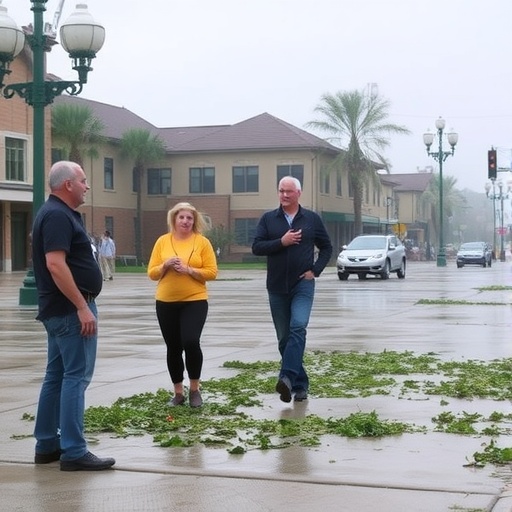
As the climate crisis intensifies and coastal regions grapple with increasingly frequent and severe storms, the ability to predict and respond to these natural disasters has never been more crucial. The University of Rhode Island (URI) is pioneering innovative approaches that blend advanced simulation technology with rigorous emergency management practices to bolster coastal resilience. In a groundbreaking study published in the Journal of Coastal and Riverine Flood Risk, URI researchers unveil how the application of Homeland Security Exercise and Evaluation Program (HSEEP) exercises has enabled the effective evaluation and enhancement of storm decision-support tools designed specifically for coastal emergencies.
At the heart of this research is URI’s Coastal Hazards Analysis, Modeling, and Prediction (CHAMP) system, a sophisticated decision-support platform that integrates state-of-the-art computational models to forecast flooding and storm surge impacts with high spatial and temporal resolution. Using Hurricane Henri, which struck the northeastern United States in 2021, as a case study, the researchers simulated realistic scenarios that mirror the complex dynamics of tropical and extratropical storms affecting Rhode Island’s vulnerable coastline. By merging scientific modeling with emergency management exercises, the team demonstrated how tools like CHAMP can transform storm preparedness from reactive to proactive practices.
The study owes much of its inspiration and real-world grounding to the catastrophic aftermath of Hurricane Katrina in 2005. Lead author Samuel Adams, a marine affairs Ph.D. candidate and URI Emergency Management Director, brings a deeply personal perspective to this research. Having witnessed the devastation firsthand in his hometown of New Orleans—with his own family home severely damaged—Adams emphasizes that traditional disaster response paradigms must evolve to meet the unprecedented challenges posed by climate change. His commitment to refining emergency management stems from these lived experiences, motivating the integration of scientific innovation with practical training exercises.
One of the distinguishing features of URI’s approach is the utilization of HSEEP-based exercises, a recognized standard within U.S. emergency management circles. These exercises foster a dynamic environment in which local emergency managers engage directly with CHAMP’s predictive capabilities, simulating decision-making processes in real time. Conducted at URI’s Narragansett Bay Campus and the Rhode Island Emergency Management Agency headquarters in Cranston, the exercises spanned the entire state, highlighting geographic vulnerabilities along Rhode Island’s uniquely oriented coastline.
Rhode Island’s coastal configuration presents unique challenges. The east-west alignment combined with the north-south orientation of Narragansett Bay results in 21 out of 39 municipalities being exposed to potentially debilitating storm surges. This makes the state an ideal testbed for predicting how infrastructure and communities might be physically and socially impacted during significant weather events. CHAMP’s flooding and surge models revealed critical scenarios, such as how the peninsula towns of Bristol and Warren could effectively become isolated “islands” during extreme flooding, cutting them off from emergency aid and evacuation routes.
Such insights underscore the value of advanced predictive modeling in emergency planning. By visualizing potential isolation zones and flooding extents, local authorities are empowered to develop early intervention strategies that prioritize evacuation, resource allocation, and contingency plans. This represents a leap forward from the reactive models of the past, equipping municipalities with actionable intelligence that accounts for future superstorms, rather than relying on historical storm patterns alone.
Dr. Isaac Ginis, a professor at URI and collaborator on the project, brings decades of hurricane modeling expertise to CHAMP’s development. His experience includes creating operational hurricane-ocean coupled models for NOAA’s National Hurricane Center, particularly during the era of Hurricane Katrina. Beyond operational forecasting, Ginis spearheaded educational initiatives like the hurricanescience.org platform, which has become a prominent resource for educators nationwide. Ginis and his team’s vision extends beyond Rhode Island’s borders, envisioning the exportation of CHAMP’s decision-support framework to other vulnerable coastal regions, such as coastal Connecticut.
The research highlights that the integration of computational simulation into emergency management exercises is a paradigm shift. By embedding advanced meteorological and hydrodynamic modeling into hands-on training scenarios, emergency managers gain not only technical familiarity but also experiential understanding of potential disaster impacts. This helps bridge the gap between scientific prediction and real-world decision-making, fostering greater confidence and preparedness in the face of increasingly unpredictable weather systems.
As storms intensify under climate change, the concept of “surprise” events—unprecedented disasters that overwhelm existing response frameworks—is becoming a grim reality. Adams warns that reliance on historical storm data to guide emergency response is an outdated strategy. Instead, decision-support tools like CHAMP, combined with rigorous simulation exercises, equip managers to anticipate and prepare for novel catastrophic scenarios. This proactive stance is critical to avoiding tragedies of Katrina’s scale, as well as emerging threats like Tropical Storm Helene’s unexpected impacts in Western North Carolina.
Further cementing CHAMP’s operational relevance is its real-time forecasting capability, which Rhode Island funds to monitor and predict tropical cyclones and nor’easters. The system’s integration into state emergency protocols reflects a growing recognition that modern storms require modern tools—systems that can ingest live data streams, update flood and storm surge maps dynamically, and inform deployable emergency responses within narrow time windows.
This URI-led initiative represents an exemplary model of interdisciplinary collaboration, merging oceanography, meteorology, emergency management, and public policy. By fostering partnerships between academic researchers, government agencies, and on-the-ground responders, URI is helping to close the feedback loop and translate scientific advances into tangible societal benefits. The use of HSEEP exercises as an evaluation framework ensures that CHAMP continues to evolve in alignment with practitioner needs and operational realities.
In summation, this pioneering research from the University of Rhode Island offers a blueprint for coastal resilience in the 21st century. Through cutting-edge computational modeling and immersive emergency exercises, CHAMP provides emergency managers with a powerful toolset to visualize, anticipate, and mitigate storm impacts before they unfold. As coastal communities worldwide face the escalating challenges posed by climate change-driven storms, approaches like URI’s illuminate a path toward smarter, science-driven disaster preparedness that could save lives and safeguard infrastructure.
- CHAMP Program
- Journal of Coastal and Riverine Flood Risk
- Samuel Adams – URI
- Isaac Ginis – URI
- Hurricanescience.org
Image Credits: URI CHAMP
Keywords: Storms, Hurricanes
Cite Scienmag News
Violet Maxwell. (February 6, 2026). University of Rhode Island Team Evaluates Storm Decision Support Tool Using Homeland Security Exercises in Katrina Retrospective. Scienmag. https://scienmag.com/university-of-rhode-island-team-evaluates-storm-decision-support-tool-using-homeland-security-exercises-in-katrina-retrospective/
Violet Maxwell. "University of Rhode Island Team Evaluates Storm Decision Support Tool Using Homeland Security Exercises in Katrina Retrospective." Scienmag, 6 February 2026, https://scienmag.com/university-of-rhode-island-team-evaluates-storm-decision-support-tool-using-homeland-security-exercises-in-katrina-retrospective/. Accessed 4 September 2026.
Violet Maxwell. "University of Rhode Island Team Evaluates Storm Decision Support Tool Using Homeland Security Exercises in Katrina Retrospective." Scienmag. February 6, 2026. https://scienmag.com/university-of-rhode-island-team-evaluates-storm-decision-support-tool-using-homeland-security-exercises-in-katrina-retrospective/


