


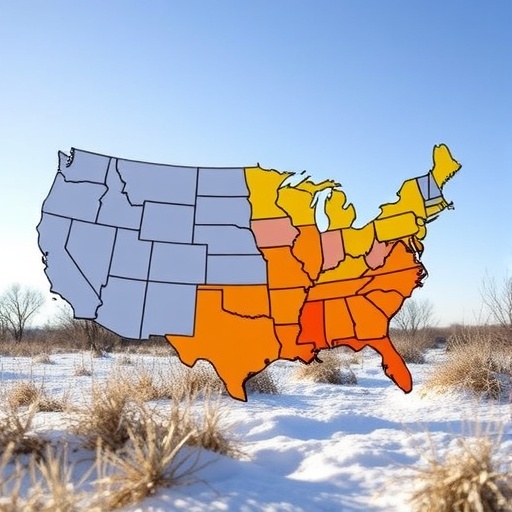
As the climate crisis intensifies, understanding its regional dynamics has become ever more crucial. A pioneering study published in February 2026 in PLOS Climate shifts focus from the often vague national averages toward a granular examination of temperature changes across the contiguous United States. This research compellingly reveals how warming is not uniform but manifests differently across regions, highlighting the intricate patterns of climate change that demand localized responses and nuanced policy frameworks.
The collaborative work by María Dolores Gadea Rivas and Jesús Gonzalo from Spanish institutions dives deep into temperature data spanning seven decades, from 1950 to 2021. They assembled a vast dataset, encompassing over 26,000 daily temperature records for each state—turning what is often treated as a monolithic warming trend into a mosaic of regional climate behaviors. This method enables a fresh perspective on how temperature shifts vary not just in magnitude but in their position within the temperature spectrum.
A core conclusion from this extensive analysis shows that while only 27 out of 48 contiguous states exhibit significant increases in average temperatures, a remarkable 41 states show warming trends within specific segments of their temperature distributions. This delineates a critical insight: average temperature metrics obscure the localized and extreme changes that could have substantial ecological, social, and economic consequences. For instance, warmer extremes on the West Coast contrast with milder impacts such as rising lows in northern states, demonstrating warming’s multifaceted nature.
The West Coast’s intensified high-temperature events pose serious threats including increased heatwaves, droughts, and wildfire risks. These heightened extremes are not captured fully by simplistic average trends but are starkly evident when examining the upper bounds of temperature ranges. Conversely, many northern states experience rises primarily in the lower temperature percentiles. While seemingly less severe, these subtle warming shifts can still disrupt ecosystems, agricultural cycles, and human health in ways that necessitate region-sensitive interventions.
This multidimensional warming approach carries profound implications for regional adaptation strategies. Agriculture, for instance, is highly sensitive to temperature thresholds, and localized elevations in maximum or minimum temperatures can affect crop viability or pest populations differently across states. Public health ramifications are equally complex; heat-related illnesses tie to extreme highs, while milder winters may alter disease vectors and allergen patterns, revealing the importance of dissecting where and how warming occurs within the temperature range.
National climate policy traditionally relies heavily on average temperature increases for setting targets and planning mitigation steps. However, this study argues that such an approach risks overlooking the patchwork of warming experiences and the socio-environmental vulnerabilities that come with them. Policies that ignore extremes at either end of the temperature spectrum might fail to protect communities or infrastructure that face disproportionate climate risks.
Moreover, understanding regional warming patterns can influence public perception and engagement with climate action. Communities experiencing drastic daytime temperature spikes may develop more acute awareness and urgency for mitigation measures, whereas areas with less obvious average warming might experience complacency or skepticism. This highlights the intersection of climatic science with psychology and policy communication strategies, underscoring the need for tailored messaging based on regional realities.
The methodology aligned with this framework leverages quantile regression analysis, enabling a detailed capture of temperature distribution shifts instead of focusing solely on mean values. This technical advancement empowers researchers and policymakers to pinpoint warming “dominance” in specific parts of the temperature data, such as winter lows, summer highs, or median conditions. It opens pathways for similar assessments across other climate variables like precipitation or humidity.
Importantly, the study’s granular dataset and analytical model provide a reliable foundation for projecting future climate scenarios with refined regional specificity. This could facilitate the design of adaptive infrastructures, such as improved building codes that reflect regional heat patterns or agricultural advisories tailored to precise thermal shifts. By understanding “where” within the temperature profile warming is concentrated, mitigation becomes not just about overall reduction but strategic resilience-building.
This nuanced perspective on climate heterogeneity also invites reevaluation of climate justice concerns. Regions disproportionately affected by certain kinds of temperature increase—whether extreme heat in the West or rising lows in the North—may face unique socioeconomic repercussions. Vulnerable communities in these areas often have limited capacity to adapt, amplifying inequalities. The study’s framework enables enhanced targeting of support measures, fostering equitable climate adjustment efforts.
Beyond the U.S. context, the analytical approach demonstrated here offers a scalable blueprint for global climate research. As nations grapple with diverse warming patterns shaped by topography, ocean currents, and atmospheric conditions, the ability to reveal subtle but significant thermal shifts can enrich global understanding and cooperation in climate mitigation. The authors explicitly suggest applying this methodology to precipitation, sea level, and other climate phenomena to foster comprehensive risk mapping.
The recognition that average warming masks critical extremities and distributional changes challenges dominant narratives in climate science and discourse. It underscores the vital role of observational climatology and big data analytics in evolving our understanding of climate change from a blunt statistical phenomenon into an intricate, textured challenge. This, in turn, demands more sophisticated, multifaceted responses aligned with local realities rather than generalized assumptions.
As this work gains traction among climate scientists, policymakers, and the public, it is poised to recalibrate efforts toward climate adaptation and resilience. The evidence that 84% of U.S. states show significant warming in some part of their temperature range strengthens the case for decentralized climate governance capable of addressing diverse regional threats. The stakes—ranging from food security to public health and biodiversity—could not be higher, reinforcing the urgency of this innovative research.
In summation, the study by Gadea Rivas and Gonzalo marks a critical advancement in climate science by spotlighting “warming heterogeneity” across the U.S. Their findings dismantle the notion of uniform warming trends, illustrating instead a patchwork of changes with varied implications. Such intricate knowledge equips us better to confront the realities of climate change—and to craft effective, region-specific solutions that meet the moment’s challenge.
News Publication Date: 4-Feb-2026
Web References: https://doi.org/10.1371/journal.pclm.0000808
Cite Scienmag News
Miles G. (February 5, 2026). 41 US States Are Warming — Each in Its Own Unique Way. Scienmag. https://scienmag.com/41-us-states-are-warming-each-in-its-own-unique-way/
Miles G. "41 US States Are Warming — Each in Its Own Unique Way." Scienmag, 5 February 2026, https://scienmag.com/41-us-states-are-warming-each-in-its-own-unique-way/. Accessed 29 August 2026.
Miles G. "41 US States Are Warming — Each in Its Own Unique Way." Scienmag. February 5, 2026. https://scienmag.com/41-us-states-are-warming-each-in-its-own-unique-way/


