


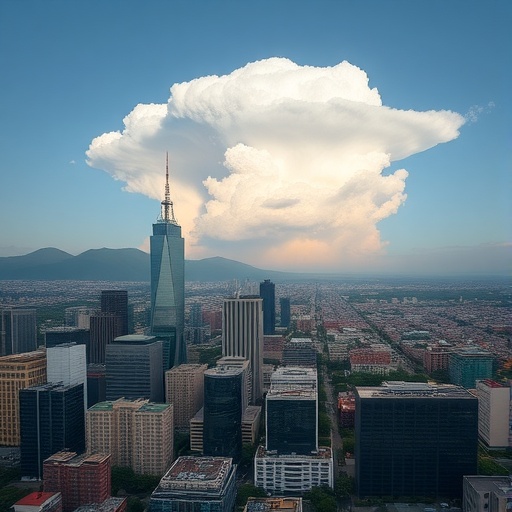
Urban landscapes are transforming not just our cities, but also the very atmosphere around them. A pioneering study led by Cui, Chen, Xue, and colleagues pushes the boundaries of our understanding by unveiling how urban morphology—the distinct shapes and layouts of city structures—plays a crucial role in local cloud enhancement. This interplay between urban form and atmospheric dynamics is poised to redefine climate science and urban planning, offering new avenues for addressing weather extremes intensified by urbanization.
At the heart of this breakthrough is an intricate synthesis of empirical observations and sophisticated idealized large-eddy simulations (LES). By leveraging high-resolution data gathered from heavily urbanized regions and matching it against computational models that replicate turbulent atmospheric processes with fine granularity, the researchers have charted how building clusters, street canyons, and open spaces modulate convective cloud development. The resultant localized cloud enhancement, as the research reveals, is not merely a byproduct of heat islands but a complex dance of airflow perturbations and thermal dynamics directly linked to the geometry of the urban canopy.
The urban heat island (UHI) phenomenon, widely recognized for raising temperatures in metropolitan areas compared to surrounding rural zones, has long been associated with altered precipitation patterns. However, the new findings significantly deepen our grasp of the mechanisms at play beyond the surface heat flux. The research illustrates that urban morphology introduces heterogeneous vertical motions within the atmospheric boundary layer, fostering regions of uplift that act as catalysts for cloud formation and growth. These uplift zones are neither uniform nor incidental; instead, they echo the physical contours and spatial configuration of urban structures, underscoring morphology as a pivotal factor.
One of the remarkable contributions of this study is the use of idealized LES models to isolate the aerodynamic impacts of urban geometry from other meteorological influences. Unlike conventional numerical weather prediction models that often treat urban areas as homogenous heat sources or roughness elements, LES frameworks operate on the turbulent eddy scale, capturing intricate airflow patterns induced by building shapes and arrangements. This approach has unveiled the nuanced feedback loops where wind patterns are dynamically shaped by urban layouts, which then influence moisture convergence and subsequent cloud microphysical processes.
Observational campaigns complementing the simulations involved state-of-the-art remote sensing techniques, including ground-based lidar and radar systems, along with satellite meteorological instruments. These tools allowed the team to document cloud cover variability over various urban settings and correlate it with surface morphological data derived from high-resolution digital elevation models. The integrated analysis validates that cloud enhancement frequently coincides with areas characterized by dense high-rise clusters and intricate street networks, whereas more open or suburban-like configurations showed attenuated cloud development.
Delving deeper into the micro-scale meteorology, the study highlights how urban morphology modulates not only cloud initiation but also cloud lifespan and precipitation intensity. Enhanced vertical mixing and localized updrafts associated with specific building distributions enhance moisture condensation rates, leading to more persistent cloud decks over cities compared to surrounding rural regions. Simultaneously, these processes tend to contribute to localized precipitation events, which can have profound implications for urban flood risk management and water resource planning.
A striking implication emerging from this research is the potential for urban design to strategically influence local weather and climate. By manipulating building heights, spacing, and orientation, it may be possible to mitigate unfavorable atmospheric conditions or even promote beneficial microclimatic effects, such as increasing localized cloud cover to shade urban heat islands or enhancing precipitation to replenish water supplies. This concept introduces a paradigm where city planning and atmospheric science converge, opening multidisciplinary dialogues on sustainable urban futures under changing climate regimes.
The research also sheds light on the interplay between anthropogenic aerosols and urban-induced cloud processes. While previous studies emphasized aerosols as primary cloud condensation nuclei modifying cloud microphysics, this new work suggests that structural aerodynamic effects synergistically interact with aerosol distributions to shape cloud characteristics. The urban morphology-driven uplift zones gather and concentrate aerosols, potentially amplifying their cloud-forming capacity locally, a detail prior models may have understated.
Furthermore, the temporal variability of urban cloud enhancement is explored, emphasizing how diurnal cycles, seasonal shifts, and synoptic weather patterns modulate the urban-atmosphere interactions. Peak cloud enhancement occurs during daylight hours when surface heating and thermal gradients between urban and rural zones are maximized, reinforcing the links between urban morphology, heat fluxes, and atmospheric stability. Seasonal variations in solar irradiance and humidity influence the scale and intensity of these phenomena, suggesting that urban form’s impact cannot be fully decoupled from broader meteorological context.
Methodological innovations showcased in this study set a new standard for urban meteorological research. The coupling of observational datasets with LES that incorporate realistic yet idealized urban morphologies represents a methodological advancement enabling the disentanglement of complex cause-effect relationships in urban atmospheres. The models’ ability to resolve eddies down to tens of meters enables a detailed exploration of turbulence statistics and thermodynamic variables critical for cloud physics, a feat unattainable by coarser climate models.
The findings have significant policy and public health implications. Enhanced urban cloudiness may influence local radiation budgets, air quality, and human thermal comfort, with repercussions for energy consumption and climate adaptation strategies. Understanding urban cloud dynamics better equips city planners and public authorities to anticipate weather extremes exacerbated by urbanization, devise responsive infrastructures, and design “climate-smart” cities resilient to future climatic uncertainties.
Moreover, the study challenges existing assumptions in urban climate models, advocating for integrating detailed morphological data as a standard component. This demands collaboration across disciplines, including climatology, urban planning, architecture, and computer science, to generate urban land surface representations with the fidelity necessary for accurate weather and climate projections. Enhanced models can improve forecasting capabilities, informing initiatives ranging from disaster preparedness to smart water management.
Future research trajectories inspired by Cui et al.’s work point towards expanding the LES framework to include heterogeneous land-use types, vegetation cover, and anthropogenic heat flux variability, all of which influence urban-atmosphere interactions. Further, incorporating socio-economic factors underpinning urban growth patterns may help predict how evolving city morphologies will shape regional climates. Such holistic models could drive integrative strategies balancing urban development with environmental stewardship.
In essence, this landmark study uncovers the pivotal role of urban morphology in crafting microclimatic cloud environments, uncovering an underappreciated dimension of human-environment interactions. As cities continue to expand globally, the insights gained herein form a foundation for harnessing urban forms not only as spatial arrangements for living and working but as active components shaping atmospheric processes. The implications for climate adaptation, urban resilience, and sustainable development resonate far beyond meteorological circles, heralding a new epoch in the collaborative governance of urban and atmospheric systems.
As we look to the future, the integration of urban morphological considerations into atmospheric modeling promises to revolutionize how we understand and manage urban weather phenomena. The coupling of high-resolution simulations and observational validation sets a precedent for rigor and precision in urban climate science, inspiring confidence that cities can become part of the solution rather than the problem in mitigating climate impacts. The nexus unveiled by this study between built environments and clouds prompts a reimagining of urban design as a co-creator of local weather and climate, opening an exciting frontier in environmental science.
Cite Scienmag News
Violet Maxwell. (February 5, 2026). Urban Shapes Boost Local Cloud Formation: Study. Scienmag. https://scienmag.com/urban-shapes-boost-local-cloud-formation-study/
Violet Maxwell. "Urban Shapes Boost Local Cloud Formation: Study." Scienmag, 5 February 2026, https://scienmag.com/urban-shapes-boost-local-cloud-formation-study/. Accessed 3 September 2026.
Violet Maxwell. "Urban Shapes Boost Local Cloud Formation: Study." Scienmag. February 5, 2026. https://scienmag.com/urban-shapes-boost-local-cloud-formation-study/


