


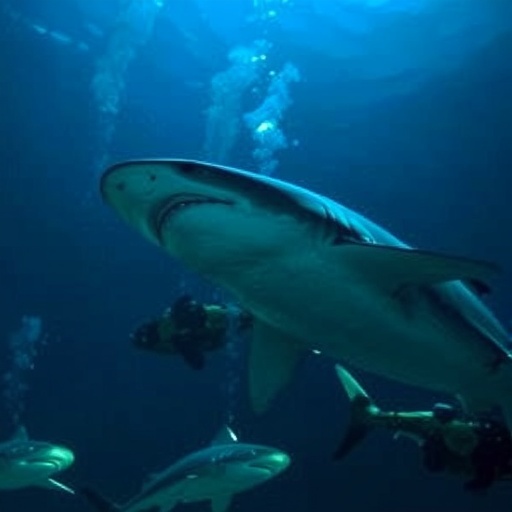
In a groundbreaking study that unveils the unseen consequences of urbanization on marine life, researchers have presented the first-ever evidence that artificial nighttime lighting influences hormone regulation in wild sharks. Conducted by the University of Miami’s Shark Research and Conservation Program, this pioneering research provides compelling data on how artificial light at night (ALAN) disturbs melatonin production, a critical hormone involved in regulating biological rhythms, in coastal shark populations. Published in the Science of the Total Environment, the study particularly highlights differential responses between two species with contrasting ecological behaviors, shedding light on the subtle yet profound effects of human-induced light pollution beneath the ocean’s surface.
Artificial light pollution has long been recognized as a significant disruptor of terrestrial ecosystems, yet its impact on marine environments remains underexplored. This study addresses that knowledge gap by evaluating how urban light intensity affects melatonin levels in nurse sharks (Ginglymostoma cirratum) and blacktip sharks (Carcharhinus limbatus), species whose activity patterns differ markedly. Nurse sharks, characterized by their relatively sedentary behavior and site fidelity, contrasted with the wide-ranging, highly mobile blacktip sharks, provided an ideal model to investigate behavioral vulnerabilities to ALAN. The research was conducted in the coastal waters off Miami, Florida, a global hotspot of urban illumination.
Melatonin plays a pivotal role in orchestrating circadian rhythms—biological processes aligned to day-night cycles—across a wide array of vertebrates. In sharks, however, the hormone’s physiological roles have remained largely enigmatic until this study. By directly measuring plasma melatonin concentrations extracted during nocturnal sampling expeditions, the researchers revealed that nurse sharks inhabiting brightly illuminated urban waters present a pronounced suppression of melatonin levels relative to individuals captured in darker, less disturbed zones. Conversely, blacktip sharks did not exhibit significant hormonal fluctuations attributable to light exposure, suggesting an intrinsic resilience potentially linked to their broad spatial movements.
The methodology employed was meticulously designed to minimize sampling bias and animal stress. Utilizing short-duration research drumlines, sharks were captured at night under low-impact red lighting conditions, which do not interfere with normal melatonin rhythms. Immediate blood sample collection allowed for precise baseline hormone quantification. In parallel, the study accounted for relevant environmental variables such as ambient light intensity, water temperature, and depth to robustly establish causative links between ALAN and endocrine changes. This rigorous experimental approach represents a significant advancement in field-based marine physiological research.
Urban coastal environments, typified by Miami’s metropolis, emanate intense artificial light from street lamps, buildings, and marine vessel activities. This anthropogenic illumination extends far beyond terrestrial boundaries, penetrating shallow marine habitats where sharks and many other organisms conduct critical life cycle activities. Suppression of melatonin in resident nurse sharks implies that light pollution might disrupt essential behaviors such as foraging, reproduction, and predator avoidance that are temporally regulated by natural light-dark cycles. Such hormonal imbalances could therefore cascade into altered population dynamics and ecosystem functions.
The study’s findings also invoke broader ecological concerns. Sharks are apex predators that maintain the structure and stability of marine food webs. Hormonal disruption in these keystone species could precipitate shifts in species interactions and trophic cascades with far-reaching consequences. Physiological stress induced by ALAN might impair immunity, metabolism, and growth, further jeopardizing shark health and their ecological effectiveness. The evidence underscores the urgency of incorporating artificial light pollution as a recognized environmental stressor alongside chemical pollutants and habitat degradation within marine conservation frameworks.
Interestingly, the differential effects observed between nurse and blacktip sharks hinge on behavioral ecologies. The nurse shark’s relatively fixed home ranges within illuminated areas make them more vulnerable to prolonged exposure, whereas blacktip sharks, through their mobile lifestyle, likely experience episodic or limited light exposure, potentially allowing physiological recovery. This species-specific vulnerability highlights the necessity for conservation strategies tailored to life history traits and spatial ecology, rather than generalized management paradigms.
From an evolutionary perspective, the suppression of melatonin due to light pollution in sharks—ancient creatures with origins dating back over 400 million years—illustrates the deeply conserved nature of light-sensitive hormonal processes across vertebrates. Such findings not only enhance understanding of marine chronobiology but also evoke parallels with terrestrial species, including humans, where circadian disruption has been increasingly implicated in health disorders. The study thus bridges disciplines, suggesting that mitigating light pollution benefits biodiversity and human well-being alike.
Moreover, exploring the molecular and receptor-level mechanisms underlying melatonin regulation in sharks could unlock novel biomedical insights. Sharks possess unique physiological adaptations that have long fascinated researchers; deciphering their melatonin receptor pathways may inform new therapeutic approaches for circadian-related diseases in humans. Consequently, this research opens new frontiers in comparative endocrinology and translational medicine.
This investigative effort was supported by The Batchelor Foundation Inc. and Canon Solutions USA, emphasizing the growing recognition by funding bodies of the environmental ramifications of urbanization on marine health. The integration of marine biology, physiology, environmental science, and conservation in this study exemplifies the multidisciplinary approach essential for addressing complex anthropogenic challenges.
Looking ahead, the baseline melatonin concentrations established provide a critical reference point for continued monitoring as coastal urbanization intensifies globally. Future studies should expand to include additional shark species and varied geographic locales, advancing comprehensive understanding of ALAN’s ecological impact. Such research will be indispensable for informing policy decisions, urban planning, and marine protected area design that minimize light pollution and safeguard oceanic biodiversity.
In conclusion, the study presents a compelling narrative that the glow of coastal cities does not end at the shoreline but infiltrates marine ecosystems, physiologically perturbing top predators like sharks. Recognizing artificial light pollution as a significant environmental stressor necessitates urgent action to develop mitigation strategies that harmonize urban development with marine ecosystem integrity. As researchers continue to illuminate these hidden interactions, the urgent message is clear: safeguarding the ocean’s rhythmic balance is vital for preserving both marine life and the planetary health upon which human existence depends.
Cite Scienmag News
Margaret Porter. (February 3, 2026). Study Reveals How Urban Light Pollution Disrupts Nighttime Hormones in Sharks. Scienmag. https://scienmag.com/study-reveals-how-urban-light-pollution-disrupts-nighttime-hormones-in-sharks/
Margaret Porter. "Study Reveals How Urban Light Pollution Disrupts Nighttime Hormones in Sharks." Scienmag, 3 February 2026, https://scienmag.com/study-reveals-how-urban-light-pollution-disrupts-nighttime-hormones-in-sharks/. Accessed 3 September 2026.
Margaret Porter. "Study Reveals How Urban Light Pollution Disrupts Nighttime Hormones in Sharks." Scienmag. February 3, 2026. https://scienmag.com/study-reveals-how-urban-light-pollution-disrupts-nighttime-hormones-in-sharks/


