


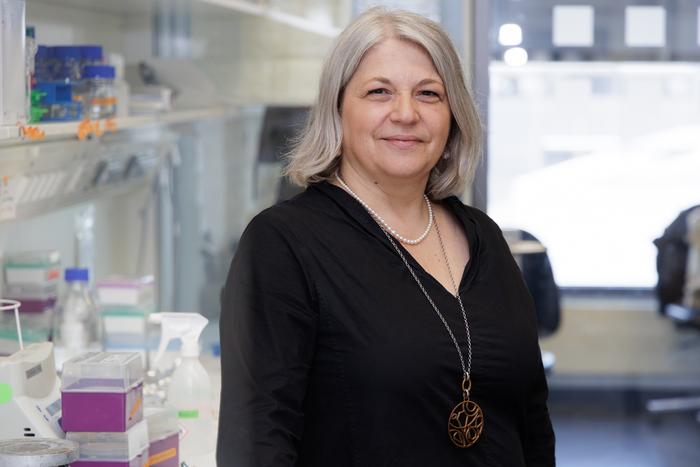
Together with other internationally renowned European scientists, the European Molecular Biology Organization (EMBO) has accepted the molecular biologist Professor Dr Aleksandra Trifunovic from the Institute of Mitochondrial Diseases and Ageing at the University of Cologne’s Faculty of Medicine and the CECAD Cluster of Excellence for Aging Research as a new member.
In its decision to admit new members, EMBO looks for scientific excellence and ground-breaking research achievements. Trifunovic is being honoured for her pioneering work on unravelling the molecular mechanisms of the accumulation of mitochondrial DNA mutations and organelle quality control, and their role in diseases and aging. Her ground-breaking work on the role of mitochondria and mitochondrial DNA (mtDNA) metabolism in aging led to a huge paradigm shift in the field and opened an entirely new research area (Nature 2004, Cell Metabolism 2009, 2010).
Trifunovic made crucial contributions to the field of mitochondrial quality control by discovering fundamental roles of the mitochondrial matrix protease CLPP in regulating mitochondrial homeostasis (EMBO Journal 2016, EMBO Reports 2016, Nature Communications 2020, Brain 2021). She also pioneered research into mitochondrial stress responses (mitoISR), revealing intricate interplays that regulate these stress signalling cascades, thus determining the physiological outcome (Cell Metabolism 2014, Science Advances 2021, 2022). Collectively, her work highlights the complexity of mitochondrial stress responses by revealing the importance of tissue specificity and dose dependency of mitoISR. More recently, in close collaboration with the group of Professor Dr Manolis Pasparakis, Trifunovic uncovered a novel role of mitochondria in the regulation of dietary-lipid transport from enterocytes to peripheral organs (Nature 2024).
Aleksandra Trifunovic was born in 1971. She studied biology at the University of Belgrade (Serbia) and received her doctoral degree in molecular biology and biochemistry from the same University in 2000. After a period as a postdoctoral researcher at Karolinska Institute in Stockholm (Sweden), she obtained an assistant professor position at Karolinska Institute in 2006. In 2009 she was recruited as a research group leader through the CECAD Cluster of Excellence initiative and in 2014 appointed Full Professor in Mitochondrial Diseases and Ageing at the University of Cologne’s Faculty of Medicine. Currently, Trifunovic serves as the head of Research Area 1 and coordinator of Core Facilities of the CECAD Cluster of Excellence. She has organized multiple international conferences and serves as a member of several editorial board of research journals.
Aleksandra Trifunovic has been awarded prestigious funding for her research, including an ERC Starter/Consolidator Grant in 2012 and an ERC Proof of Concept Grant in 2018.
The European Molecular Biology Organization (EMBO) was officially founded in 1964. Its members include more than 1,800 internationally renowned scientists from the life sciences. In total 88 Nobel Laureates have been elected to EMBO’s membership. EMBO supports outstanding early-career researchers and promotes scientific exchange in the life sciences.

Credit: Ludolf Dahmen | University of Cologne
Together with other internationally renowned European scientists, the European Molecular Biology Organization (EMBO) has accepted the molecular biologist Professor Dr Aleksandra Trifunovic from the Institute of Mitochondrial Diseases and Ageing at the University of Cologne’s Faculty of Medicine and the CECAD Cluster of Excellence for Aging Research as a new member.
In its decision to admit new members, EMBO looks for scientific excellence and ground-breaking research achievements. Trifunovic is being honoured for her pioneering work on unravelling the molecular mechanisms of the accumulation of mitochondrial DNA mutations and organelle quality control, and their role in diseases and aging. Her ground-breaking work on the role of mitochondria and mitochondrial DNA (mtDNA) metabolism in aging led to a huge paradigm shift in the field and opened an entirely new research area (Nature 2004, Cell Metabolism 2009, 2010).
Trifunovic made crucial contributions to the field of mitochondrial quality control by discovering fundamental roles of the mitochondrial matrix protease CLPP in regulating mitochondrial homeostasis (EMBO Journal 2016, EMBO Reports 2016, Nature Communications 2020, Brain 2021). She also pioneered research into mitochondrial stress responses (mitoISR), revealing intricate interplays that regulate these stress signalling cascades, thus determining the physiological outcome (Cell Metabolism 2014, Science Advances 2021, 2022). Collectively, her work highlights the complexity of mitochondrial stress responses by revealing the importance of tissue specificity and dose dependency of mitoISR. More recently, in close collaboration with the group of Professor Dr Manolis Pasparakis, Trifunovic uncovered a novel role of mitochondria in the regulation of dietary-lipid transport from enterocytes to peripheral organs (Nature 2024).
Aleksandra Trifunovic was born in 1971. She studied biology at the University of Belgrade (Serbia) and received her doctoral degree in molecular biology and biochemistry from the same University in 2000. After a period as a postdoctoral researcher at Karolinska Institute in Stockholm (Sweden), she obtained an assistant professor position at Karolinska Institute in 2006. In 2009 she was recruited as a research group leader through the CECAD Cluster of Excellence initiative and in 2014 appointed Full Professor in Mitochondrial Diseases and Ageing at the University of Cologne’s Faculty of Medicine. Currently, Trifunovic serves as the head of Research Area 1 and coordinator of Core Facilities of the CECAD Cluster of Excellence. She has organized multiple international conferences and serves as a member of several editorial board of research journals.
Aleksandra Trifunovic has been awarded prestigious funding for her research, including an ERC Starter/Consolidator Grant in 2012 and an ERC Proof of Concept Grant in 2018.
The European Molecular Biology Organization (EMBO) was officially founded in 1964. Its members include more than 1,800 internationally renowned scientists from the life sciences. In total 88 Nobel Laureates have been elected to EMBO’s membership. EMBO supports outstanding early-career researchers and promotes scientific exchange in the life sciences.
Cite Scienmag News
Drew Townsend. (July 9, 2024). Cologne biologist Aleksandra Trifunovic accepted as a new member of the European Molecular Biology Organization (EMBO). Scienmag. https://scienmag.com/cologne-biologist-aleksandra-trifunovic-accepted-as-a-new-member-of-the-european-molecular-biology-organization-embo/
Drew Townsend. "Cologne biologist Aleksandra Trifunovic accepted as a new member of the European Molecular Biology Organization (EMBO)." Scienmag, 9 July 2024, https://scienmag.com/cologne-biologist-aleksandra-trifunovic-accepted-as-a-new-member-of-the-european-molecular-biology-organization-embo/. Accessed 4 September 2026.
Drew Townsend. "Cologne biologist Aleksandra Trifunovic accepted as a new member of the European Molecular Biology Organization (EMBO)." Scienmag. July 9, 2024. https://scienmag.com/cologne-biologist-aleksandra-trifunovic-accepted-as-a-new-member-of-the-european-molecular-biology-organization-embo/

