


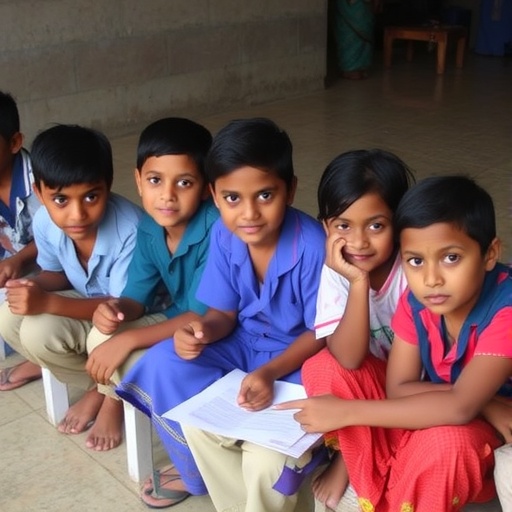
In a groundbreaking study published in the journal Discover Education, researchers S.I. Karim, M. Das, and S.B. Chakraborty delve into the profound socio-economic barriers hindering primary education among Munda children in Bangladesh. This scholarly work sheds light on an issue that affects countless communities across the globe, inviting a broader discourse on education equity, social justice, and the need for targeted interventions to amplify the voices of marginalized populations.
The Munda community, an indigenous group with a rich cultural history, finds itself at the crossroads of tradition and modernity, facing formidable challenges in accessing quality education. The research encapsulates a thorough examination of the socio-economic dynamics that impede educational attainment, particularly focusing on the historical marginalization and systemic inequalities experienced by this community. The complexity of these barriers is not merely a local issue; it reflects broader global patterns of inequity in education.
One of the critical findings of the research is the entrenched poverty that significantly limits educational opportunities for Munda children. Economic instability forces families to make difficult choices, often prioritizing immediate survival over long-term educational investment. In many cases, children are required to contribute to household income, pulling them out of school and into labor-intensive roles. This cycle of poverty perpetuates the lack of education, creating a bleak future for the younger generation.
Additionally, cultural factors play a pivotal role in shaping educational access. Traditional beliefs and practices may discourage families from valuing formal education, particularly for girls. The study reveals that societal norms often dictate the educational landscape, further marginalizing Munda children by fostering an environment where education is viewed as secondary to cultural obligations or economic necessity. This intersection of culture and education underscores the complexity of addressing educational disparities.
The research also sharply critiques the inadequate infrastructure surrounding rural education. Many schools serving Munda communities are poorly equipped, lacking essential resources such as textbooks, trained teachers, and adequate facilities. The authors argue that without significant investment in educational infrastructure, attempts to improve access and quality are likely to remain superficial. They emphasize that infrastructure should encompass not only physical buildings but also the development of supportive educational programs tailored to the unique needs of indigenous populations.
Another significant finding revolves around government policies and their efficacy in addressing educational inequalities. The study outlines how existing policies often fail to account for the specific challenges faced by marginalized groups like the Munda. This gap in policy implementation creates a discord between the intention of educational reforms and their practical effects on the ground. The authors advocate for a re-evaluation of current policies to ensure that they are inclusive and responsive to the needs of all children, especially those from disadvantaged backgrounds.
Moreover, the researchers highlight the role of community engagement in overcoming educational barriers. The study suggests that successful interventions must involve collaboration with local leaders and families to foster a sense of ownership and accountability in educational initiatives. By empowering communities to take an active role in shaping educational outcomes, stakeholders can create more sustainable and effective solutions.
The emotional toll of these socio-economic barriers is another vital aspect that the study addresses. The psychological implications of being denied education can be profound, leading to feelings of hopelessness and frustration among Munda children and their families. The authors draw attention to the need for psychological support and counseling services within educational frameworks, emphasizing that mental health is intrinsically linked to educational success.
Furthermore, the research points to the importance of accessible transportation as a crucial barrier to education. Many Munda children must travel long distances to reach the nearest schools, often facing dangers and challenges along the way. Advocating for improved transportation infrastructure could remove one of the many obstacles to consistent school attendance, thus providing a more stable educational experience for these children.
The study’s findings resonate with global education goals, particularly the United Nations’ Sustainable Development Goals (SDGs). Advocates for education equity are increasingly pressing for comprehensive approaches that address not just access but also quality and inclusivity in education. The authors emphasize that without addressing the socio-economic realities faced by marginalized groups, achieving these global goals will remain an elusive aim.
The research also underscores the potential for technology to bridge some of these educational gaps. With the rapid advancement of digital tools, there exists an opportunity to deliver educational resources to remote communities. However, the authors caution that reliance on technology must be coupled with efforts to equip families with the necessary skills to navigate digital environments effectively. This multi-faceted approach ensures that technology serves as a true ally in the quest for educational equity.
In conclusion, the study by Karim, Das, and Chakraborty is a call to action for policymakers, educators, and society at large to recognize and dismantle the socio-economic barriers that perpetuate educational inequalities for the Munda community in Bangladesh. It asks us to think critically about the structures in place that hinder access to education while urging a collective effort to create inclusive systems that champion the rights of every child, regardless of their background.
This research serves as a powerful reminder of the complexities involved in achieving educational equity and the urgent need for comprehensive, multi-layered strategies to address the myriad barriers faced by marginalized communities. By fostering an environment where education can thrive, we not only uplift the Munda children but contribute to a future where every child has the opportunity to reach their full potential.
Karim, S.I., Das, M. & Chakraborty, S.B. Socio-economic barriers to primary education: a case study of Munda children in Bangladesh.
Discov Educ (2026). https://doi.org/10.1007/s44217-026-01171-z
Cite Scienmag News
Courtney Benton. (February 3, 2026). Challenges to Munda Children’s Primary Education in Bangladesh. Scienmag. https://scienmag.com/challenges-to-munda-childrens-primary-education-in-bangladesh/
Courtney Benton. "Challenges to Munda Children’s Primary Education in Bangladesh." Scienmag, 3 February 2026, https://scienmag.com/challenges-to-munda-childrens-primary-education-in-bangladesh/. Accessed 4 September 2026.
Courtney Benton. "Challenges to Munda Children’s Primary Education in Bangladesh." Scienmag. February 3, 2026. https://scienmag.com/challenges-to-munda-childrens-primary-education-in-bangladesh/


