


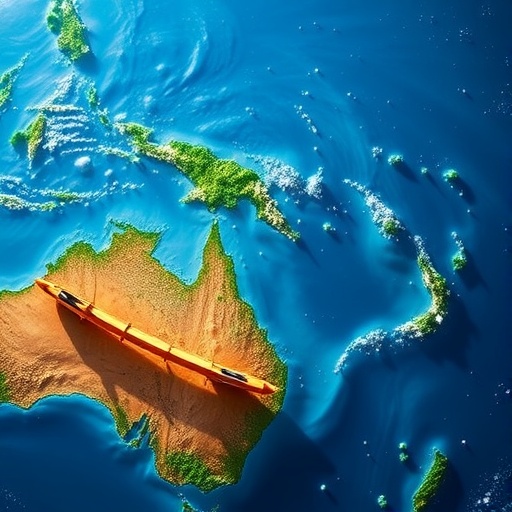
In a groundbreaking study that sheds new light on the complexities of the global water cycle, researchers have unveiled dramatic changes occurring in the South Indian Ocean, a pivotal component of Earth’s climate system. This region, long recognized as a critical conduit for interocean exchange, is now experiencing the most significant freshening trend in the Southern Hemisphere since the 1960s. These findings are poised to transform our understanding of ocean freshwater variability, with profound implications for climate dynamics, marine ecosystems, and future water resource predictions.
The research reveals that the freshening of the South Indian Ocean—a process marked by a decrease in salinity—is driving a southward expansion of the Indo-Pacific freshwater pool. This expansion is quantified by a consistent shrinkage of the 35.3 practical salinity unit (psu) isohaline, which is a crucial marker used by oceanographers to delineate changes in freshwater content. Remarkably, this freshening is occurring at an accelerated rate, with freshwater concentrations rising by approximately 6.5 ± 0.5% per decade, signifying a notable shift in the ocean’s salinity balance that has far-reaching climatic implications.
Central to this freshwater influx are two powerful oceanographic processes: the Indonesian Throughflow and the Subtropical Gyre inflow. The Indonesian Throughflow, a major ocean current that transports warm, low-salinity water from the Pacific Ocean into the Indian Ocean, has intensified significantly. Concurrently, the Subtropical Gyre, a large system of circulating ocean currents, has also seen enhanced inflow into the region. Together, these mechanisms facilitate the transfer of substantial freshwater volumes, reshaping the hydrographic landscape of the South Indian Ocean.
Intriguingly, the research highlights a shift in the typical pathways of freshwater distribution within the upper ~200 meters of the ocean. Traditionally, freshwater from the Indo-Pacific pool has followed a tropical route; however, this paradigm is changing. Scientists have identified what they term a “new subtropical pathway,” indicating a divergence in the trajectory of freshwater flow that is likely to influence water mass structure, nutrient transport, and biological productivity patterns in the South Indian Ocean subtropics.
This shift arises from atmospheric and oceanic dynamics intricately linked to climate change. A fundamental driver is the poleward expansion of the Hadley cell, the large-scale atmospheric circulation pattern that governs tropical and subtropical climate zones. The expansion results in altered wind patterns pushing the freshwater flow southward, thereby changing the ocean’s salinity distribution. Simultaneously, warming of the warm pool—an area of elevated sea surface temperatures in the tropical Indo-Pacific—enhances the Indonesian Throughflow, providing a dual impetus for the observed freshening and pathway changes.
The consequences of these transformations extend beyond salinity patterns. The changing freshwater content and its novel routes have the potential to impact interocean exchange processes drastically, which in turn modulate heat and carbon transport between the Pacific and Indian Oceans. Such alterations could influence broader climate variability phenomena, including the Indian Ocean Dipole and the El Niño-Southern Oscillation, underscoring the interconnectedness of oceanic and atmospheric systems on a global scale.
Moreover, the evolving freshwater distribution is expected to affect marine ecosystems that are finely tuned to salinity gradients and nutrient availability. Freshwater expansion can alter stratification, nutrient cycling, and habitat conditions, potentially disrupting fisheries and biodiversity hotspots. As these changes unfold, the South Indian Ocean may witness shifts in marine species composition and productivity, with socioeconomic ramifications for communities dependent on ocean resources.
This pivotal study employed a suite of observational data and advanced modeling techniques to unravel the complex interactions underlying the freshwater variability in the South Indian Ocean. By integrating salinity measurements, ocean current analyses, and atmospheric circulation models, the research team was able to construct a detailed and dynamic picture of how freshwater inputs and pathways have evolved over decades. This multidisciplinary approach sets a new standard for oceanographic investigations, emphasizing the nuanced interplay between oceanic currents and atmospheric forces driven by climate dynamics.
Importantly, the research underscores that ongoing and future global warming will likely accelerate these trends. As sea surface temperatures continue to rise, the warm pool’s temperature anomaly is projected to strengthen, further intensifying the Indonesian Throughflow. Consequently, the Indo-Pacific freshwater pool is expected to expand even further, and the new subtropical pathway for freshwater transport will broaden. These anticipated changes emphasize the urgency of monitoring and modeling ocean salinity as an integral part of climate assessment and prediction.
The findings also reveal crucial insights for understanding freshwater storage and transport mechanisms, which have remained elusive despite their importance in the global hydrological cycle. This study provides robust quantification of freshwater increases and clarifies the mechanisms by which freshwater moves through critical ocean gateways, providing invaluable data for climate scientists striving to improve predictive models.
These developments in the South Indian Ocean represent more than a regional phenomenon; they are emblematic of a global reorganization of ocean freshwater pathways in response to anthropogenic climate forcing. As such, the study calls attention to the need for comprehensive ocean observing systems that can capture ongoing salinity changes and their broader climatic impacts in near real-time.
In combining detailed oceanographic data with insights into atmospheric circulation and climate trends, this research offers a compelling narrative about the dynamic shifts occurring in the Earth’s oceans. It highlights the complex feedback loops linking ocean currents, freshwater variability, and global warming, illustrating the intricate fabric of Earth’s climate system that must be unraveled to anticipate future environmental changes.
This landmark study sets the stage for future research investigating the implications of freshwater variability on ocean circulation patterns, surface heat exchange, and biogeochemical cycles. It also opens new avenues for examining the socioeconomic impacts of shifting marine conditions on coastal and island nations, particularly those reliant on the Indian Ocean’s resources.
As the climate crisis accelerates, comprehending the delicate balance of freshwater in the oceans emerges as a critical component in formulating responsive and adaptive strategies. This work represents a vital step toward such understanding, offering hope that enhanced scientific knowledge can lead to more effective stewardship of the planet’s vital ocean systems.
Ultimately, the expanding Indo-Pacific freshwater pool and the changing subtropical pathway in the South Indian Ocean underscore the profound transformations underway beneath the waves—a silent but significant indicator of the climate upheavals shaping our future.
Cite Scienmag News
Violet Maxwell. (February 3, 2026). Growing Indo-Pacific Freshwater Shift in South Indian Ocean. Scienmag. https://scienmag.com/growing-indo-pacific-freshwater-shift-in-south-indian-ocean/
Violet Maxwell. "Growing Indo-Pacific Freshwater Shift in South Indian Ocean." Scienmag, 3 February 2026, https://scienmag.com/growing-indo-pacific-freshwater-shift-in-south-indian-ocean/. Accessed 3 September 2026.
Violet Maxwell. "Growing Indo-Pacific Freshwater Shift in South Indian Ocean." Scienmag. February 3, 2026. https://scienmag.com/growing-indo-pacific-freshwater-shift-in-south-indian-ocean/


