


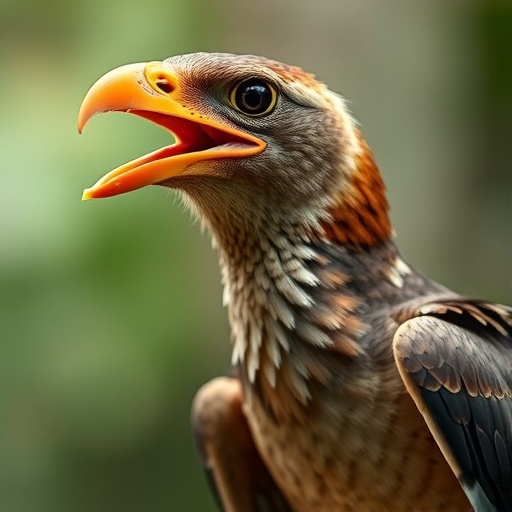
In the relentless quest to understand how flight evolved in the animal kingdom, recent groundbreaking research on the earliest known bird, Archaeopteryx, has unveiled a suite of specialized feeding adaptations deeply embedded in avian evolution. Flying, as a mode of locomotion, demands extraordinary metabolic energy far surpassing that required by terrestrial locomotion such as walking or running. This energetic constraint has driven birds to develop remarkably efficient feeding and digestive systems to maximize calorie intake and nutrient absorption. The discovery of advanced oral structures in Archaeopteryx—dating back roughly 150 million years—provides compelling evidence that such sophisticated feeding apparatuses existed far earlier than previously assumed, suggesting a crucial link between evolutionary innovations in feeding and the acquisition of flight.
Archaeopteryx has long been celebrated as the transitional fossil bridging non-avian dinosaurs and modern birds, but distinguishing early birds from their closely related yet flightless feathered dinosaur cousins has posed significant challenges for paleontologists. The latest study, led by Dr. Jingmai O’Connor at Chicago’s Field Museum, sheds new light on this conundrum by identifying distinctive oral anatomical features in Archaeopteryx that parallel those seen in contemporary birds. These include oral papillae—tiny fleshy projections on the roof of the mouth—a sensitive bill-tip organ bristling with nerve endings, and remarkably flexible tongues supported by additional hyoid skeletal elements.
The Chicago Archaeopteryx specimen, the most recent addition to the scientific archives, was meticulously prepared over the course of more than a year after being acquired by the Field Museum in 2022. Fossil preparators, under the leadership of Akiko Shinya, employed an array of delicate mechanical techniques combined with ultraviolet light imaging to reveal not just the fossilized bones but also traces of preserved soft tissues critical for interpreting the bird’s feeding anatomy. These technological advances and painstaking efforts enabled the identification of minuscule anatomical details that had remained obscured for centuries.
One of the most striking findings was the presence of oral papillae, small cone-shaped projections previously undocumented in the fossil record prior to this study. These structures function analogously to rudimentary teeth, assisting in the manipulation and processing of food as it passes through the oral cavity. By comparing the morphology and spatial arrangement of these papillae in Archaeopteryx with those in extant birds, researchers confirmed that these were not taphonomic artifacts but genuine biological features, establishing a new diagnostic trait signifying true avian lineage.
Further detailed inspections using high-resolution CT scans revealed an unexpectedly complex tongue architecture. Unlike mammals, birds possess specialized bones embedded within their tongues called hyoid bones, which serve as attachment points for muscles, allowing enhanced tongue mobility. Archaeopteryx displayed a tiny, slender bone consistent with this structure, indicating that it too had a highly mobile and flexible tongue. This suggests evolutionary pressures favored precise food handling abilities concurrent with the development of flight, given the need for rapid and efficient feeding to meet high metabolic demands.
Complementing these internal oral adaptations, the team discovered evidence of a sophisticated sensory apparatus at the beak’s tip. The presence of microscopic nerve tunnels matches the structure of the bill-tip organ found in many modern birds, a sensory organ exquisitely tuned to detecting environmental cues for foraging. This highly innervated beak tip would have allowed Archaeopteryx to probe and discern food items with exceptional sensitivity, a significant advantage for a volant animal relying on quick reactions and accurate prey capture.
Collectively, these findings imply that the earliest birds had already evolved a multifaceted feeding toolkit incorporating both mechanical and sensory modifications. The oral papillae provided a robust means of food manipulation without the presence of true teeth; a flexible tongue enabled dexterous handling of diverse food types, and a sensitive bill-tip organ facilitated environmental exploration for hidden prey. This ensemble of traits likely optimized feeding performance and caloric intake, directly supporting the high energetic requirements necessary for powered flight.
These revelations also redefine the narrative of avian evolution, positioning changes in feeding ecology as a central driver in the rise of flight rather than a mere byproduct. The morphological transitions heralded by Archaeopteryx’s mouth structures hint at a profound evolutionary shift wherein dinosaurs adapted their dietary strategies to accommodate and exploit the aerial niche. It is a testament to the intricate interplay between behavior, anatomy, and energetics that characterizes major biological innovations.
Moreover, the study emphasizes the critical role of fossil preparation and cutting-edge imaging techniques in uncovering subtle but transformative anatomical features. The discovery was only made possible through the painstaking, methodical work of preparators who combined traditional mechanical excavation with innovative ultraviolet fluorescence to detect hidden soft tissues. Such methodological rigor sets a new standard for paleontological investigations into soft tissue anatomy, a frontier that continues to revolutionize our understanding of ancient life.
This research not only realigns the evolutionary timeline for avian feeding adaptations but also provides a blueprint for identifying early bird fossils with greater confidence. The oral features characterized in this study can serve as diagnostic markers, enabling paleontologists to distinguish volant birds from non-flying dinosaurian relatives more definitively. This has broad implications for reconstructing avian phylogeny and interpreting the functional ecology of early birds.
In the context of broader evolutionary biology, the archaeopteryx findings underscore the intimate relationship between locomotion and feeding strategies, two fundamental aspects of animal biology. As flight evolved, the pressures imposed by the high energetic cost necessitated innovations not only in wing morphology but also in digestive efficiency starting from the oral cavity. This holistic view offers profound insights into how complex traits emerge through coordinated anatomical and behavioral adaptations.
Finally, this study highlights the enduring legacy of Archaeopteryx as a key species illuminating the evolutionary origin of birds. By revealing that many of the peculiarities once seen as peculiarities of modern birds have deep evolutionary roots stretching back to the Late Jurassic, it enshrines Archaeopteryx as a critical specimen bridging the terrestrial and aerial worlds. The discoveries affirm that the journey to flight was accompanied by an equally remarkable transformation in feeding anatomy, facilitating a lifestyle that remains unparalleled in the animal kingdom.
News Publication Date: February 2, 2026
Web References: DOI: 10.1016/j.xinn.2025.101086
Cite Scienmag News
Gavin Prescott. (February 2, 2026). Ancient Bird Species Featured Complex Tongue Bones and Fleshy “Teeth” to Aid in Flight-Ready Feeding. Scienmag. https://scienmag.com/ancient-bird-species-featured-complex-tongue-bones-and-fleshy-teeth-to-aid-in-flight-ready-feeding/
Gavin Prescott. "Ancient Bird Species Featured Complex Tongue Bones and Fleshy “Teeth” to Aid in Flight-Ready Feeding." Scienmag, 2 February 2026, https://scienmag.com/ancient-bird-species-featured-complex-tongue-bones-and-fleshy-teeth-to-aid-in-flight-ready-feeding/. Accessed 3 September 2026.
Gavin Prescott. "Ancient Bird Species Featured Complex Tongue Bones and Fleshy “Teeth” to Aid in Flight-Ready Feeding." Scienmag. February 2, 2026. https://scienmag.com/ancient-bird-species-featured-complex-tongue-bones-and-fleshy-teeth-to-aid-in-flight-ready-feeding/


