


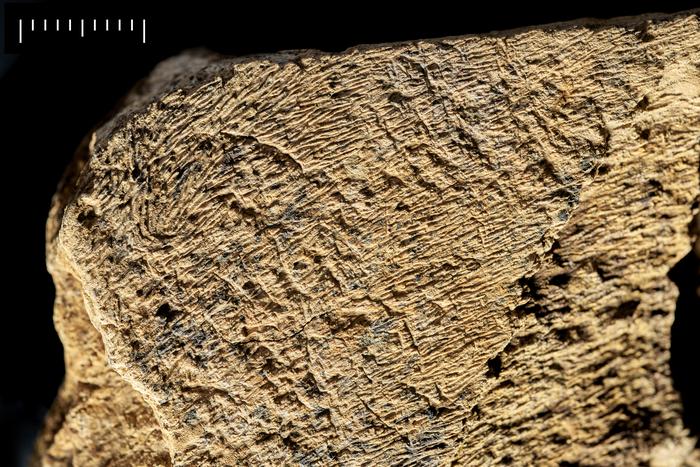
In a groundbreaking archaeological discovery that pushes the boundaries of our understanding of prehistoric tool use in Europe, researchers from University College London (UCL) and the Natural History Museum in London have identified the oldest elephant bone tool ever found on the continent. Unearthed from the extensively studied site of Boxgrove in southern England, this tool dates back almost 500,000 years, offering unparalleled insight into the ingenuity and technical sophistication of early human ancestors, potentially early Neanderthals or Homo heidelbergensis.
This artifact is no ordinary bone fragment; it is a carefully shaped hammer-like implement, roughly triangular and measuring 11 by 6 by 3 centimeters, crafted from the dense cortical layer of elephant or mammoth bone. The tool’s craftsmanship reflects a nuanced understanding of material properties, as elephant bone’s resilience made it particularly well-suited for use as a retoucher—a specialized hammer used to refine and sharpen flint handaxes and other stone tools through a process called knapping. The process involves striking the edges of these implements to detach flakes, renewing the cutting surfaces vital for survival.
Employing advanced analytical techniques such as 3D surface scanning and electron microscopy, the researchers identified distinct notches and impact marks on the tool’s surface. These marks, combined with embedded micro-fragments of flint, unequivocally demonstrate its repeated use as a striking instrument. The finesse evident in both the shaping and wear patterns signals a level of cognitive and motor skills that challenges previous assumptions about prehistoric technologies in temperate European contexts, where elephant and mammoth remains were scarce.
The discovery is remarkable not only for its age but also for highlighting the adaptive and strategic use of rare resources. Elephant bones were not abundant in the landscape around prehistoric southern England, making such materials all the more valuable. The toolmakers’ ability to recognize, select, and preserve this difficult-to-acquire raw material suggests a sophisticated understanding of tool functionality and resource availability, one that transcends basic survival to embody strategic foresight and material specialization.
The bone tool’s context enriches the narrative of Acheulean technology—the distinctive stone tool industry characterized by oval and pear-shaped handaxes ubiquitous in the Lower Paleolithic era. While the flint handaxes of Boxgrove had long been documented, the presence of a bone retoucher elevates this site’s significance, speaking to refined knapping methods and complex operational sequences. This evidence aligns with broader archaeological trends demonstrating an evolution towards precision and efficiency in tool manufacture long before the advent of modern Homo sapiens.
Lead author Simon Parfitt of UCL notes the exceptional nature of this find, emphasizing that early humans possessed a deep empirical knowledge of local resources, coupled with an ability to transform these into multi-functional tools. In the broader scope of human evolution, such sophistication signals incremental cognitive advances, likely supporting enhanced hunting and butchery strategies vital in fluctuating Pleistocene environments. This discovery adds a tangible dimension to understanding how early hominins adapted their material culture to challenging ecological constraints.
Moreover, co-author Dr Silvia Bello of the Natural History Museum highlights the multifaceted intelligence demonstrated by these prehistoric knappers. The crafting and repeated use of elephant bone retouchers reveal abstract thought processes and complex planning abilities. The selection and modification of specialized toolstone and bone indicate not only dexterity but also an appreciation for longevity in tool performance, marking a significant evolutionary step towards more complex technological behavior.
Archaeologically, Boxgrove remains a cornerstone for understanding European prehistoric life. Among its many finds, comprising stone, bone, and antler tools, the elephant bone retoucher stands out as a technological outlier. This discovery suggests that human ancestors in higher latitudes did not simply replicate southern European or African toolkits but innovated contextually, exploiting locally available resources with remarkable sophistication and intention.
The condition of the bone suggests it was worked while fresh, implying either direct hunting of elephants or opportunistic scavenging from recently deceased specimens. This distinction bears implications for understanding early hominin subsistence economies, indicating either advanced hunting capabilities or a keen adaptation to scavenging strategies within dynamic eco-systems of the mid-Pleistocene. Such insights weave together the ecological and cultural facets of early human life.
Comparison with African sites, notably Olduvai Gorge, where elephant bone tools up to 1.5 million years old have been found, frames this European discovery within a broader diasporic narrative of early tool innovation. However, the rarity of elephant bone tools in Europe, especially of such antiquity, underscores regional differences in resource availability, climatic factors, and adaptive strategies. It provides a unique testament to the technological pluralism that characterized the Acheulean world.
The analysis presented in the forthcoming publication in Science Advances meticulously documents the bone tool’s morphology, use-wear, and contextual stratigraphy, paving the way for robust comparisons with contemporaneous assemblages. This research is set to recalibrate longstanding perspectives on early hominin technological repertoires, particularly emphasizing the role of organic materials such as bone in conjunction with lithics within complex tool-use behaviors.
Supported by English Heritage, UCL, and the Calleva Foundation, this interdisciplinary study exemplifies contemporary archaeological practice—melding cutting-edge technology with rigorous fieldwork and lab analysis to illuminate the nuanced relationship between our ancestors and their environment. It fundamentally enriches the narrative of human evolution, chronicling an inventive episode in the prehistory of Europe that foregrounds cognition, innovation, and resilience.
Cite Scienmag News
Courtney Benton. (February 2, 2026). Oldest Prehistoric Tool in Europe Unearthed: Crafted from Elephant Bone. Scienmag. https://scienmag.com/oldest-prehistoric-tool-in-europe-unearthed-crafted-from-elephant-bone/
Courtney Benton. "Oldest Prehistoric Tool in Europe Unearthed: Crafted from Elephant Bone." Scienmag, 2 February 2026, https://scienmag.com/oldest-prehistoric-tool-in-europe-unearthed-crafted-from-elephant-bone/. Accessed 4 September 2026.
Courtney Benton. "Oldest Prehistoric Tool in Europe Unearthed: Crafted from Elephant Bone." Scienmag. February 2, 2026. https://scienmag.com/oldest-prehistoric-tool-in-europe-unearthed-crafted-from-elephant-bone/


