


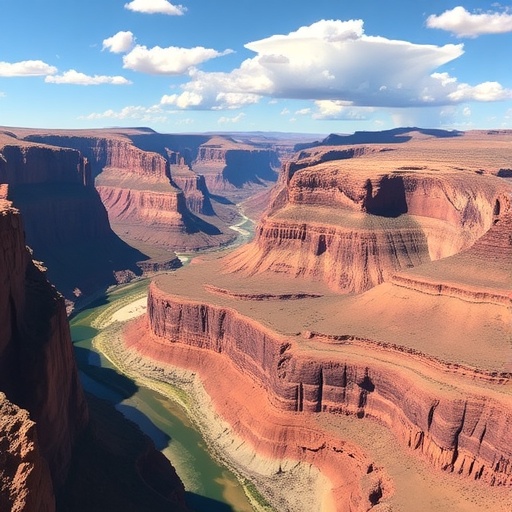
Beneath the vast expanse of the Atlantic Ocean, far from the familiar landscapes we traverse, lies a submarine canyon of staggering proportions and geological intrigue: The King’s Trough Complex. Situated roughly 1,000 kilometers off the coast of Portugal, this colossal feature rivals and surpasses even the grandest terrestrial canyons in scale. Stretching approximately 500 kilometers, the King’s Trough Complex is an interconnected system of parallel trenches and deep basins, culminating at its eastern extremity in Peake Deep—one of the Atlantic Ocean’s deepest known points. Despite its enormity, the origins of this enigmatic submarine canyon have long baffled the scientific community.
Traditionally, deep canyons on land, such as the iconic Grand Canyon, owe their existence to the relentless erosive power of flowing water. However, no equivalent erosional force acts upon the ocean floor to sculpt comparable structures below sea level. This disparity raised fundamental questions about the genesis of such features beneath oceanic waters. An international team of marine geologists, spearheaded by the GEOMAR Helmholtz Centre for Ocean Research Kiel, has now unveiled compelling new evidence suggesting that the formation of the King’s Trough Complex was driven primarily by tectonic forces rather than sedimentary erosion.
Central to this groundbreaking discovery is the concept of transient plate boundary dynamics. The team’s research, published in the prestigious journal Geochemistry, Geophysics, Geosystems (G-Cubed), elucidates how, approximately between 37 and 24 million years ago, a temporary plate boundary existed in the North Atlantic within the region now occupied by the King’s Trough. During this interval, tectonic forces stretched and fractured the oceanic crust along this boundary, a geodynamic process scientists liken to a zipper progressively opening from east to west. This transient fault system fundamentally reshaped the seafloor, carving out the parallel trenches and basins that define the complex today.
More intriguingly, prior to this plate boundary’s relocation to its current position, the oceanic crust beneath the King’s Trough was anomalously thick and geothermally altered. This exceptional crustal thickness is interpreted as the geological footprint of a mantle plume—a localized upwelling of abnormally hot and buoyant material originating deep within the Earth’s mantle. The mantle plume at play is hypothesized to be an early branch of the modern-day Azores mantle plume. Mantle plumes have long been recognized as critical drivers of crustal dynamics, influencing local lithosphere conditions and acting as catalysts for tectonic boundary migration.
The significant thickening and thermal transformation of the oceanic crust likely rendered this region mechanically weaker, creating a preferential site for the plate boundary’s transitory passage. As co-author PD Dr. Jörg Geldmacher from GEOMAR notes, “This thickened, heated crust may have made the region mechanically weaker, so that the plate boundary preferentially shifted here.” This weakening effect, combined with extensional tectonic forces, initiated the crustal fracturing that ultimately formed the King’s Trough system’s deep and elongated trench network. When the plate boundary subsequently migrated southwards towards the present Azores triple junction, the rifting process in the King’s Trough ceased, leaving the submarine canyon complex as a testament to this ephemeral yet profound tectonic episode.
The King’s Trough Complex not only offers a rare geological archive illustrating the interplay between deep mantle activity and supra-mantle tectonic reorganizations but also provides a compelling case study linking mantle plumes and plate boundary evolution. This dynamic highlights how pre-existing structural anomalies, nurtured by mantle-derived heat and material, can predetermine deformation localization and tectonic plate boundary positioning in oceanic lithosphere. Understanding this intricate feedback represents a significant stride forward in unraveling the geodynamic mechanisms shaping the Earth’s crust beneath the oceans.
Furthermore, this research sheds light on analogies with present-day processes. Notably, the Azores region exhibits similar geological patterns wherein the contemporaneous formation of the Terceira Rift—a trench system comparable to the King’s Trough—is underway within a region of thickened oceanic crust. This parallel suggests that ancient tectonic-mantle interactions preserved beneath the North Atlantic floor may illuminate ongoing rift dynamics and mantle plume influences in the modern Earth system, offering valuable predictive insights for plate tectonics and ocean basin evolution.
These insights were derived from meticulous field studies carried out during the 2020 M168 expedition aboard the German research vessel METEOR, led by Dr. Antje Dürkefälden. Employing high-resolution multibeam sonar mapping, researchers produced detailed bathymetric maps of the King’s Trough Complex, revealing the fine-scale morphology of its trench and basin architecture. Subsequently, targeted collection of volcanic rock samples from specific trench locales was conducted using chain bag dredges, enabling precise geochemical and geochronological characterization of the crustal materials involved in the canyon formation.
Back onshore, comprehensive geochemical analyses and radiometric dating were executed, with ages of sampled rocks determined at the University of Wisconsin-Madison. This isotopic dating provided temporal brackets crucial for reconstructing the tectonic history underlying the King’s Trough’s formation. Bathymetric data contributions from the Portuguese research center Estrutura de Missão para a Extensão da Plataforma Continental (EMEPC), along with collaborations from Kiel University and Martin Luther University Halle-Wittenberg, enriched the dataset and facilitated integrative interpretations of seafloor structure, tectonics, and mantle influences.
The team’s holistic approach integrated geological sampling, geophysical mapping, and advanced geochemical dating to conclusively link the King’s Trough origin to a transient tectonic plate boundary affected by mantle plume interactions. These findings forge new pathways for understanding how the Earth’s lithosphere evolves through complex interactions between deep mantle processes and plate movements, transcending traditional models focused predominantly on surface erosion and sedimentation.
This pioneering study redefines the geological narrative for submarine canyon formation and emphasizes the significance of mantle plumes in shaping oceanic lithosphere heterogeneities and tectonic architectures. The King’s Trough is thus emblematic not only of Earth’s dynamic past but also of the intricate, multi-scale processes that continue to sculpt our planet’s geological fabric beneath the waves.
As we deepen our investigation into ocean basins, the revelations from the King’s Trough Complex underscore the profound interconnectedness between mantle convection, crustal deformation, and seafloor morphology. Such knowledge equips geoscientists with crucial tools to interpret Earth’s tectonic past and anticipate future structural transformations, highlighting the ocean’s seafloor as a critical archive of planetary evolution.
News Publication Date: 27-Nov-2025
Web References:
10.1029/2025GC012616
Cite Scienmag News
Violet Maxwell. (February 1, 2026). The Atlantic’s “Grand Canyon” Unveiled. Scienmag. https://scienmag.com/the-atlantics-grand-canyon-unveiled/
Violet Maxwell. "The Atlantic’s “Grand Canyon” Unveiled." Scienmag, 1 February 2026, https://scienmag.com/the-atlantics-grand-canyon-unveiled/. Accessed 4 September 2026.
Violet Maxwell. "The Atlantic’s “Grand Canyon” Unveiled." Scienmag. February 1, 2026. https://scienmag.com/the-atlantics-grand-canyon-unveiled/


