


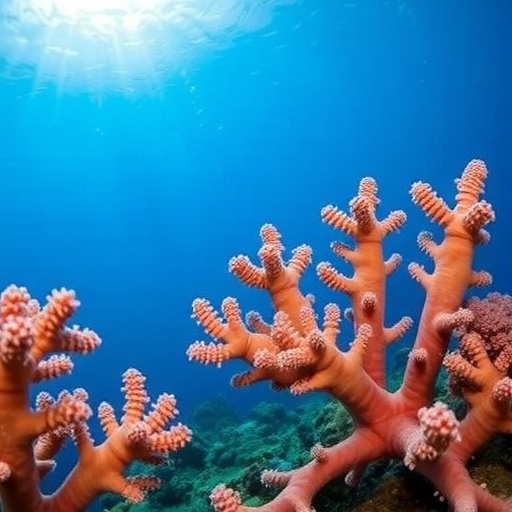
In the vast and varied ecosystems of our planet’s oceans, the Atlantic and Indo-Pacific regions are traditionally viewed as distinct biogeographical realms, each hosting unique and diverse marine life. This long-standing scientific paradigm posits that species found in one oceanic region are largely different from those in the other, due to geographic, climatic, and evolutionary barriers. However, recent groundbreaking research published in Frontiers of Biogeography shatters this conventional wisdom, revealing a fascinating exception in the form of zoantharians—colorful, anemone-like hexacorals that defy the presumed biogeographical divide between these two marine expanses.
The team of international scientists, spearheaded by Dr. Maria “Duda” Santos of the University of Hawai‘i at Mānoa’s Hawaiʻi Institute of Marine Biology (HIMB) and the University of the Ryukyus, embarked on this study following a striking underwater observation experienced by Dr. Santos herself. During an exploratory dive in Okinawa, she encountered zoantharian specimens so morphologically identical to those found in her native Brazil that it prompted a comprehensive global investigation. These remarkable creatures appeared to bridge an immense oceanic gap, exhibiting surprisingly minimal differences in both form and genetic makeup across vastly separated populations.
Zoantharians, belonging to Hexacorallia, are distinguished not only by their vibrant coloration and anatomical complexity but also by their ecological significance within coral reef communities. Typically overshadowed by their stony coral counterparts, these invertebrates have, until now, remained understudied in the context of global biogeographic patterns. The new research leverages advanced molecular genetic tools alongside detailed morphological analyses to delineate population structures across tropical and temperate marine provinces, revealing unexpectedly subtle genetic differentiation between Atlantic and Indo-Pacific groups.
Key to their extraordinary dispersal capability is the extended larval duration of zoantharians, a planktonic phase that can exceed 100 days. This prolonged window allows larvae to be carried over vast distances by ocean currents, an evolutionary trait that is rare among many other sessile marine organisms. In addition, these creatures have adapted to “rafting”—the phenomenon of attaching themselves to floating debris or other substrates, effectively hitching rides across ocean basins. Such strategies combine to facilitate gene flow across regions separated by continental landmasses and vast water expanses.
Moreover, the study indicates that zoantharians exhibit an unusually slow rate of molecular evolution compared to other coral reef species. This evolutionary stasis contributes to their persistent morphological similarities despite millions of years of geographic separation. The slow genetic divergence challenges assumptions about the speed of speciation in marine environments and prompts a re-evaluation of the evolutionary dynamics that govern sessile marine invertebrates.
This revelation carries profound implications for our understanding of marine biodiversity patterns and the resilience of coral reef ecosystems in a changing climate. As global warming and ocean acidification increasingly threaten stony corals, zoantharians have begun to colonize spaces once dominated by these reef architects. Their ability to rapidly expand in stressed habitats could alter the foundational biological structures of reefs, triggering phase shifts with ecosystem-wide consequences. Understanding their dispersal and adaptive strategies is crucial for scientists aiming to predict the future ecological trajectories of coral reefs.
By assembling an extensive global dataset encompassing DNA sequences and ecological records from locations as widespread as Mexico, the Philippines, Brazil, and Okinawa, this collaborative project has created the first comprehensive biogeographic atlas for zoantharians worldwide. This synthesis brings to light the complex interplay between dispersal capability, evolutionary rate, and environmental adaptation that shapes marine communities across ocean boundaries.
The monumental effort involved not only provides critical baseline data for future monitoring efforts but also exemplifies the power of international scientific collaboration in addressing big-picture questions about life in the oceans. The findings challenge long-held assumptions about marine species distribution and pave the way for new frameworks in marine conservation biology, particularly in assessing connectivity among distant reef systems.
Furthermore, the interplay between biogeographic patterns and genetic data offers new perspectives on how marine organisms respond to both historical and contemporary environmental changes. The study’s insights into zoantharian biology may also inform broader discussions about the evolutionary mechanisms underpinning dispersal, speciation, and adaptation in marine habitats, contributing to a more nuanced understanding of ocean biodiversity.
As reefs worldwide continue to face unprecedented environmental pressures, this research underscores the importance of lesser-known taxa in maintaining ecological balance. Zoantharians, once overshadowed by more conspicuous coral species, emerge as key players with unique survival strategies that may define reef futures. Their remarkable dispersal and evolutionary stasis shine a spotlight on the complexity and interconnectedness of marine ecosystems in an era of rapid global change.
In sum, the discovery that zoantharians exhibit weak genetic differentiation between the Atlantic and Indo-Pacific oceans challenges the foundational biogeographical paradigm dividing these two marine realms. This insight revolutionizes our understanding of oceanic biodiversity patterns and calls for a reassessment of how marine species distributions are influenced by both biological traits and physical barriers. It marks a significant step forward in marine biology, opening avenues for future research into the adaptive capacities and evolutionary histories of reef-associated organisms.
This extraordinary research not only advances marine science but also highlights the need to integrate genetic, ecological, and evolutionary data to fully grasp the ramifications of climate change on oceanic life. As we strive to protect and manage fragile coral reef ecosystems, recognizing the roles and resilience of cryptic yet widespread organisms like zoantharians becomes vital. Their story is an emblem of the ocean’s intricate biological tapestry—dynamic, interconnected, and continuously surprising.
News Publication Date: January 30, 2026
Web References:
References:
Santos, M.E.A., Kise, H., Fourreau, C.J.L., Kiriukhin, B., Kitahara, M.V., Baker, D.M., Toonen, R.J., Liu, P.J., Chang, A., Tu, T.-H., Widiastuti, Agustini, K.M.P., Bowen, B.W., Reimer, J.D. (2026). Global biogeography of zoantharians indicates a weak genetic differentiation between the Atlantic and Indo-Pacific oceans, and distinct communities in tropical and temperate provinces. Frontiers of Biogeography, 19. DOI:10.21425/fob.19.174247
Cite Scienmag News
Gavin Prescott. (February 1, 2026). Meet Corals’ Boldest Relatives: UH Scientists Uncover Marine Creatures Defying Evolutionary Norms. Scienmag. https://scienmag.com/meet-corals-boldest-relatives-uh-scientists-uncover-marine-creatures-defying-evolutionary-norms/
Gavin Prescott. "Meet Corals’ Boldest Relatives: UH Scientists Uncover Marine Creatures Defying Evolutionary Norms." Scienmag, 1 February 2026, https://scienmag.com/meet-corals-boldest-relatives-uh-scientists-uncover-marine-creatures-defying-evolutionary-norms/. Accessed 4 September 2026.
Gavin Prescott. "Meet Corals’ Boldest Relatives: UH Scientists Uncover Marine Creatures Defying Evolutionary Norms." Scienmag. February 1, 2026. https://scienmag.com/meet-corals-boldest-relatives-uh-scientists-uncover-marine-creatures-defying-evolutionary-norms/


