


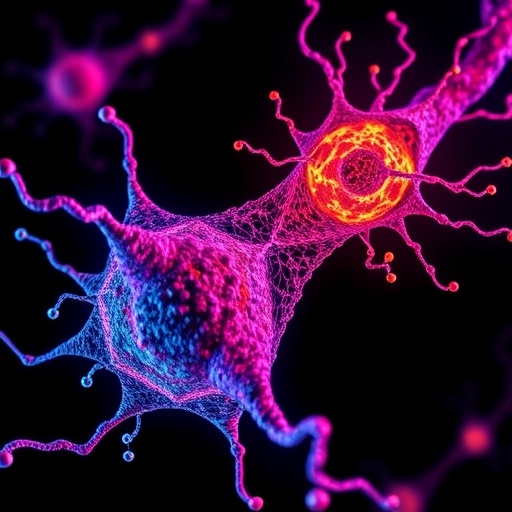
In a groundbreaking study that challenges long-held principles of biophysics and cellular mechanics, researchers at the University of Wisconsin–Madison have unveiled the existence of “negative viscosity” within groups of epithelial cells. This astonishing discovery upends traditional understanding of how cell collectives move through tissue, revealing a dynamic where cells can seemingly propel themselves forward by injecting, rather than dissipating, energy into their environment. The implications of this revelation extend far beyond fundamental cell biology, potentially transforming approaches to wound healing, tissue engineering, and developmental biology.
At its core, cell movement has always been modeled assuming positive viscosity—a drag force that inherently resists motion, akin to pushing through a fluid like honey or oil. Viscosity, a measure of a substance’s resistance to flow or deformation, generally acts as a dissipative factor slowing motion. For decades, scientists accepted that within cellular assemblies, this viscosity would impede the ability of cells to migrate collectively, particularly in tightly packed epithelial layers essential for forming barriers and repairing tissue. However, the latest research led by Associate Professor Jacob Notbohm and PhD candidate Molly McCord has turned this assumption on its head by demonstrating that, in certain conditions, cellular collectives generate negative viscosity.
The team’s pioneering methodology involved an innovative combination of optical imaging and mechanical analysis. By observing how monocultures of epithelial cells deformed an underlying compliant gel substrate as they migrated, they were able to quantify the forces these cells exerted on their environment with unprecedented spatial resolution. Beyond just cataloging force magnitudes, McCord developed an advanced analytical framework to dissect viscosity values not only at the cellular level but across multicellular regions within the monolayer. Unexpectedly, areas emerged where viscosity values dipped below zero—a hallmark of negative viscosity suggesting that instead of resisting motion, these cells actively contributed energy to propel collective movement.
To conceptualize this phenomenon, Notbohm draws an analogy to driving a car: “Imagine a vehicle moving through air, which normally provides drag, slowing it down. Negative viscosity would be like the air instead pushing the car forward, adding energy rather than removing it.” While initially counterintuitive and seemingly contradictory to foundational physical laws, negative viscosity is permissible in active biological systems that continuously transduce chemical energy into mechanical work. The cells, powered by metabolic processes converting nutrients into usable energy, can therefore exhibit complex mechanical behaviors not seen in passive materials.
Delving deeper, the researchers correlated regions of negative viscosity with heightened metabolic activity, underscoring the biological underpinnings of this mechanical anomaly. Cells in these zones exhibited elevated energy consumption, reflecting a biochemical state primed to generate motion-enhancing forces within the cellular collective. This discovery elegantly links cellular energetics with emergent mechanical properties, suggesting a coordinated interplay where bioenergetics directly modulates the physical characteristics of tissue motion. Such insights provide a fresh framework to reevaluate how cellular systems integrate metabolic cues with mechanical outputs.
The ramifications of uncovering negative viscosity stretch beyond basic science, offering transformative possibilities for medical and bioengineering disciplines. Wound healing, an inherently collective cellular process requiring coordinated migration to restore tissue integrity, may be influenced by modulating these viscous properties. Accelerating or directing collective movement by harnessing or mimicking negative viscosity mechanisms could pave the way for therapies that improve recovery outcomes and reduce chronic wound complications.
Similarly, the findings may illuminate key processes in embryonic development and tissue morphogenesis, where precise cell group movements sculpt form and function. Understanding the mechanical language of cells operating under negative viscosity could unravel developmental pathologies and offer avenues to engineer tissues with enhanced regenerative capabilities. By integrating these mechanical principles into computational models, researchers can predict and potentially control how cells behave within complex multicellular systems.
Furthermore, the study breaks ground on quantifying a parameter that had eluded direct measurement—effective viscosity within cell monolayers. Prior attempts to model collective cell motion often lacked empirical measures of viscous resistance, limiting predictive accuracy. McCord and Notbohm’s experimental approach fills this critical gap, providing a robust platform for future investigations on cellular mechanics. This quantitative advance enables refinement of biophysical models, enhancing understanding of force generation, tissue rheology, and mechanotransduction.
The implications of negative viscosity extend to the realm of active matter physics, where biological systems are viewed through the lens of nonequilibrium thermodynamics. Cells, as active materials, convert stored energy into mechanical work, displaying properties unattainable in inanimate matter at equilibrium. Demonstrating negative viscosity in epithelial monolayers not only supports active matter theories but encourages cross-disciplinary dialogues bridging biology, physics, and engineering.
While the discovery is compelling, the research community acknowledges that much remains to be explored. How widespread is negative viscosity among different cell types and tissues? What molecular mechanisms govern the transition from positive to negative viscosity states? Can external factors such as biochemical signals or mechanical constraints modulate this property? Addressing these questions will deepen mechanistic insights and unlock new frontiers in cellular biomechanics.
The research, funded by the National Science Foundation and the National Institutes of Health, exemplifies how interdisciplinary collaboration enhances innovation. By combining experimental mechanics, advanced imaging, and biological analysis, the team achieved a synthesis of quantitative rigor and physiological relevance that sets new standards in the field.
In conclusion, the identification of negative viscosity within epithelial cell collectives marks a paradigm shift in our comprehension of cellular motion. It challenges prevailing assumptions and opens avenues that span from fundamental science to applied medicine. As this novel concept gains momentum, it promises to reshape the landscape of cellular biomechanics and inspire inventive strategies to manipulate tissue dynamics for health and disease.
News Publication Date: 4-Dec-2025
Web References: https://journals.aps.org/prxlife/abstract/10.1103/9lnm-gm3j
References: Not specified beyond the journal article.
Keywords
Cells, Cell Biology, Biomechanics, Negative Viscosity, Epithelial Cells, Collective Cell Migration, Active Matter, Tissue Mechanics, Wound Healing, Cell Metabolism, Biophysics, Tissue Development
Cite Scienmag News
Katie Riggs. (February 1, 2026). Breakthrough Discovery Challenges Physics, Revealing New Insights into Cellular Movement. Scienmag. https://scienmag.com/breakthrough-discovery-challenges-physics-revealing-new-insights-into-cellular-movement/
Katie Riggs. "Breakthrough Discovery Challenges Physics, Revealing New Insights into Cellular Movement." Scienmag, 1 February 2026, https://scienmag.com/breakthrough-discovery-challenges-physics-revealing-new-insights-into-cellular-movement/. Accessed 4 September 2026.
Katie Riggs. "Breakthrough Discovery Challenges Physics, Revealing New Insights into Cellular Movement." Scienmag. February 1, 2026. https://scienmag.com/breakthrough-discovery-challenges-physics-revealing-new-insights-into-cellular-movement/


