


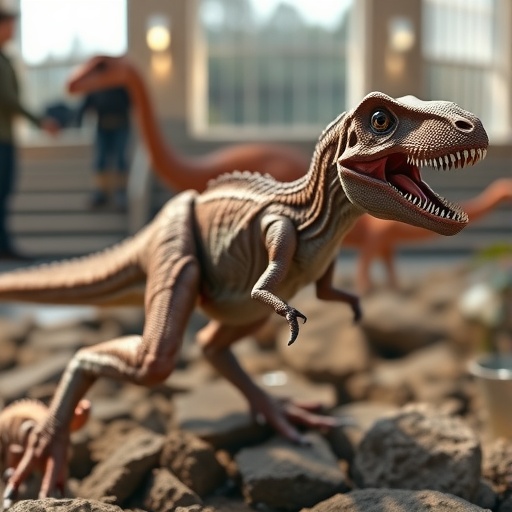
In a groundbreaking study led by researchers at University College London, scientists have revealed that juvenile sauropods—those iconic, long-necked giants of the Late Jurassic—played a crucial role in sustaining predator populations around 150 million years ago. This research, published in the New Mexico Museum of Natural History and Science Bulletin, unveils a complex food web within the Morrison Formation, an immensely fossil-rich sedimentary deposit in the western United States. By combining paleontological data and ecological modeling, the team offers unprecedented insight into how these massive herbivores influenced predator-prey dynamics in their ancient landscape.
Sauropods like Diplodocus, Brachiosaurus, and Apatosaurus are often celebrated for their sheer size, sometimes exceeding the length of modern blue whales. However, this study emphasizes a critical phase in their life cycle typically overshadowed in the fossil record: their vulnerable infancy and youth. The surprisingly small size of sauropod eggs—only about a foot in diameter—and the lengthy growth period after hatching meant these dinosaurs faced significant mortality risks. The absence of parental care, inferred from multiple lines of evidence, rendered baby sauropods easy prey for numerous carnivorous dinosaurs.
Lead author Dr. Cassius Morrison points out that the dinosaur ecosystem was one of relentless survival pressures and opportunism. Adult sauropods, due to their massive size, were mostly immune to predation, but their juveniles were far less protected. Morrison notes that akin to modern sea turtles, which hatch and are left to survive independently, young sauropods were frequently targeted. This predation likely constituted a substantial energy source for large theropods. “Life was cheap in this ecosystem,” Morrison explains, highlighting the idea that juvenile sauropods were integral in fueling predator populations such as Allosaurus and Torvosaurus.
The paleoecological reconstruction was painstakingly derived from fossil assemblages found at the Dry Mesa Dinosaur Quarry in Colorado. This site, active over a period of roughly 10,000 years, preserves an extraordinary diversity of dinosaur taxa, providing a snapshot of Late Jurassic biodiversity. By studying not only the fossils’ physical characteristics but also the chemical signatures preserved within bones and teeth—including isotope analyses and tooth wear patterns—the researchers could infer dietary habits and predator-prey relationships with remarkable precision.
One of the study’s most novel aspects involved the use of sophisticated ecological network modeling software traditionally reserved for contemporary ecosystems. This tool allowed the team to map a high-resolution food web, linking multiple species and revealing the complexity of dietary interactions. Results suggested that sauropods had far more feeding connections—both as primary consumers of ancient gymnosperms and as prey for carnivores—than their ornithischian contemporaries, such as the plated Stegosaurus, which likely posed a more formidable threat to would-be predators.
The ecological implications extend beyond mere diet. By quantifying these intricate relationships, the researchers shed light on selective pressures shaping dinosaur evolution. Understanding the availability of juvenile sauropods as an “easy prey” resource may explain adaptive traits in predatory dinosaurs of the Jurassic, such as hunting strategies and injury resilience. Some Allosaurus fossils show healed and unhealed wounds from encounters with armored prey like Stegosaurus, implying that access to vulnerable juveniles could have been critical to survival and recovery from such injuries.
This insight also offers a fascinating evolutionary contrast with Late Cretaceous ecosystems dominated by formidable predators like Tyrannosaurus rex. Around 70 million years after the Morrison Formation ecosystem thrived, fewer sauropods existed, and the main prey were better-armed herbivores such as Triceratops. This shift may have driven the evolution of stronger bite forces, improved vision, and larger body size seen in T. rex, allowing it to tackle more dangerous prey that could inflict serious harm in return—a far different dynamic from the Late Jurassic predation scenario.
Furthermore, the dominance of gymnosperm flora—including conifers and ferns—underpinned the entire ecosystem structure. This was a world before flowering plants, with vegetation types affecting herbivore feeding patterns and, consequently, predator positions in the food chain. Juvenile sauropods, surrounded by this gymnosperm-dominated habitat, depended on a steady supply of fresh plant growth. Their massive plant intake linked terrestrial primary production directly to the carnivorous dinosaurs, making them keystone species in the Late Jurassic food web.
The Morrison Formation itself, spanning over one and a half million square kilometers, provides an unparalleled window into this era. These sedimentary deposits from ancient rivers and floodplains encapsulate diverse faunal communities. The Dry Mesa Quarry, in particular, serves as a temporal hotspot, capturing multiple decades of ecological interaction. Such sites enable paleontologists to reconstruct not only species diversity but also ecological dynamics, feeding hierarchies, and life history traits—transforming our understanding of Mesozoic ecosystems from static snapshots to complex, interconnected webs of life.
Through this synthesis of paleontology, geochemistry, and ecological modeling, the study opens new pathways for examining fossil ecosystems. It allows scientists to examine evolutionary drivers with a fresh lens, connecting morphology, behavior, and ecosystem roles. The critical function of baby sauropods—often overlooked in previous research—is now acknowledged as central to sustaining predator populations and maintaining ecosystem balance during the Late Jurassic.
In conclusion, juvenile sauropods were not merely the future giants of their time; they were pivotal ecological players whose presence shaped Jurassic predator-prey dynamics in a profound way. Their vulnerability created a cascade of evolutionary and ecological effects, helping to sustain some of the era’s apex predators. This research underscores the importance of considering life stages and ecological roles in paleobiology and demonstrates how modern analytical techniques can revolutionize our understanding of ancient life. As Dr. Morrison states, reconstructing food webs provides a key to unlocking evolutionary mysteries hidden deep within the fossil record, illuminating why dinosaurs evolved the incredible diversity and adaptations that continue to captivate scientists and enthusiasts alike.
News Publication Date: 30-Jan-2026
References: Published in the New Mexico Museum of Natural History and Science Bulletin
Cite Scienmag News
Gavin Prescott. (February 1, 2026). Baby Dinosaurs Frequently Targeted by Late Jurassic Predators, Study Reveals. Scienmag. https://scienmag.com/baby-dinosaurs-frequently-targeted-by-late-jurassic-predators-study-reveals/
Gavin Prescott. "Baby Dinosaurs Frequently Targeted by Late Jurassic Predators, Study Reveals." Scienmag, 1 February 2026, https://scienmag.com/baby-dinosaurs-frequently-targeted-by-late-jurassic-predators-study-reveals/. Accessed 3 September 2026.
Gavin Prescott. "Baby Dinosaurs Frequently Targeted by Late Jurassic Predators, Study Reveals." Scienmag. February 1, 2026. https://scienmag.com/baby-dinosaurs-frequently-targeted-by-late-jurassic-predators-study-reveals/


