


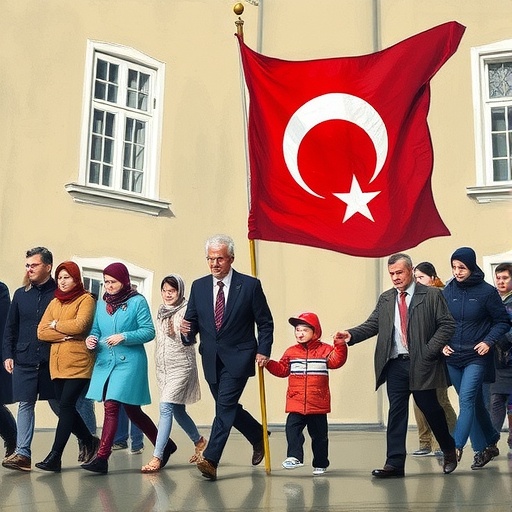
In recent years, the plight of Syrian refugees in Turkey has drawn significant attention, marking a pivotal moment in the nation’s history. As millions fled war and devastation, Turkey became one of the largest host countries, accommodating over 3.5 million Syrian refugees. This situation has sparked complex socio-political dynamics involving identity, national cohesion, and the quest for acceptance. A groundbreaking study by N.N. Pehlivan and H. Coşkun titled “Apology and national identity play a role in forgiveness toward Syrian refugees in Turkey” sheds light on the psychological mechanisms that underpin forgiveness in this context.
Understanding the dynamics of forgiveness is crucial in multi-ethnic societies like Turkey, especially when tectonic shifts in demography and identity politics come into play. The study emphasizes that national identity can significantly shape how people process grievances and interpersonal conflicts. In Turkey, where national pride and historical grievances often intersect, the need for a comprehensive framework to understand these shifts is more pressing than ever. The findings of Pehlivan and Coşkun provide critical insights into how apologies and acknowledgments can act as bridges toward reconciliation among diverse groups, notably Syrian refugees.
The authors articulate the role of official and societal apologies in mitigating tensions between host communities and refugees. Apologies serve a dual purpose: they can validate the pain experienced by individuals during displacement and express a commitment to healing relationships. In the context of Turkish identity, which is deeply tied to concepts of honor and communal integrity, the power of a sincere apology cannot be overstated. This study highlights how psychological elements—such as empathy and acknowledgment—play into broader national narratives.
However, the complexities of this issue cannot be ignored. The Turkish population has had varying responses to the inflow of refugees, ranging from solidarity and support to resentment and xenophobia. Factors such as economic strain, cultural differences, and political manipulations have fueled hostilities in some segments of society. The research conducted by Pehlivan and Coşkun delves deep into these multifaceted responses, offering an evidence-based examination of attitudes toward forgiveness and the role national identity plays in shaping these views.
Moreover, the study emphasizes that forgiveness is not merely the absence of anger or resentment; rather, it is an active process that requires engagement. It involves a transformation of perceptions, feelings, and attitudes toward the offending party. In the case of Syrian refugees, the Turkish populace is encouraged to wield forgiveness as a tool for community development and social cohesion. Pehlivan and Coşkun’s work illustrates, through empirical evidence, how engendering compassion and understanding can pivotally influence public perception and ultimately foster a spirit of cohabitation.
The research is particularly timely, considering the ongoing political discourse surrounding refugees and their integration into Turkish society. By analyzing the psychological components of forgiveness, the study offers a roadmap for policy-makers and community leaders aiming to bridge gaps between Turkish citizens and Syrian refugees. The findings underscore that national identity does not have to be a zero-sum game; rather, it can be expanded to include diverse narratives and experiences.
Additionally, the study investigates how collective memory and trauma play into these dynamics. National identity in Turkey has been shaped by historical events that have led to intergroup tensions. However, the acknowledgment of shared vulnerabilities, especially in the context of suffering, may foster a sense of unity rather than division. The authors advocate for programs that promote intercultural dialogue and community engagement as essential pathways to effective integration of refugees.
Furthermore, the authors conceptualize solutions that can emerge from the recognition of historical injustices. They argue that fostering a community-oriented approach to refugee integration can lead to better psychological outcomes for both Turks and Syrians. By framing such integration as a shared responsibility, communities can cultivate empathy and reduce stereotypes that often contribute to social fragmentation.
In understanding the interplay between apology and forgiveness, the implications of this research reach far beyond the specific practices of one nation. It prompts an international dialogue about how nations can learn from each other in their approaches to conflict resolution, especially in times of crisis. Furthermore, it illustrates how national identities can evolve in response to external pressures, such as refugee crises—turning challenges into opportunities for growth and understanding.
The findings of Pehlivan and Coşkun advocate for a multi-layered approach to forgiveness based on layers of personal and collective identity. This is crucial in settings where intergroup relations are fraught with historical animosities. By addressing underlying tensions through acknowledging suffering and validating identities, it is possible to pave the way toward more harmonious cohabitation.
The study also raises critical questions about the responsibilities of refugees in this intricate social tapestry. It suggests that refugees, too, can play an active role in fostering understanding and facilitating reconciliation processes within their new communities. By engaging in cultural exchanges and sharing their stories, Syrian refugees can help reshape the dominant narratives surrounding their presence in Turkey.
The critical takeaway from this research is the pressing need for inclusive national dialogue surrounding refugees. The authors stress that when apologies come from both sides—where the host community acknowledges its role and the refugee community shares its struggles and aspirations—a more profound and lasting reconciliation is possible. This mutual understanding becomes a foundation upon which new forms of national identity can emerge, enriched by diverse perspectives and experiences.
In conclusion, Pehlivan and Coşkun’s research serves as a clarion call for societies facing similar dilemmas. It sheds light on the essential role of forgiveness in shaping a nation’s collective identity, especially in the era marked by displacement and seeking safety. By fostering a culture of empathy and understanding, nations can not only help individuals heal but also reframe their identities in a manner that embraces diversity and inclusion.
Pehlivan, N.N., Coşkun, H. Apology and national identity play a role in forgiveness toward Syrian refugees in Turkey.
Discov Psychol (2026). https://doi.org/10.1007/s44202-026-00601-1
Cite Scienmag News
Glenn Wilkins. (February 1, 2026). Forgiveness, Apology, and Identity: Turkey’s Refugee Response. Scienmag. https://scienmag.com/forgiveness-apology-and-identity-turkeys-refugee-response/
Glenn Wilkins. "Forgiveness, Apology, and Identity: Turkey’s Refugee Response." Scienmag, 1 February 2026, https://scienmag.com/forgiveness-apology-and-identity-turkeys-refugee-response/. Accessed 3 September 2026.
Glenn Wilkins. "Forgiveness, Apology, and Identity: Turkey’s Refugee Response." Scienmag. February 1, 2026. https://scienmag.com/forgiveness-apology-and-identity-turkeys-refugee-response/


