


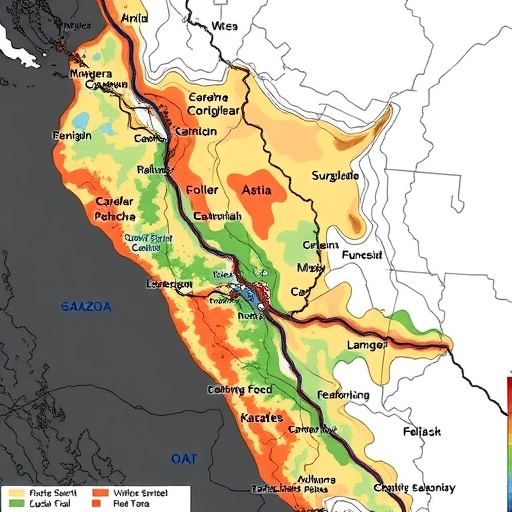
In recent advancements within the field of geology and resource management, researchers have shifted their focus to the intricate world of organic facies distribution, particularly in coal-bearing source rocks. A notable contribution to this realm is the work conducted by Wang et al., who have meticulously explored the Jurassic coal-bearing rocks located in the Junggar Basin. Their study delves deep into predictive modeling, harnessing sophisticated techniques to enhance our understanding of these deposits’ spatial characteristics and organic content, which are crucial for energy resource generation and environmental management.
The Jurassic period, a pivotal time in Earth’s history, is renowned for its rich coal deposits, largely found in sedimentary basins worldwide. The Junggar Basin, situated in northwestern China, is home to some of the most significant coal reserves in the region, making it an essential area for energy production. The researchers employed a combination of Particle Swarm Optimization (PSO) and eXtreme Gradient Boosting (XGBoost) to predict the distribution of organic facies, which refers to the varying types of organic matter that contribute to coal formation. This approach not only enhances accuracy in predictions but also offers insights into the geological processes that govern these facies’ distribution.
PSO is a computational method inspired by social behavior of birds and fish. It proves particularly effective in optimizing complex functions in high-dimensional space. In the context of Wang et al.’s research, PSO was utilized to fine-tune the parameters of the XGBoost model, which is renowned for its rapid performance and robust predictive capabilities. By implementing this hybrid technique, the team managed to significantly improve their predictions, reflecting a deeper understanding of the geological factors influencing organic matter accumulation.
XGBoost operates through a gradient boosting framework, where weak learners are sequentially added to minimize errors from previous models. This method not only aids in dealing with diverse data types but also excels in managing large datasets common in geological studies. As coal distribution can be influenced by a myriad of factors such as sedimentation rates, organic matter input, and diagenetic processes, employing a machine learning approach like XGBoost allows researchers to robustly model these complex relationships.
The study conducted by Wang and colleagues represents more than just a mathematical exercise; it underscores the importance of integrating machine learning techniques with traditional geological practices. The findings have the potential to revolutionize how geologists view organic facies distribution. By moving beyond heuristic methods, which have traditionally guided explorations and predictions, researchers can now employ quantitative models that yield not only predictions but also insights into the underlying mechanisms of coal formation.
Moreover, the implications of this research extend beyond academic curiosity. As nations worldwide strive for energy independence and sustainability, understanding the distribution and quality of coal deposits becomes imperative. This study serves as a crucial tool for resource managers and policymakers who need precise data to make informed decisions regarding coal extraction and utilization. The insights gained from their models can significantly influence exploration strategies, leading to more efficient resource management.
In addition to energy resource management, the methodology outlined in this study holds valuable potential for environmental assessments. Understanding the distribution of organic facies can aid in identifying areas at risk of environmental degradation due to mining activities. This knowledge arms environmental scientists with the information needed to advocate for sustainable practices, ensuring that natural ecosystems are conserved while meeting energy demands.
Critically, the work by Wang et al. not only sheds light on the complexities of organic facies distribution but also serves as a call to action for further research in this area. The awareness that remains to be uncovered concerning coal-bearing formations could lead to innovative solutions for energy challenges facing nations today. The integration of advanced machine learning techniques with traditional geological research hints at a future where predictive models can aid in discovering new reserves, thus extending the lifecycle of fossil fuels responsibly.
The research findings also highlight the importance of interdisciplinary collaborations, combining insights from geology, data science, and machine learning. Future geological explorations may benefit from such collaborative approaches, where varying academic disciplines intersect to solve pressing resource allocation problems. As traditional methodologies evolve, so too must the academic framework supporting them, encouraging future researchers to adopt these novel techniques.
As we look ahead, the outcomes of this study beckon a deeper inquiry into other similar geological settings. The methodologies employed by Wang et al. can be replicated in different sedimentary basins worldwide; thus, promoting a global strategy for managing coal resources. By extending these predictive models across various geological contexts, we can build a comprehensive understanding of global coal distributions and their associated risks and opportunities.
In conclusion, the pioneering research by Wang et al. marks a significant step forward in the field of organic facies distribution in coal-bearing source rocks. With their innovative fusion of PSO and XGBoost techniques, they have set a precedent for geologists and resource managers alike. Their findings underscore the critical balance between energy resource extraction and sustainable environmental practices. As the global community increasingly turns towards data-driven solutions, this research could serve as a model for future explorations that prioritize both efficiency and ecological stewardship.
As we further explore the intersections of geology and machine learning, it is clear that we stand on the precipice of a new era in resource management. The tools developed by Wang and colleagues provide not just a method for prediction but a pathway to a more comprehensive understanding of the Earth’s fossil fuel resources. These insights will be instrumental in shaping the future of energy policy and environmental stewardship.
Cite Scienmag News
Violet Maxwell. (February 1, 2026). Optimizing Organic Facies Distribution in Jurassic Coal. Scienmag. https://scienmag.com/optimizing-organic-facies-distribution-in-jurassic-coal/
Violet Maxwell. "Optimizing Organic Facies Distribution in Jurassic Coal." Scienmag, 1 February 2026, https://scienmag.com/optimizing-organic-facies-distribution-in-jurassic-coal/. Accessed 4 September 2026.
Violet Maxwell. "Optimizing Organic Facies Distribution in Jurassic Coal." Scienmag. February 1, 2026. https://scienmag.com/optimizing-organic-facies-distribution-in-jurassic-coal/


