


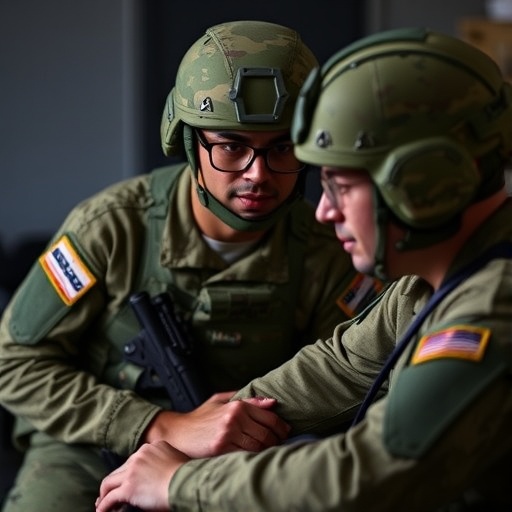
In recent years, the mental health of military personnel has gained significant attention, with research focusing on innovative interventions to improve emotional regulation and overall well-being. A groundbreaking study conducted by Cheng, C., Li, Y., and Lv, W. sheds light on a novel dual pathway intervention that combines transcranial electrical stimulation (tES) with fecal microbiota transplantation (FMT). This promising approach aims to enhance emotional regulation among stressed military personnel, a group often exposed to high-stress environments and trauma.
The study highlights the impact of psychological stress on military individuals, who are frequently subjected to overwhelming situations that require quick, effective emotional responses. The ability to manage these emotions is crucial, not just for personal well-being, but also for operational effectiveness. With increasing incidences of post-traumatic stress disorder (PTSD) and anxiety-related conditions, the search for effective treatments has never been more critical. Cheng and colleagues’ research offers a novel perspective on addressing these challenges through alternative therapeutic interventions.
Transcranial electrical stimulation (tES) represents an innovative approach by inducing electrical currents within the brain to modulate neural activity. This non-invasive technique has been researched for its potential to enhance cognitive functions and emotional regulation. By targeting specific areas of the brain associated with mood and emotional responses, tES can provide a form of neural recalibration. The researchers aimed to explore how tES, when combined with FMT, could yield synergistic effects on improving emotional resilience among military personnel.
Fecal microbiota transplantation (FMT) has garnered attention for its role in impacting mental health, particularly through the gut-brain axis. This connection suggests that the composition of gut microbiota can influence brain function and emotional responses. Military personnel often experience significant changes in their gut microbiota due to stress, poor diet, and lifestyle changes. By restoring a healthier gut microbiome through FMT, the researchers postulate that there may be an improvement in emotional regulation and resilience against stress.
Through rigorous testing and an extensive experimental design, the study recruited participants from military backgrounds, who exhibited signs of emotional distress or dysfunction. Participants underwent a comprehensive screening to ensure eligibility, allowing researchers to isolate the effects of the combined intervention. Each participant received personalized treatment regimens, highlighting the need for individualized approaches in mental health interventions.
The combined intervention of tES and FMT was delivered over several weeks, with participants receiving sessions of tES paired with FMT at strategically timed intervals. The researchers documented changes in participants’ emotional states, such as mood swings, anxiety levels, and overall psychological well-being. Utilizing validated psychological assessments allowed them to gauge the effectiveness of the intervention accurately.
Results indicated a statistically significant improvement in emotional regulation among those who underwent the dual pathway intervention compared to control groups. Participants reported feeling less affected by stressors and an overall enhancement in mood stability. These findings suggest that combining neurological modulation with microbiome restoration can dramatically improve emotional responses, providing evidence for the efficacy of this innovative approach.
Furthermore, the study revealed fascinating insights into the underlying mechanisms through which this intervention operates. By analyzing brain imaging data, researchers observed alterations in neural pathways associated with emotional processing. Alongside these neurological changes, shifts in gut microbiota composition were also documented, correlating with improvements in emotional regulation. These results form a compelling narrative about the interplay between brain health and gut health, underscoring the need for multidisciplinary approaches in psychological care.
Cheng and colleagues’ study extends beyond mere academic exploration; it raises critical questions about future treatment avenues for military personnel suffering from emotional and psychological disturbances. The findings suggest the potential for personalized medicine, wherein treatment can be tailored to individual biological and psychological profiles. This personalized approach is paramount in addressing the intricate challenges faced by military insiders, who often encounter a complex interplay of stressors.
Attention now turns to the implications of scaling this dual intervention approach within military healthcare systems. If proven cost-effective and efficient, adopting such treatments could revolutionize mental health protocols for military personnel. Implementing tES and FMT as standard interventions may empower individuals to regain control over their emotional health, promoting resilience during challenging times. This potential reform in mental health treatment aligns with the growing trend of integrating emerging neuroscience with holistic approaches to welfare.
As the military grapples with the psychological aftermath of service—whether in combat zones or through other high-stress environments—investigating new methods of support remains imperative. The groundbreaking intervention posed by Cheng and colleagues signals a shift toward embracing innovative, interdisciplinary strategies to nurture well-being within this community. Ultimately, fostering emotional resilience through such integrative approaches can significantly contribute to improving the overall quality of life for service members.
In conclusion, the research led by Cheng, C., Li, Y., Lv, W. emphasizes a vital evolution in how we perceive and address the mental health needs of military personnel. By marrying tES with FMT, this study not only presents a groundbreaking intervention but opens the door to further exploration into the connections between the brain and gut health. As the world anticipates the broader application of these findings, the military community stands poised for a transformative shift in mental health care, driven by research and innovation.
This study, slated for publication in “Discover Mental Health” in 2026, invites further exploration and discussion in the scientific community and military healthcare frameworks. As we unravel more about the intricacies of psychological wellness through research, we edge closer to developing effective, supportive interventions that can make a profound difference in the lives of those who serve.
Cheng, C., Li, Y., Lv, W. et al. A dual pathway intervention of tES and FMT enhances emotion regulation in stressed military personnel.
Discov Ment Health (2026). https://doi.org/10.1007/s44192-026-00375-x
Cite Scienmag News
Glenn Wilkins. (January 31, 2026). tES and FMT Boost Emotion Regulation in Soldiers. Scienmag. https://scienmag.com/tes-and-fmt-boost-emotion-regulation-in-soldiers/
Glenn Wilkins. "tES and FMT Boost Emotion Regulation in Soldiers." Scienmag, 31 January 2026, https://scienmag.com/tes-and-fmt-boost-emotion-regulation-in-soldiers/. Accessed 5 September 2026.
Glenn Wilkins. "tES and FMT Boost Emotion Regulation in Soldiers." Scienmag. January 31, 2026. https://scienmag.com/tes-and-fmt-boost-emotion-regulation-in-soldiers/


