


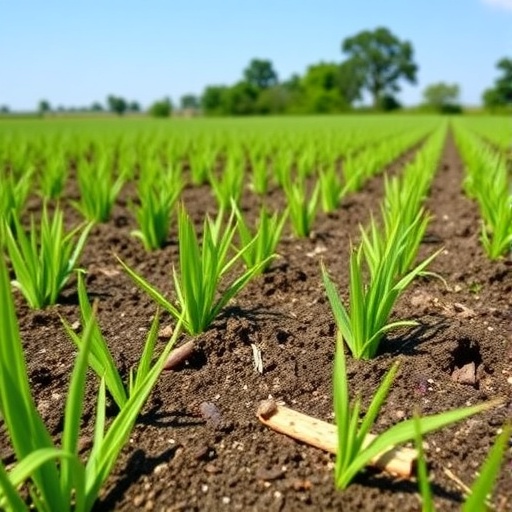
In a groundbreaking advancement for sustainable agriculture, researchers have uncovered a molecular mechanism through which rice plants orchestrate the assembly of their rhizosphere microbiome to optimize organic nitrogen acquisition. This discovery revolves around the natural genetic variation of the Lysine-Histidine-Type Transporter-1 (OsLHT1) gene in rice, specifically contrasting between the japonica and indica subspecies. Amino acids, which serve as a crucial form of organic nitrogen in soils, are directly absorbable by plants but rely heavily on microbial breakdown of organic matter in the rhizosphere—the dynamic soil environment immediately surrounding roots. The newly reported study elucidates how the OsLHT1a allele, predominantly found in japonica rice, fosters a beneficial microbial community that bolsters amino acid availability and uptake, thereby enhancing nutrient efficiency and crop yield.
The intricate soil-plant-microbe interactions have long intrigued scientists interested in nutrient cycling and plant nutrition, but the specifics of how plant genetics influence microbiome assembly remain poorly understood. This research bridges that knowledge gap by demonstrating a direct genetic link between OsLHT1 variants and rhizosphere microbial composition. Notably, the OsLHT1a protein variant not only enhances amino acid transport at the root but also drives selective recruitment of a microbiota conducive to organic matter decomposition, creating a positive feedback loop that significantly improves organic nitrogen use under certain soil nutrient regimes.
Central to this discovery is the concept that amino acids in the soil are a vital but often underappreciated source of nitrogen for plants. While mineral nitrogen forms such as nitrate and ammonium dominate conventional fertilization strategies, organic nitrogen compounds like amino acids offer key benefits in sustainability and resource efficiency. The absorption of amino acids by plant roots depends on transport proteins such as OsLHT1. Strikingly, the natural variation of this transporter gene between japonica and indica rice varieties affects not only amino acid uptake capacity but also how roots influence microbial community assembly, suggesting an evolutionary adaptation to differing soil environments.
Through comprehensive field sampling and molecular analyses, the researchers pinpointed that the OsLHT1a allele is predominantly present in japonica rice cultivated in soils rich in organic nitrogen. This geographic and ecological distribution hints at a selective advantage conferred by OsLHT1a in organic-rich soil habitats. Functional assays revealed that this allele enhances root uptake of amino acids directly, streamlining nitrogen assimilation. Crucially, however, the OsLHT1a allele also modulates rhizosphere microbial communities, favoring bacteria that are efficient decomposers of soil organic matter and prolific producers of amino acids, thus replenishing the amino acid pool available to the plant.
To dissect the causal relationship between plant genotype and microbiome composition, the study introduced a synthetic microbiota composed of bacteria enriched by OsLHT1a in japonica rhizospheres. When this synthetic community was inoculated into soil, it significantly stimulated soil organic nitrogen mineralization and amino acid production. Concurrently, it amplified the expression of OsLHT1 in plant roots, creating a synergistic loop where plants and microbes mutually reinforced each other’s functions. This synergism ultimately led to increased amino acid uptake by rice roots, demonstrating a novel mode of functional integration between plant genetic traits and soil microbiota.
Interestingly, the synthetic microbiota’s successful colonization of the rice rhizosphere was shown to be dependent on the functional activity of OsLHT1. Experiments involving plants with mutant or silenced OsLHT1 genes failed to sustain the enriched microbial consortium. This finding confirms that the transporter gene itself—and not merely plant root exudates or other indirect factors—is a critical determinant of microbial recruitment. Thus, OsLHT1 acts as a molecular hub coordinating both nutrient uptake and rhizosphere microbial community assembly, highlighting the sophisticated level of interplay between plant genes and soil microbes.
The study also demonstrated that the presence of organic fertilizers markedly enhances the effectiveness of this plant-microbe interaction. Organic amendments increase organic nitrogen pools in the soil, which in turn promote colonization by the amino acid-producer microbiota linked to OsLHT1a. This organic fertilizer-driven enhancement not only improved rice’s organic nitrogen use efficiency but also led to increases in grain yield. These results underscore the practical agricultural implications and offer a promising strategy to reduce reliance on synthetic nitrogen fertilizers, which are energetically costly and environmentally damaging.
This research opens exciting avenues for leveraging natural genetic variation in crops to engineer rhizosphere microbiomes tailored for improved nutrient utilization. By harnessing OsLHT1-mediated microbiota assembly, breeders and agronomists might enhance organic nitrogen cycling in soils, reduce fertilizer inputs, and improve crop resilience sustainably. The idea that a single transport gene can mediate such complex ecological interactions represents a paradigm shift in understanding plant nutrition beyond classical nutrient transport pathways.
Mechanistically, the OsLHT1 transporter belongs to a family of amino acid transporters responsible for importing various amino acids into root cells. The OsLHT1a variant differs from the indica allele in key protein domains that presumably increase affinity or expression levels, thereby intensifying root amino acid uptake. This enhanced uptake likely alters the root exudation profile and soil microenvironment, creating niche conditions that favor beneficial microbial taxa specialized in degrading organic matter and producing amino acids from complex polymers.
The recruitment of such a targeted microbiome implies that plants actively sculpt their rhizosphere to meet nutritional demands, contradicting earlier views of soil microbes as passive participants. Instead, intimate genetic control over microbial community structure enables plants to tap into organic nitrogen pools otherwise inaccessible. This represent a sophisticated nutrient acquisition strategy integrated across molecular, organismal, and ecosystem levels.
In the context of global agriculture’s urgent need to balance productivity with environmental sustainability, this discovery is especially timely. Conventional nitrogen fertilizers are not only expensive but also lead to nitrogen losses through leaching and emissions of nitrous oxide, a potent greenhouse gas. By optimizing organic nitrogen use through natural plant-microbe partnerships, farmers can potentially reduce fertilizer inputs while maintaining or increasing yields, benefiting both economic and environmental outcomes.
Beyond rice, the implications may extend to other staple crops that harbor amino acid transporter gene variants with similar rhizosphere modulation capacities. Future research could explore gene editing or conventional breeding approaches to introduce beneficial transporter alleles into diverse crop varieties adapted to organic nutrient-rich soils. Additionally, tailored microbial inoculants that synergize with specific plant genotypes might catalyze advances in rhizosphere engineering.
This study exemplifies the power of integrating molecular genetics, soil microbiology, and plant physiology to unravel complex belowground interactions. It highlights the necessity of holistic approaches that consider genetic determinants of plant traits alongside dynamic microbial ecosystems. Such integrative frameworks are essential for unlocking the full potential of microbiomes in sustainable food production.
Ultimately, the findings shed new light on the evolutionary adaptations of rice to different agroecological niches. The OsLHT1a allele not only promotes direct nutrient uptake efficiency but also shapes a microbial community that can augment nutrient availability, representing a duality of function that has likely contributed to japonica rice’s success in organic-rich environments. This insight enriches our understanding of plant-microbe co-evolution and offers a template for rational microbiome design strategies.
In conclusion, the identification of OsLHT1-mediated rhizosphere microbiome assembly as a key determinant in organic nitrogen acquisition marks a milestone in plant nutrition science. The elucidation of this root-microbe communication axis reveals novel targets for breeding and management practices aimed at enhancing organic fertilizer usage efficiency. As agriculture strives to meet global food demands sustainably, exploiting such natural plant genetic variations coupled with microbiome manipulation signals a promising frontier in ecological intensification.
Cite Scienmag News
Alan Morgan. (January 30, 2026). Amino Acid Transporters Boost Rice Soil Nitrogen Uptake. Scienmag. https://scienmag.com/amino-acid-transporters-boost-rice-soil-nitrogen-uptake/
Alan Morgan. "Amino Acid Transporters Boost Rice Soil Nitrogen Uptake." Scienmag, 30 January 2026, https://scienmag.com/amino-acid-transporters-boost-rice-soil-nitrogen-uptake/. Accessed 3 September 2026.
Alan Morgan. "Amino Acid Transporters Boost Rice Soil Nitrogen Uptake." Scienmag. January 30, 2026. https://scienmag.com/amino-acid-transporters-boost-rice-soil-nitrogen-uptake/


