


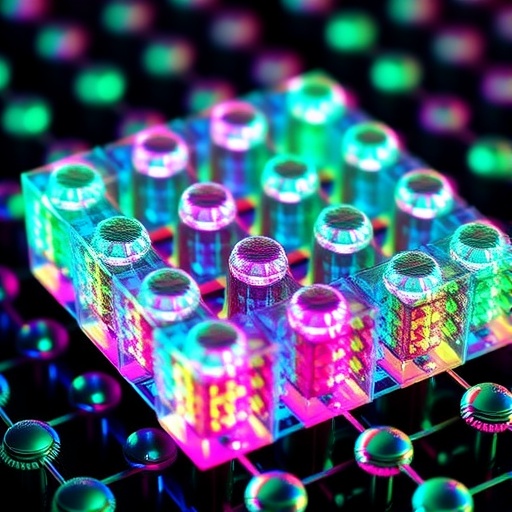
In the relentless pursuit of sustainable energy solutions, the direct conversion of sunlight and water into clean hydrogen has long been heralded as a transformative technology capable of underpinning a carbon-neutral future. Despite the promise, the widespread deployment of solar-driven water splitting technologies has been hampered by the notoriously low efficiency of photocatalysts, primarily due to the rapid recombination and inefficient utilization of photogenerated charge carriers. In a groundbreaking development, researchers have introduced excitonic quantum superlattice structures composed of nanometre-scale gallium nitride (GaN) and indium gallium nitride (InGaN), heralding a new era of enhanced photocatalytic efficiency and charge management.
This novel architecture capitalizes on the unique physical phenomena inherent to excitons — bound states of electrons and holes held together by Coulombic attraction — which can be manipulated within quantum-confined materials to extend their lifetimes and enhance their spatial separation. The team’s strategic layering of GaN and InGaN at the nanoscale forms a quantum superlattice, where the photogenerated indirect excitons demonstrate a remarkably prolonged existence. This extension, facilitated by the quantum-confined Stark effect, provides a temporal window during which charge carriers can effectively participate in crucial surface redox reactions involved in overall water splitting.
The quantum-confined Stark effect, a fundamental phenomenon in semiconductor physics, arises from the application of an internal electric field within quantum well structures, leading to spatial separation of electron and hole wavefunctions. By carefully engineering these internal fields in the GaN/InGaN superlattice, the researchers achieved a profound enhancement in exciton lifetimes, mitigating the otherwise rapid recombination losses that plague conventional photocatalysts. This manipulation ensures that photogenerated charge carriers are kinetically preserved, enabling efficient charge steering towards the catalytic sites on the surface.
Under ambient environmental conditions combined with concentrated solar irradiation, the system exhibited a solar-to-hydrogen (STH) efficiency reaching an impressive 3.16%. This figure is particularly notable given that it extends the photocatalytic activity well into the visible spectrum of sunlight, a critical attribute for practical utilization given the sun’s spectral distribution. The broad spectral response enables the harnessing of a greater fraction of incident solar energy, thereby improving the overall energy conversion efficiency.
Beyond laboratory-scale achievements, the technology demonstrated robust scalability with outdoor tests showing an average STH efficiency of 1.64% under sunlight concentrated to 204 times natural intensity. This significant demonstration under real-world conditions underscores the potential of GaN/InGaN quantum superlattices as viable candidates for large-scale hydrogen production, addressing concerns about the transition from experimental setups toward industrially relevant applications.
The foundational principle behind this breakthrough lies in tackling one of the fundamental bottlenecks in photocatalysis: the fleeting lifetime and rapid recombination of charge carriers. Traditional semiconductor photocatalysts often fail to sustain spatial charge separation long enough for water-splitting reactions to occur efficiently, which drastically limits their quantum efficiency. By leveraging excitonic effects and nanostructure engineering within these quantum superlattices, the researchers provide a pathway to manage and extend the life cycle of these charge carriers, thus unlocking their catalytic potential.
Gallium nitride, with its wide bandgap and excellent thermal stability, synergizes effectively with indium gallium nitride, a tunable semiconductor whose bandgap can be adjusted by controlling indium composition. This tunability enables the quantum superlattice to absorb a broader section of the solar spectrum, which is crucial for harnessing visible light that makes up the majority of solar energy reaching Earth’s surface. The nanometre-scale layering ensures quantum mechanical effects dominate, providing discrete energy states and enabling precise control over exciton dynamics.
This research not only advances the scientific understanding of excitonic behavior in engineered superlattices but also provides an innovative platform for the design of next-generation photocatalysts. The demonstrated influence of the quantum-confined Stark effect in modulating exciton lifetime invites further exploration into manipulating internal electric fields as a tool for enhancing photocatalytic performance, potentially applying such concepts to other materials systems and solar conversion processes.
The team’s work sets a new benchmark by effectively bridging fundamental quantum physics with pragmatic solar fuel generation—a union that speaks to the power of interdisciplinary approaches in addressing global energy challenges. By guiding photogenerated charges precisely where they are needed for catalytic action, this method mitigates energy losses and elevates the solar-to-hydrogen conversion efficiency beyond previous limits.
Importantly, the approach maintains high stability and performance under prolonged exposure to ambient outdoor conditions and intense concentrated sunlight. Stability is a crucial criterion for hydrogen production systems envisioned for real-world deployment, where persistent exposure to varying environmental factors tends to degrade conventional photocatalysts quickly.
Looking forward, the integration of excitonic quantum superlattice photocatalysts could revitalize the hydrogen economy by providing a scalable, efficient, and sustainable route to solar hydrogen. The ability to modulate electronic and excitonic properties within these well-defined nanostructures promises exciting opportunities for further enhancement via materials chemistry, quantum engineering, and surface catalysis.
As renewable energy landscapes continue to evolve, innovations such as these exemplify how fundamental physics can be harnessed to overcome longstanding technological barriers. The unusually long-lived indirect excitons engineered in GaN/InGaN quantum well superlattices showcase the potential for quantum design principles to elevate photocatalytic water splitting, potentially culminating in cost-effective and high-output hydrogen production systems.
With this discovery, the pathway toward green hydrogen as a major energy vector becomes clearer and more tangible. The researchers’ scale-up demonstrations reinforce the economic viability and industrial relevance, marking an important milestone in the global transition toward climate-friendly fuels and energy independence.
This landmark research not only redefines photocatalytic efficiency concepts but also underscores the immense potential of nanostructured excitonic materials for tackling climate change. By delivering a versatile and high-performance platform, it reinvigorates hopes for clean hydrogen fuel as a cornerstone for future sustainable energy frameworks, showcasing a union of quantum science and environmental stewardship.
Cite Scienmag News
Katie Riggs. (January 30, 2026). Excitonic Superlattices Boost Photocatalytic Water Splitting. Scienmag. https://scienmag.com/excitonic-superlattices-boost-photocatalytic-water-splitting/
Katie Riggs. "Excitonic Superlattices Boost Photocatalytic Water Splitting." Scienmag, 30 January 2026, https://scienmag.com/excitonic-superlattices-boost-photocatalytic-water-splitting/. Accessed 4 September 2026.
Katie Riggs. "Excitonic Superlattices Boost Photocatalytic Water Splitting." Scienmag. January 30, 2026. https://scienmag.com/excitonic-superlattices-boost-photocatalytic-water-splitting/


