


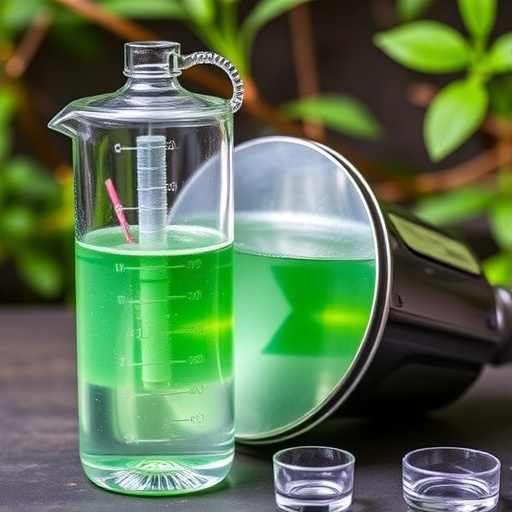
In an effort to tackle the pervasive issue of volatile organic compounds (VOCs) in industrial applications, researchers are exploring innovative methods for gaseous chlorobenzene removal. Recent findings from a study led by Chen et al. have shed light on the effectiveness of modified packings in conjunction with a magnetic field within a biotrickling filter, paving the way for potentially groundbreaking advancements in environmental remediation technologies.
Chlorobenzene, a commonly used solvent in the manufacturing sector, poses significant health risks due to its associated toxicity and environmental persistence. The need for efficient methods of removal has never been more urgent, as the release of such compounds can lead to severe consequences for air quality and public health. The study highlights the advances made in biotechnological approaches to mitigate this issue, showcasing the application of magnetically enhanced microbial activity in biotrickling filters.
Utilizing biotrickling filters is not a new concept; however, elevating this technology with enhanced packing materials and external magnetic fields is a novel step forward. The research reveals how these modified packings improve the contact between microbes and the target pollutant, leading to a more efficient degradation process. By increasing the surface area available for microbial colonization, the study demonstrates that the efficiency of chlorobenzene removal can be significantly amplified.
The introduction of a magnetic field plays a crucial role in this innovative approach. Magnetic fields can influence microbial behavior and enhance metabolic processes within biofilms that develop on the packing materials. This provides a synergistic effect, where the magnetic field not only supports microbial growth but also catalyzes the degradation of chlorobenzene through advanced bio-remedial mechanisms. Understanding these intricate interactions is essential for optimizing the use of biotrickling filters in practical applications.
The results of the study are compelling. Through the use of modified packings and a precisely calibrated magnetic field, the research team reported remarkable increases in chlorobenzene removal rates. Their experimental setup demonstrated a marked improvement over traditional biotrickling methods, confirming that alterations in physical packing structures can profoundly benefit microbial efficiency. Notably, this enhancement offers a dual advantage: it not only expedites the removal process but also reduces the overall footprint of the biotreatment system.
Moreover, the implications of these findings extend beyond just chlorobenzene removal. The methodologies developed in this study could be adapted to address other pollutants that present similar challenges, potentially revolutionizing how industries approach VOC management. This adaptability underscores the potential for widespread applicability within various sectors, including petrochemicals and pharmaceuticals, where chlorobenzene and similar compounds are prevalent.
The microbial mechanisms that underpin this enhanced performance also warrant attention. Detailed investigations into the metabolic pathways activated under strong magnetic fields revealed a notable acceleration in the biodegradation processes. Understanding these pathways offers invaluable insights into optimizing bioremediation technologies, guiding future research toward the development of even more potent environmental cleanup strategies.
Furthermore, the results observed in this study provide a foundational basis for scaling the technology for real-world applications. With regulatory pressures increasing for industries to minimize emissions and waste, this novel technique aligns perfectly with global sustainability goals. As companies strive to comply with stricter environmental standards, innovations like the one presented by Chen and colleagues represent not just scientific progress, but also a roadmap for industry adaptation.
The collaboration between researchers and industry is crucial in bringing these laboratory findings into practice. Future studies should focus on pilot projects to test the viability of such biotrickling filter systems in diverse operational environments, establishing benchmarks for performance against existing technologies. This progression from research to application requires careful consideration of factors such as cost, ease of integration, and long-term sustainability.
In addition to industrial applications, the implications of this study reach public health and safety domains. As VOCs like chlorobenzene remain a concern for air quality, the effectiveness of these innovative solutions could lead to healthier living environments, ultimately contributing to broader public health benefits. The intersection of science, technology, and public health underscores the importance of continued investment in environmental research.
In conclusion, Chen et al.’s exploration into enhanced gaseous chlorobenzene removal using modified packings and magnetic fields within a biotrickling filter represents a significant advancement in environmental engineering. The potential to revolutionize air quality management and reduce toxic emissions heralds a futuristic approach to addressing industrial pollution, setting a precedent for further innovations in the field.
Researchers are optimistic that with increased funding and collaboration, the findings will inspire further developments in bioremediation sciences. The overarching goal is to create more efficient systems that can cope with complex and variable pollutant scenarios, setting high standards for environmental sustainability. Overall, this pioneering study stands as a beacon of hope for scientists dedicated to making our planet safer and cleaner.
Chen, D., Qiu, J., Meng, C. et al. Enhanced gaseous chlorobenzene removal and its microbial mechanism through innovative modified packings coupled with magnetic field in a biotrickling filter. Front. Environ. Sci. Eng. 19, 152 (2025). https://doi.org/10.1007/s11783-025-2072-x
Cite Scienmag News
Violet Maxwell. (January 29, 2026). Boosted Chlorobenzene Removal via Magnetic Biotrickling Filter. Scienmag. https://scienmag.com/boosted-chlorobenzene-removal-via-magnetic-biotrickling-filter/
Violet Maxwell. "Boosted Chlorobenzene Removal via Magnetic Biotrickling Filter." Scienmag, 29 January 2026, https://scienmag.com/boosted-chlorobenzene-removal-via-magnetic-biotrickling-filter/. Accessed 5 September 2026.
Violet Maxwell. "Boosted Chlorobenzene Removal via Magnetic Biotrickling Filter." Scienmag. January 29, 2026. https://scienmag.com/boosted-chlorobenzene-removal-via-magnetic-biotrickling-filter/


