


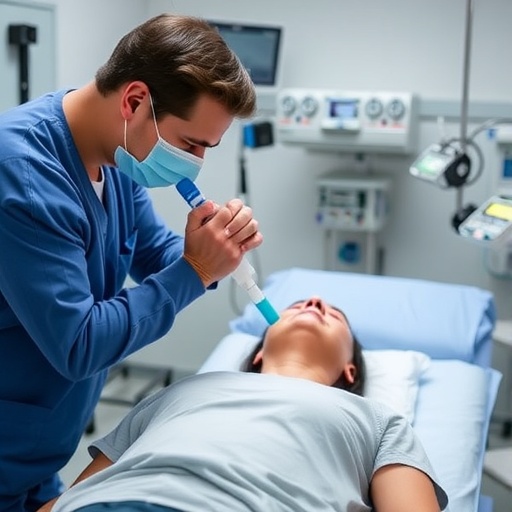
In a rapidly evolving medical landscape, maintaining the competence of healthcare professionals in advanced airway management techniques is of paramount importance. A recent study by Stochlinski and colleagues offers new insights into the effectiveness of simulation training for skill retention in this critical area. This randomized prospective study, published in BMC Medical Education, aims to address a crucial question: How well do clinicians retain the skills learned during simulation training for advanced airway techniques over time?
This investigation stems from the recognition that effective airway management is a life-saving intervention, yet previous studies have raised concerns about the retention of these vital skills post-training. Given how quickly techniques and technologies evolve, physicians often find themselves with too much theoretical knowledge, which can dissipate without routine practical application. Simulation training provides a structured environment to practice these skills, yet its long-term effectiveness remains inadequately explored in the literature.
The researchers enrolled a diverse group of medical professionals, including residents and attending physicians, to participate in the study. Participants underwent a standardized simulation training program designed to enhance their competence in advanced airway management, encompassing techniques such as endotracheal intubation, bag-mask ventilation, and the use of supraglottic airway devices. A well-structured protocol ensured that participants not only learned these techniques but also developed critical decision-making skills regarding airway management.
Following the simulation training, the researchers assessed skill retention at multiple time points. The assessments were designed to simulate real-world scenarios under controlled conditions, enabling precise measurement of both technical skill and decision-making abilities. By employing objective assessment tools, the investigators aimed to capture nuanced data on participant performance, providing a clearer picture of how well these skills translate to clinical practice.
One of the notable findings from this study was that skill retention significantly varied among different techniques. While some participants demonstrated competency in fundamental skills up to six months following training, others exhibited a decline in performance over time, particularly in more complex maneuvers. The researchers theorized that the intricacies of certain techniques may contribute to a steeper learning curve, thus impacting long-term retention.
The study also emphasized the need for continuous education and practice beyond initial simulation training. It showed that healthcare professionals benefit from recurrent practice sessions, offering an opportunity to reinforce skills and enhance confidence. This reinforcements of practical skills can significantly bridge the gap between theoretical knowledge and real-world application, ultimately improving patient outcomes.
Furthermore, the research team highlighted how technology could aid in skill retention. Innovations in simulation technology and virtual reality could play a pivotal role in allowing clinicians to engage in self-directed learning. These tools provide immersive experiences, fostering an environment conducive to skill refinement even in the absence of direct supervision, thereby promoting a culture of continuous learning.
Results from this study have the potential to influence how medical educators design curricula for airway management training. Institutions may rethink their approaches, incorporating periodic refresher courses and integrating advanced simulation technologies to ensure that essential skills are retained throughout a clinician’s career. These adaptations could enhance the overall caliber of healthcare professionals and ultimately lead to improved patient safety.
In addition, the implications of this research extend beyond the confines of individual training programs. They underscore the critical nature of medical education reform and the necessity for a shift toward evidence-based training curricula. As healthcare continues to evolve, understanding the dynamics of skill retention will become increasingly important for maintaining a competent and confident workforce.
Ultimately, Stochlinski and colleagues’ study serves as a timely reminder of the importance of both initial training and continuous skill reinforcement. The findings expose vulnerabilities in traditional training paradigms and emphasize the need for integrated strategies that prioritize skill retention across a medical professional’s career. Policymakers and educators should heed this call to action as they strive to deliver the highest standards of care in an era marked by rapid medical advancements.
This research lays the groundwork for future studies that can further dissect the variables influencing skill retention. By identifying which factors contribute to a decline in performance and why some techniques are more challenging to retain than others, the medical community will be better equipped to formulate solutions. Understanding the cognitive and psychomotor elements that play a role in skill retention could lead to more tailored educational interventions.
In conclusion, as the medical community continues to grapple with issues of skill retention in advanced airway management, studies like this one shine a light on the importance of comprehensive simulation training and its impact on clinicians’ abilities to deliver safe and effective care. With the stakes as high as they are in emergency medicine, addressing these complexities becomes not just a matter of educational efficiency but a fundamental aspect of patient safety and healthcare quality.
Medical institutions are thus urged to carefully consider these findings and adapt their training methodologies to ensure both new and seasoned practitioners maintain their proficiency in essential life-saving techniques. The effective integration of training programs with periodic evaluations and skill refreshers could bridge the current gaps, equipping healthcare professionals with the tools necessary to navigate the demands of their critical roles.
Cite Scienmag News
Courtney Benton. (January 28, 2026). Assessing Advanced Airway Skills Retention Post-Simulation. Scienmag. https://scienmag.com/assessing-advanced-airway-skills-retention-post-simulation/
Courtney Benton. "Assessing Advanced Airway Skills Retention Post-Simulation." Scienmag, 28 January 2026, https://scienmag.com/assessing-advanced-airway-skills-retention-post-simulation/. Accessed 3 September 2026.
Courtney Benton. "Assessing Advanced Airway Skills Retention Post-Simulation." Scienmag. January 28, 2026. https://scienmag.com/assessing-advanced-airway-skills-retention-post-simulation/


