


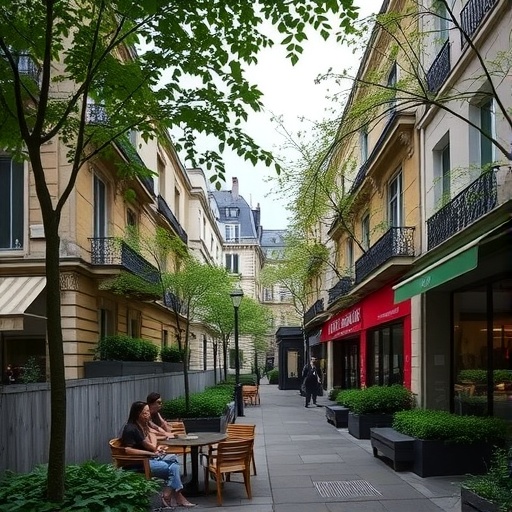
In the face of escalating climate change and urbanization, heat waves have emerged as one of the most deadly environmental hazards for metropolitan populations. Recent research published in npj Urban Sustainability brings forward compelling evidence that urban greening—the strategic incorporation of vegetation in city landscapes—plays a crucial role in mitigating heat-related mortality, particularly in the sprawling and densely populated city of Paris. This study offers a groundbreaking perspective on how green infrastructure can serve as an essential public health tool, fundamentally reshaping urban design in an era of increasing thermal stress.
Heat-related mortality, driven by prolonged exposure to high temperatures, has risen dramatically worldwide. Cities, with their extensive concrete and asphalt surfaces, exacerbate this problem through what is known as the urban heat island effect. This phenomenon causes urban areas to become significantly warmer than their rural surroundings, leading to elevated risks of heat strokes, cardiovascular stress, and respiratory problems, especially among vulnerable populations such as the elderly and those with pre-existing conditions. The research team, led by experts Achebak, Masselot, and Ballester, meticulously analyzed the impact of greening interventions on reducing these risks in Paris, a city notorious for its heat waves and crowded urban environment.
The study’s methodology combined high-resolution temperature data, mortality records, and detailed urban green space mapping to establish correlations between greening and heat-related fatalities. Researchers utilized satellite imagery alongside ground-based temperature measurements, enabling them to accurately capture localized thermal variations across Paris. The study also incorporated demographic data to assess the disparity in heat vulnerability, paying special attention to socioeconomic factors that often compound health risks during heat waves. Their multi-dimensional approach sets a new standard in urban climate health research by integrating environmental, social, and epidemiological data streams.
One of the most striking findings from the study is that neighborhoods with higher tree canopy coverage and increased presence of parks experienced significantly fewer heat-related deaths compared to less vegetated areas. This finding underscores the protective microclimate created by urban vegetation, which can cool surrounding air temperatures by several degrees Celsius. Urban trees and parks not only provide shade and evapotranspiration cooling but also help reduce the thermal load on surrounding buildings, thereby decreasing indoor temperatures and reducing the stress on air conditioning systems. This multifaceted cooling effect directly translates into saving lives during extreme heat events.
The researchers further highlight the importance of strategic planning and distribution of green spaces within the urban fabric. Their data suggest that equitable access to green infrastructure can reduce health disparities by offering protection to populations in heat-vulnerable neighborhoods, often characterized by lower income and limited resources. This pattern of spatial inequality in heat exposure and health outcomes is a growing concern globally. Therefore, urban policy makers are encouraged to prioritize greening projects in these high-risk zones to maximize public health benefits, an approach that could serve as a model for many cities confronting similar climate challenges.
The implications of this research extend beyond the environmental and public health sectors, reaching urban economics and social policy. Heat-related mortality and morbidity impose significant costs on healthcare systems and reduce overall workforce productivity during summer months. By illustrating how simple and cost-effective green interventions can substantially mitigate these impacts, the study makes a compelling economic case for urban greening initiatives. Investing in tree planting, park enhancement, and green roofs not only contributes to climate resilience but also yields long-term financial savings by lowering medical costs and improving quality of life.
Technically, the study delves into the mechanisms through which urban vegetation influences microclimates. Photosynthesis-driven evapotranspiration acts as a natural cooling process, where water absorbed by roots is released into the atmosphere, cooling the air. Furthermore, tree canopies intercept solar radiation, reducing the heat absorbed by hard urban surfaces. This dual process helps counteract the heat-retaining properties of concrete and asphalt. The research team modeled these processes using advanced urban climate simulation tools, validating their findings against observed temperature variations and mortality data, which enhances the robustness of their conclusions.
In addition to local cooling, vegetation improves urban air quality by filtering pollutants and increasing oxygen levels, which indirectly supports cardiovascular and respiratory health during heatwaves. The synergistic effects of greening thus amplify resilience not only by reducing thermal stress but also by mitigating the burden of air pollution, which often spikes during hot weather. This multifactorial protective effect positions urban greening as a comprehensive strategy for enhancing overall urban health and sustainability.
The study also acknowledges potential challenges and limitations in expanding urban greening. While the benefits are clear, maintaining green spaces requires careful planning around water use, species selection, and urban biodiversity to avoid unintended consequences such as increased water demand or the introduction of allergenic plants. Moreover, retrofitting highly built-up areas may pose logistical and financial challenges, requiring integrated urban policies that balance greening with other infrastructural demands. The authors call for interdisciplinary collaboration among urban planners, ecologists, public health experts, and local communities to optimize greening efforts sustainably.
Importantly, the Paris-specific insights from this work may be adapted to other global cities facing similar climatic threats. While different urban morphologies and local climates will influence outcomes, the confirmed protective value of vegetation holds broad relevance. Cities in the Mediterranean basin, North America, Asia, and elsewhere can draw lessons about prioritizing green infrastructure development for climate adaptation. This research adds to the growing evidence supporting urban greening as an essential element in the global fight against heat-related morbidity and mortality.
The timing of this research is particularly pertinent as climate models forecast increasing frequency and intensity of heat waves in coming decades. Urban populations are projected to grow, intensifying heat island effects unless proactive measures are taken. Integrating green infrastructure within urban development strategies not only helps mitigate imminent risks but also contributes to longer-term sustainability goals, such as carbon sequestration, biodiversity conservation, and enhanced social cohesion through shared public spaces.
Furthermore, this body of work enriches the discourse on climate justice. Heat impacts often fall disproportionately on socially marginalized communities with the least resources to adapt. Ensuring equitable access to cooling green spaces addresses these disparities and empowers vulnerable populations. Policies promoting urban greening thus align with equity-driven climate adaptation frameworks that emphasize the rights and needs of all city residents, particularly those historically underserved.
In light of these findings, city officials, architects, and urban designers are urged to rethink conventional urban layouts that privilege impervious surfaces and car-centric development. Instead, they should embrace nature-based solutions that integrate trees, parks, green roofs, and vertical gardens as standard components of urban infrastructure. The study adds empirical weight to this vision by quantifying how such interventions translate into measurable health benefits, a critical consideration for evidence-based policy making.
Public engagement also plays a vital role in the success of urban greening initiatives. Community involvement in planting and maintaining green areas fosters stewardship and raises awareness about heat risks, encouraging behavioral changes alongside structural adaptations. The synergistic effect of infrastructural and community-based responses could enhance resilience significantly more than either approach alone. Future urban governance models should therefore factor in participatory frameworks that empower residents to co-create healthier, cooler city environments.
In conclusion, the pioneering research by Achebak, Masselot, Ballester, and colleagues marks a major advancement in understanding how urban greening can serve as a lifeline in the face of mounting heat challenges. It not only elucidates the scientific principles behind vegetation-driven cooling but also charts a practical path towards safer, healthier, and more resilient cities. In an era defined by climate uncertainty, these insights offer a beacon of hope—nature’s own solutions embedded within the urban fabric, transforming lethal heat into a manageable threat through thoughtful design and committed action.
Cite Scienmag News
Sloane Callahan. (January 27, 2026). Greening Reduces Heat-Related Deaths in Paris. Scienmag. https://scienmag.com/greening-reduces-heat-related-deaths-in-paris/
Sloane Callahan. "Greening Reduces Heat-Related Deaths in Paris." Scienmag, 27 January 2026, https://scienmag.com/greening-reduces-heat-related-deaths-in-paris/. Accessed 5 September 2026.
Sloane Callahan. "Greening Reduces Heat-Related Deaths in Paris." Scienmag. January 27, 2026. https://scienmag.com/greening-reduces-heat-related-deaths-in-paris/


