


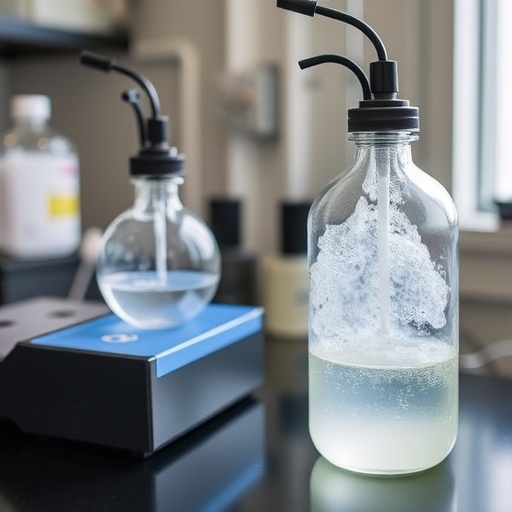
In recent years, the quest for sustainable energy solutions has intensified, pushing researchers to explore innovative methods for producing essential chemicals like hydrogen peroxide (H2O2). In a groundbreaking study, Zhang et al. have made significant strides in enhancing the electrosynthesis of hydrogen peroxide. This research delves deep into the mechanisms of anode-cathode coupling and the advantages of pulsed electrolysis, shedding light on their roles in maximizing the efficiency of this vital chemical production.
Hydrogen peroxide, known for its wide-ranging applications from industrial processes to environmental remediation, primarily functions as an oxidizing agent. With increasing demand for eco-friendly production methods, the traditional approaches to synthesizing H2O2 have shown limitations in terms of sustainability and efficiency. Zhang and colleagues have scrutinized these methods, presenting their findings on a more effective electrochemical route that combines the use of pulsed electrolysis with judiciously designed anode-cathode configurations.
The study outlines the importance of a stable reaction environment, which is crucial for maximizing the yield of H2O2 during its electrosynthesis. One of the prominent problems in existing methods is the formation of undesirable byproducts that can significantly reduce overall efficiency. In their experiments, the authors demonstrate how anode-cathode coupling creates an optimized electrochemical environment that lowers the energy threshold needed for H2O2 production, effectively steering the reaction toward the desired outcome.
Pulsed electrolysis emerges as a transformative technique in this study, allowing for more controlled current application while optimizing the reaction kinetics. This method permits the system to oscillate between high and low currents, which facilitates a more effective transfer of electrons on the anode surface. Zhang et al. reveal that this pulsing effect not only enhances the production rate of H2O2 but also diminishes the side reactions that typically plague continuous electrolysis methods.
Through extensive experimentation, the researchers employed quantitative analysis to examine how various operational parameters influence the generation of hydrogen peroxide. They meticulously varied the frequency and duration of the current pulses and monitored the resulting H2O2 concentrations. This careful tuning illuminated the intricacies of electron transfer, highlighting how specific pulse settings can significantly enhance the overall efficiency of the electrosynthesis process.
Moreover, the authors discuss the electrode materials and surface modifications that play a role in optimizing the anode-cathode interface. By selecting catalysts with superior properties, they contextualize their findings within the broader landscape of electrocatalytic research. This targeted approach allows for a deeper understanding of how material properties correlate with electrochemical performance, paving the way for advancements in other electrochemical applications beyond hydrogen peroxide synthesis.
The implications of this research extend beyond mere academic curiosity. As industries increasingly pivot towards greener production methodologies, the ability to efficiently produce hydrogen peroxide via electrochemical means positions it as a frontrunner in the push for sustainable practices. Companies involved in chemical manufacturing may soon find themselves reevaluating their strategies based on the insights provided by Zhang et al.
Additionally, the environmental benefits associated with this method cannot be overstated. Traditional methods for producing hydrogen peroxide often generate considerable waste and depend heavily on fossil fuels. By contrast, the electrochemical approach promotes a cleaner production cycle while directly contributing to reduction in carbon footprint—an essential consideration for today’s high-demand industries plagued by environmental regulations.
As the energy transition accelerates, innovations like those presented in this study point to a future where high-value chemicals can be produced with minimal environmental impact. The coupling of pulsed electrolysis with strategic anode-cathode configurations stands as a potential game changer that could usher in a new era in the field of chemical synthesis.
In summary, this research significantly contributes to the growing body of knowledge surrounding hydrogen peroxide electrosynthesis. By marrying theoretical insights with practical applications, Zhang et al. have set the stage for future explorations into sustainable chemical production. Their findings not only enhance our understanding of electrochemical processes but also foster hope for a more sustainable and efficient future in chemical manufacturing.
As this study gains traction, further exploration is warranted in various sectors that rely on hydrogen peroxide. Cross-disciplinary collaboration may enhance the understanding and application of these innovative techniques, leading to broader adaptations of pulsed electrolysis in other chemical synthesis domains.
Going forward, researchers are eager to assess the viability of scaling these findings for industrial applications. The overarching goal remains clear: to advance the efficiency and sustainability of hydrogen peroxide production, thereby addressing urgent environmental concerns and driving forward the shift toward cleaner chemical manufacturing processes.
This compelling research encapsulates a blend of science and practicality that resonates within the broader scientific community. With the landscape of energy and chemical production evolving rapidly, studies like this are crucial in defining a path toward a more sustainable and economically feasible future.
In conclusion, Zhang et al.’s work on enhancing hydrogen peroxide electrosynthesis through anode-cathode coupling and pulsed electrolysis marks a significant milestone in electrochemical research. Their innovative approach not only holds potential for increased efficiency but also aligns with global trends toward sustainable production practices, making it a noteworthy contribution in the field of environmental science and engineering.
Cite Scienmag News
Violet Maxwell. (January 27, 2026). Boosting Hydrogen Peroxide Production with Innovative Electrolysis. Scienmag. https://scienmag.com/boosting-hydrogen-peroxide-production-with-innovative-electrolysis/
Violet Maxwell. "Boosting Hydrogen Peroxide Production with Innovative Electrolysis." Scienmag, 27 January 2026, https://scienmag.com/boosting-hydrogen-peroxide-production-with-innovative-electrolysis/. Accessed 4 September 2026.
Violet Maxwell. "Boosting Hydrogen Peroxide Production with Innovative Electrolysis." Scienmag. January 27, 2026. https://scienmag.com/boosting-hydrogen-peroxide-production-with-innovative-electrolysis/


