


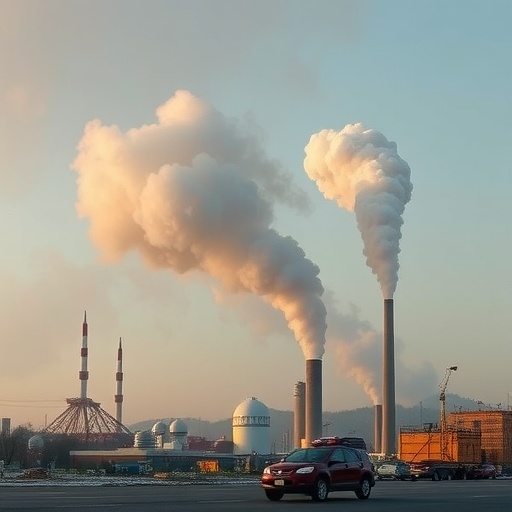
In the ever-evolving landscape of global climate policy, a recent groundbreaking study published in Nature Communications by Nawaz and Henze (2026) casts a sharp light on the complex interplay between national climate actions and international air pollution disparities. As nations ramp up their commitments to curb greenhouse gas emissions, the ripple effects on air quality across borders are now emerging as a critical, if less understood, facet of climate governance. This study delves deeply into how such national endeavors might simultaneously alleviate, perpetuate, or even intensify air pollution inequalities on a supranational scale, a dynamic with profound implications for environmental justice and global health.
Climate change mitigation strategies, broadly aimed at reducing carbon dioxide and other greenhouse gas emissions, often employ measures such as transitioning to renewable energy, enhancing energy efficiency, and implementing stricter emission standards. While these strategies are primarily designed to reduce global warming, Nawaz and Henze’s research highlights that their benefits and drawbacks extend beyond domestic borders. The research underscores that various countries’ efforts, depending on their scale, nature, and the underlying economy and industry profiles, can generate complex transboundary pollution patterns that may shift the burden of air quality impacts to different regions.
The methodology of this study is anchored in advanced atmospheric modeling coupled with socioeconomic and policy scenario analyses. By integrating these sophisticated tools, the researchers simulate intricate emission pathways and atmospheric transport processes under various national climate action scenarios projected out to 2050. This allows for a nuanced quantification of how pollutants like fine particulate matter (PM2.5) and ground-level ozone respond not only locally but also in downwind nations, thereby revealing how climate policy can reshuffle exposure burdens internationally.
One of the most striking findings is the dual-edged nature of climate policies: while stringent national actions in developed countries greatly reduce their local emissions and improve air quality, they may inadvertently cause a relative increase in pollution burdens in neighboring developing regions. This phenomenon arises partly because industries with high emissions intensify their operations in countries with laxer regulations, a process commonly referred to as carbon leakage. Consequently, the local improvements in air quality in one nation can come at the expense of increased pollution exposure and worsened health outcomes elsewhere, thus exacerbating global environmental inequities.
Conversely, the research identifies pathways through which coordinated, multilateral climate actions can synchronize emission reductions to ensure more equitable air quality improvements worldwide. For example, uniform implementation of clean energy technologies and stringent cross-border pollution standards could significantly mitigate the negative spillover effects. The study emphasizes the vital role of international cooperation frameworks that integrate air pollution considerations explicitly into climate policy negotiations, reinforcing the notion that climate and air quality goals are inherently intertwined and must be addressed in tandem to achieve holistic sustainability.
The authors systematically explore the influence of different sectors on transboundary pollution dynamics, revealing that transportation and power generation contribute significantly to these patterns. The shift from fossil fuels to renewable energy sources in the power sector mitigates greenhouse gases and co-emitted air pollutants domestically; however, uneven adoption rates across countries create spatially heterogeneous air quality outcomes. Moreover, the transportation sector’s emissions, due to their mobility and spatial reach, complicate the attribution of pollution sources, underscoring the need for integrated transport policies aligned with climate targets.
A profound implication of Nawaz and Henze’s work lies in its call for climate equity considerations to be embedded within national strategies. As wealthier nations push for aggressive decarbonization while still maintaining global supply chains reliant on pollution-intensive manufacturing in lower-income countries, policies must reckon with these outsourced emissions and resultant inequities in exposure. This points to a pressing necessity for international mechanisms to monitor, attribute, and address pollution displacement and health impacts, adding a layer of accountability and support for vulnerable populations.
Air pollution remains one of the largest environmental risk factors for human morbidity and mortality globally. The health impact assessments integrated into the modeling reveal that the distribution of air pollution-related diseases will not decrease uniformly if current national climate policies are pursued in isolation. Some regions might witness stark improvements in air-related health burdens, while others, often less economically developed, could suffer worsened conditions. This uneven progress accentuates global health disparities and presents an urgent public policy challenge linking climate, health, and social justice.
The study also highlights feedback mechanisms where worsened air pollution can undermine climate goals themselves. Pollutants such as black carbon contribute both to warming and poor air quality; their uneven management can influence regional climate effects like monsoon patterns, thus further complicating the socio-environmental landscape. Harmonized strategies targeting both greenhouse gases and air pollutants could thus provide mutual reinforcement in mitigating climate change and improving global air quality equity.
An intriguing aspect of the analysis concerns potential future scenarios where emerging economies take divergent development trajectories. Under aggressive climate action and clean technology diffusion, these countries might leapfrog traditional pollution-intensive industrial paths, leading to a global rebalancing of emissions and exposures. However, in scenarios where fossil fuel reliance persists or intensifies, inequities could deepen considerably. This underlines the crucial role of technology transfer, financing, and capacity building in fostering sustainable development aligned with climate and air quality goals.
Beyond the environmental and health dimensions, the research brings to light socio-political ramifications of pollution inequalities influenced by climate policies. As air quality disparities become more apparent, tensions between countries could escalate, particularly if international cooperation falters or nations perceive the actions of others as unfair. This potential for diplomatic friction frames air pollution and climate action as matters of international relations and trust-building, requiring transparent data sharing, joint monitoring, and collaborative mitigation efforts.
In essence, Nawaz and Henze’s study is transformative in reframing national climate policies through the lens of global air pollution justice. It challenges the common assumption that local climate benefits accrue purely to domestic populations by revealing intricate transboundary consequences. This paradigm shift could reshape how policymakers, advocates, and scientists conceive sustainable development, pushing towards integrated global agendas that recognize and redress disparate environmental health impacts across nations.
Looking toward policy implications, the authors advocate for the inclusion of explicit air pollution equity metrics within national and international climate frameworks. Such incorporation would enable benchmarks for assessing not only emissions reductions but also the fairness of exposure burdens. Heightened transparency and data integration, perhaps under the auspices of established bodies like the United Nations Framework Convention on Climate Change (UNFCCC), could foster more comprehensive reporting and joint mitigation strategies.
Furthermore, the study exemplifies the power of interdisciplinary research combining atmospheric science, economics, public health, and policy analysis. Its integrative approach provides a model for future studies aiming to bridge knowledge gaps between climate mitigation, air quality management, and social equity. Such transdisciplinary efforts are paramount for tackling the multifaceted challenges presented by global environmental change in an increasingly interconnected world.
As the global community accelerates toward the 2030 Sustainable Development Goals and subsequent climate targets, this research serves as a clarion call to recognize that climate action does not occur in isolation. Addressing it holistically with cognizance of its wider environmental justice ramifications will be critical to ensuring that global steps toward a healthier climate do not inadvertently deepen existing inequalities in air quality and health burdens. The findings advocate for a future where climate policies are not only effective but also equitable and inclusive, uniting humanity in the pursuit of a breathable, sustainable planet.
In summary, the work by Nawaz and Henze provides a new lens to examine national climate policies’ international ripple effects on air pollution disparities. By illuminating pathways to either exacerbate or ameliorate these inequalities, it equips decision-makers with critical insights to balance domestic climate ambitions with global environmental justice imperatives. The study’s profound synthesis of environmental science and policy underscores that in confronting climate change, equity must be more than an aspiration—it must be a foundational pillar of effective and just solutions.
Cite Scienmag News
Russell Cooper. (January 26, 2026). National Climate Action Shapes Global Air Pollution Inequality. Scienmag. https://scienmag.com/national-climate-action-shapes-global-air-pollution-inequality/
Russell Cooper. "National Climate Action Shapes Global Air Pollution Inequality." Scienmag, 26 January 2026, https://scienmag.com/national-climate-action-shapes-global-air-pollution-inequality/. Accessed 4 September 2026.
Russell Cooper. "National Climate Action Shapes Global Air Pollution Inequality." Scienmag. January 26, 2026. https://scienmag.com/national-climate-action-shapes-global-air-pollution-inequality/


