


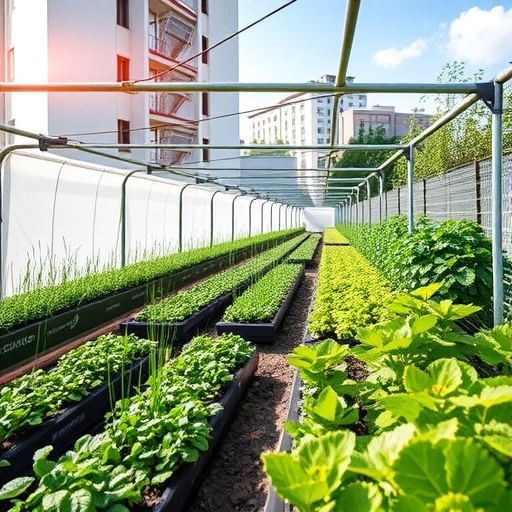
In the rapidly urbanizing landscapes of the 21st century, the phenomenon known as the urban heat island (UHI) effect has emerged as a critical environmental challenge. Cities, with their dense impervious surfaces and limited vegetation, tend to exhibit significantly higher temperatures than their surrounding rural areas, especially during summer months. This temperature disparity exacerbates energy consumption, impairs public health, and strains urban infrastructure. Recent research spearheaded by Yan, Li, Yu, and colleagues explores an innovative approach to mitigate UHI by focusing on peri-urban agriculture, shedding light on whether this strategy leads to environmental rejuvenation or socio-economic marginalization.
Peri-urban agriculture refers to farming activities occurring on the outskirts of urban areas, in zones where rural and urban characteristics blend. These agricultural zones are crucial because they serve as a transitional buffer, influencing the microclimate of adjacent urban centers. The study investigates the dual pathways that peri-urban agriculture might follow: either intensifying and contributing significantly to urban sustainability or becoming marginalized, thereby missing potential benefits in climate mitigation efforts. This investigation adds a new dimension to urban climate science by merging agricultural practices with meteorological and urban planning concerns.
UHI arises largely due to the replacement of natural land cover with concrete, asphalt, and other heat-retaining materials, which trap solar radiation and limit heat dissipation. The contribution of vegetated spaces to cooling urban atmospheres is well documented, primarily through shading, evapotranspiration, and albedo effects. However, peri-urban agricultural areas differ from urban parks or green roofs, as their spatial arrangements, crop types, and water management practices impact UHI dynamics in unique ways. This research delves into those complexities, employing high-resolution climate modeling coupled with land use assessments.
Using sophisticated climate simulation models, the authors discern that peri-urban agricultural intensification significantly enhances surface cooling during summer. Croplands with dense vegetation cover and effective irrigation regimes promote latent heat fluxes that reduce local air temperatures. This cooling potentially offsets the increased thermal load caused by urban sprawl. Furthermore, diversified cropping systems can augment this effect by increasing overall biomass and evapotranspiration rates. The investigation emphasizes that not all peri-urban farms contribute equally; the type of agriculture and management intensity matters profoundly.
Conversely, the study identifies scenarios where peri-urban agriculture risks marginalization, particularly when urban expansion leads to fragmented, poorly maintained farmland. In these cases, abandoned or poorly irrigated fields no longer provide cooling and may act as heat sources due to bare soil or built structures intruding into farmland. Furthermore, socio-economic pressures, such as land speculation, shifting ownership, and inadequate agricultural policies, contribute to the degradation of these peri-urban zones. This marginalization negates the potential climate benefits and exacerbates inequities for farming communities.
One of the core contributions of this research emerges from integrating socio-economic data with environmental assessments. The authors map peri-urban farm productivity, land tenure systems, and water resource availability alongside microclimate measurements, revealing a complex interplay between human decisions and environmental outcomes. Farms backed by strong community engagement and supportive infrastructure tend to maintain high vegetation cover and irrigation consistency, thereby sustaining their cooling roles. In contrast, fragmented governance and economic marginalization correlate with deteriorating farm conditions and diminished ecological function.
The implications of these findings resonate beyond climate science, highlighting peri-urban agriculture as a pivotal actor in sustainable urban planning. Effective land use policies that recognize peri-urban farms as climate-regulating green infrastructure can promote urban resilience to heat stress. By incentivizing sustainable intensification practices and protecting farmland from encroachment, municipal governments could harness agriculture as a low-tech yet highly effective method for UHI mitigation. This integrative approach offers a pathway to harmonize urban growth with environmental stewardship.
Technically, the study employs multi-scale remote sensing technology to monitor land surface temperature shifts and vegetative indices over different peri-urban zones. This data, calibrated with in-situ meteorological sensors, provides a granular understanding of how seasonal agricultural cycles impact local atmosphere. Advanced statistical models then synthesize these inputs to isolate the cooling effects attributable specifically to agricultural landscapes versus other urban green spaces. Such comprehensive methodologies underscore the necessity of bridging climatic, ecological, and socio-economic domains in urban sustainability research.
An intriguing aspect highlighted by the researchers is the role of water management in peri-urban agriculture’s climate function. Efficient irrigation not only promotes plant growth and evapotranspiration but requires sustainable water use practices to avoid resource depletion. Overextraction from aquifers or surface water bodies could jeopardize long-term agricultural viability and its associated cooling benefits. The study thus raises critical questions about balancing agriculture’s dual role in climate mitigation and natural resource conservation under increasing environmental stress.
Moreover, the spatial configuration of peri-urban farms influences their effectiveness at mitigating UHI. Large contiguous agricultural zones exhibit more pronounced cooling than scattered or highly fragmented plots. This spatial continuity facilitates microclimatic stability and amplifies evapotranspirative fluxes. Urban planners and landscape architects might consider this insight when designing green infrastructure networks, fostering agricultural zoning policies that promote coherent land use patterns rather than piecemeal development.
The research also uncovers a socio-political dimension to peri-urban agriculture’s future. Farm owners and local communities often lack the institutional support or financial incentives to maintain agriculture amidst urban expansion pressures. Without intervention, agricultural land might be converted to housing, industrial complexes, or vacant lots, which exacerbate heat island effects. Policymakers must therefore integrate peri-urban agriculture into urban development frameworks, recognizing its co-benefits for climate adaptation, food security, and community well-being.
From a broader environmental perspective, peri-urban agriculture exemplifies multifunctional land use with potential to contribute simultaneously to climate regulation, biodiversity conservation, and social inclusivity. The authors advocate for cross-sectoral collaborations involving agriculture, urban planning, environmental science, and public health to optimize outcomes. Such interdisciplinary approaches are vital in addressing the multifaceted challenges that modern cities face, particularly under accelerating climate change.
The findings open avenues for future exploration, including how crop selection, planting schedules, and farming practices might be optimized for climate benefits while sustaining agricultural livelihoods. There is also scope to investigate emerging technologies such as precision agriculture and smart irrigation systems in enhancing peri-urban climate services. Additionally, participatory governance models that elevate farmer voices in urban policy-making could strengthen sustainable peri-urban agriculture.
In conclusion, Yan, Li, Yu, and colleagues present compelling evidence that peri-urban agriculture holds substantial promise for mitigating urban heat island effects through strategic intensification and careful management. However, this potential is precarious and contingent upon socio-economic support and thoughtful urban planning that prevents marginalization. Recognizing and harnessing this synergy between agriculture and urban climate resilience could redefine metropolitan sustainability in the decades ahead, blending ecological function with socio-economic vitality to create cooler, healthier cities.
Yan, Z., Li, W., Yu, L. et al. Intensification or marginalization: peri-urban agriculture for mitigating urban heat island effects in summer.
npj Urban Sustain 6, 19 (2026). https://doi.org/10.1038/s42949-025-00314-9
Cite Scienmag News
Sloane Callahan. (January 25, 2026). Peri-Urban Farming to Combat Summer Urban Heat. Scienmag. https://scienmag.com/peri-urban-farming-to-combat-summer-urban-heat/
Sloane Callahan. "Peri-Urban Farming to Combat Summer Urban Heat." Scienmag, 25 January 2026, https://scienmag.com/peri-urban-farming-to-combat-summer-urban-heat/. Accessed 3 September 2026.
Sloane Callahan. "Peri-Urban Farming to Combat Summer Urban Heat." Scienmag. January 25, 2026. https://scienmag.com/peri-urban-farming-to-combat-summer-urban-heat/


