


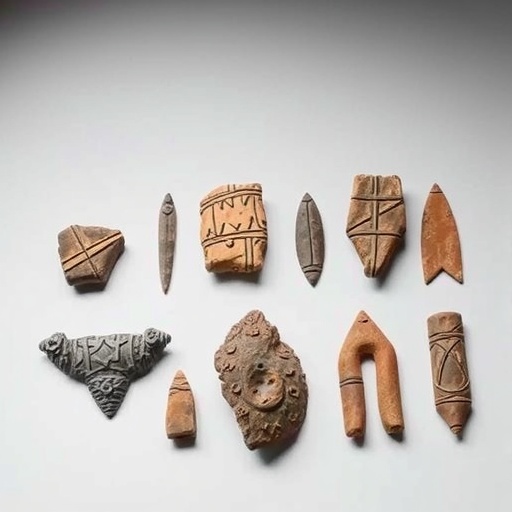
In the realm of archaeology, the study of lithic assemblages provides significant insight into the technological and cultural practices of ancient societies. The recently published research by Song and Wang sheds light on the lithic assemblage discovered at the Xiagachacunnanshan site, located in Chaoyang City, Liaoning Province, China. This investigation not only highlights the diversity of stone tools utilized by prehistoric peoples but also emphasizes the broader implications of these artifacts in understanding human behavior and adaptation during the critical phases of technological development.
The Xiagachacunnanshan site stands out due to its rich stratigraphy and the variety of lithic materials recovered from various layers. This research aims to unravel the complexity of human stone tool production and usage across different time periods, reflecting advancements in both skill and innovation. The lithic artifacts unearthed, ranging from flake tools to scrapers, indicate a sophisticated understanding of material properties and optimal shaping techniques. The findings challenge earlier notions about the simplicity of prehistoric technologies and suggest a narrative of gradual evolution influenced by environmental factors and social interaction.
Understanding the lithic assemblage from Xiagachacunnanshan requires a close examination of the raw materials used and the manufacturing processes involved. The site’s location, characterized by proximity to quality stone resources, allowed for the creation of a diverse range of tools. This availability of raw materials significantly influenced the types of stone tools produced and the techniques employed, such as flintknapping, which involves the precise striking of stones to achieve desired shapes and sharp edges. The researchers meticulously cataloged the artifacts, noting variations in tool morphology and the potential functions of each category.
Moreover, the role of these tools in subsistence activities is a focal point of the study. The assemblage offers insights into the daily lives of the inhabitants, suggesting that these lithic tools were essential for tasks such as hunting, food processing, and even crafting other items. The research posits that the efficiency of these tools would have played a crucial role in the survival strategies of the community, further influencing social structures and cultural practices.
In addition to the technological aspects, the study also delves into the socio-cultural implications of the lithic assemblage. The diversity of tools indicates not only functional versatility but also the potential for social signaling among different groups. It is hypothesized that tool differences might reflect social hierarchies or the presence of specialized craftsmen within the community. This possibility adds a layer of complexity to our understanding of prehistoric social dynamics, suggesting that tool production and distribution could have been a significant aspect of community interaction and identity.
One prominent feature noted in the lithic analysis is the variability in tool sizes and forms. Different tools were likely used for distinct purposes, and this specialization reflects an advanced understanding of resource management. For instance, larger blades may suggest use in hunting, while smaller flakes could indicate tasks related to processing plant materials or crafting. This functional differentiation points to a sophisticated set of practices that would have supported a community’s diverse needs over extended periods.
The findings from this research are set against the backdrop of a wider archaeological discourse, emphasizing how assemblage studies are pivotal for reconstructing past human behavior and environments. The authors argue that lithic technology serves not just as a reflection of material culture but also as a lens through which we can examine human adaptability in the face of climatic and ecological changes. As the landscape surrounding sites like Xiagachacunnanshan shifted, so too did the technologies and strategies employed by its ancient inhabitants.
Furthermore, the methodologies applied in the excavation and analysis of the lithic assemblage are of paramount importance. The researchers utilized both traditional archaeological techniques and contemporary technological advancements, such as 3D modeling, to accurately document and analyze the artifacts. This combination of methods allows for a more nuanced understanding of the spatial organization of tools within the xia scene, which, in turn, informs interpretations of daily life and community organization.
The implications of this study extend beyond the Xiagachacunnanshan site, contributing to a larger narrative regarding the emergence of complex societies in East Asia. By situating the findings within broader regional frameworks of stone tool development, the authors highlight patterns of innovation and technological diffusion across neighboring archaeological sites. This comparative approach fosters a deeper appreciation for the interconnectedness of prehistoric communities and the shared challenges they faced.
As archaeology continues to evolve, the integration of interdisciplinary methods will be vital for advancing our understanding of ancient societies. The lithic assemblage from Xiagachacunnanshan serves as a case study showcasing the wealth of information contained within stone tools, emphasizing their role not merely as functional objects but as crucial artifacts for interpreting the human experience throughout history. The work of Song and Wang paves the way for future inquiries into the relationship between technology, culture, and the environment, ensuring that the study of lithics remains a vibrant and essential field within archaeology.
The Xiagachacunnanshan excavation exemplifies the potential for lithic studies to reveal intricate details about our ancestors’ lives, facilitating a dialogue between past and present. Each tool, each flake recovered offers a glimpse into the ingenuity of early humans and their capacity to innovate and adapt over millennia. As researchers continue to explore ancient sites like Xiagachacunnanshan, we can expect to uncover further layers of history that connect us to the vast tapestry of human existence.
In conclusion, the lithic assemblage from Xiagachacunnanshan site holds profound significance for understanding the complex realities of ancient human life. It is through comprehensive studies such as these that we can appreciate the technological, ecological, and social factors that shaped the cultures of our forebears. The findings of Song and Wang thus not only contribute vital knowledge to the field of archaeology but also inspire ongoing exploration and reflection on our shared human heritage.
Song, J., Wang, C. Lithic assemblage from the xiagachacunnanshan site, chaoyang city, liaoning province.
asian archaeol 8, 135–142 (2024). https://doi.org/10.1007/s41826-024-00089-5
Cite Scienmag News
Courtney Benton. (January 25, 2026). Ancient Lithic Tools Discovered at Xiagachacunnanshan Site. Scienmag. https://scienmag.com/ancient-lithic-tools-discovered-at-xiagachacunnanshan-site/
Courtney Benton. "Ancient Lithic Tools Discovered at Xiagachacunnanshan Site." Scienmag, 25 January 2026, https://scienmag.com/ancient-lithic-tools-discovered-at-xiagachacunnanshan-site/. Accessed 3 September 2026.
Courtney Benton. "Ancient Lithic Tools Discovered at Xiagachacunnanshan Site." Scienmag. January 25, 2026. https://scienmag.com/ancient-lithic-tools-discovered-at-xiagachacunnanshan-site/


