


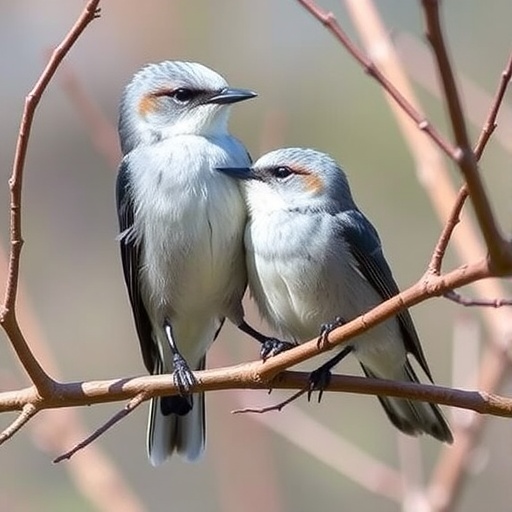
In the intricate world of avian interactions, a fascinating study brings to light the extraordinary abilities of the Red-backed Shrike (Lanius collurio) to resist the cunning acoustic mimicry employed by the Common Cuckoo (Cuculus canorus). The research, conducted by Sulej, Charalambidou, and Golawski, reveals how these shrikes have developed evolutionary traits that enable them to distinguish between their own calls and those of the Common Cuckoo, a bird notorious for its brood parasitism. This understanding sheds light on the dynamic arms race between predator and prey, raising compelling questions about the evolutionary pressures at play in bird communication.
The Common Cuckoo is well-known for its unique breeding strategy, which involves laying its eggs in the nests of other bird species, effectively outsourcing the responsibilities of raising its young. This behavior places significant pressure on host species, which must discern the cuckoo’s eggs from their own and protect their nests from this crafty intruder. However, cuckoos do not merely rely on their egg-laying strategies; they are also masterful mimics, able to replicate the calls of various birds, including those of their chosen hosts. This mimicry can confuse and disorient unsuspecting hosts, making them more vulnerable to cuckoo deception.
Red-backed Shrikes, on the other hand, have developed a keen auditory acuity that allows them to recognize and differentiate calls despite the mimicry attempts by the cuckoo. The study reveals that these shrikes exhibit a heightened sensitivity to specific acoustic features that characterize their calls, enabling them to filter out infernal mimicry. This ability not only protects them from brood parasitism but also highlights the remarkable adaptability of these birds in the face of evolutionary pressures.
The researchers employed a series of rigorous experiments designed to test the shrikes’ responses to both their calls and the mimicry of the cuckoo. They carefully analyzed the shrikes’ behavior in response to various acoustic stimuli, which led to intriguing insights into their cognitive processing. The results indicated that Red-backed Shrikes possess an innate capability to discern the subtle differences between similar-sounding calls, allowing them to avoid the traps set by cuckoos.
Interestingly, the study also points to a significant aspect of learned behavior in these birds. While their innate abilities are crucial, the researchers hypothesized that exposure to cuckoo calls over time may enhance the shrikes’ discrimination skills. This suggests that the Red-backed Shrikes may improve their recognition abilities through experience, thereby adjusting to the ongoing evolutionary battle against cuckoos. This learning curve could potentially explain the enduring success of the shrikes in maintaining their breeding integrity.
This evolutionary dance of mimicry and recognition does not only pertain to the Red-backed Shrikes. Many other bird species have developed similar mechanisms to counter the cuckoo’s strategies. Mimicry has been a common theme across the avian world, where species adapt over generations to either become effective mimics themselves or possess stronger means of detection. The findings contribute a new dimension to our understanding of these interspecies interactions, highlighting the complexity of the evolutionary adaptations that shape bird behavior.
Given the intricate auditory environment birds occupy, the study underscores the significance of sound in avian life. The findings compel researchers to explore further how communication and mimicry affect broader ecological networks, not just between predators and prey but across various species. Understanding these interactions may also open doors to conservation efforts, as knowing how birds communicate can be vital in preserving their habitats and ensuring healthy populations.
As science continues to unravel the complex web of life, the research on Red-backed Shrikes and their interaction with the Common Cuckoo provides an exemplary case illustrating the tenacity of nature’s designs. It emphasizes the fine balance maintained through evolutionary processes and the relentless adaptations that species undergo in response to their environments. Such studies also remind us of the intricate relationships within ecosystems, prompting us to look closer at the subtleties of communication among species.
This research marks an important step in avian biology, particularly in the arena of animal cognition and communication. By spotlighting the remarkable resilience of the Red-backed Shrikes, the study challenges long-held notions about the dominance of mimicry. Rather than falling prey to deception, these birds demonstrate a formidable level of awareness that allows them to navigate a world fraught with evolutionary challenges.
In conclusion, the captivating exploration of how Red-backed Shrikes resist the acoustic mimicry of the Common Cuckoo is foundational not only for ornithology but also for understanding evolutionary biology as a whole. As researchers continue to delve into the intricacies of animal communication, the lessons learned from this study can influence our comprehension of ecological dynamics and the importance of protecting diverse ecosystems in the face of anthropogenic changes.
Through the lens of this transformative study, we recognize that the challenges posed by the Common Cuckoo are not just obstacles but catalysts for evolutionary ingenuity. The research encourages further investigations into avian acoustic interactions, ultimately enriching our understanding of wildlife dynamics and enhancing our efforts in conservation initiatives.
Sulej, A., Charalambidou, I. & Golawski, A. Red-backed Shrikes (Lanius collurio) resist acoustic mimicry by the Common Cuckoo (Cuculus canorus). Anim Cogn 29, 9 (2026). https://doi.org/10.1007/s10071-025-02029-x
Cite Scienmag News
Gavin Prescott. (January 25, 2026). Red-backed Shrikes Defy Cuckoo’s Acoustic Mimicry Skills. Scienmag. https://scienmag.com/red-backed-shrikes-defy-cuckoos-acoustic-mimicry-skills/
Gavin Prescott. "Red-backed Shrikes Defy Cuckoo’s Acoustic Mimicry Skills." Scienmag, 25 January 2026, https://scienmag.com/red-backed-shrikes-defy-cuckoos-acoustic-mimicry-skills/. Accessed 4 September 2026.
Gavin Prescott. "Red-backed Shrikes Defy Cuckoo’s Acoustic Mimicry Skills." Scienmag. January 25, 2026. https://scienmag.com/red-backed-shrikes-defy-cuckoos-acoustic-mimicry-skills/


