


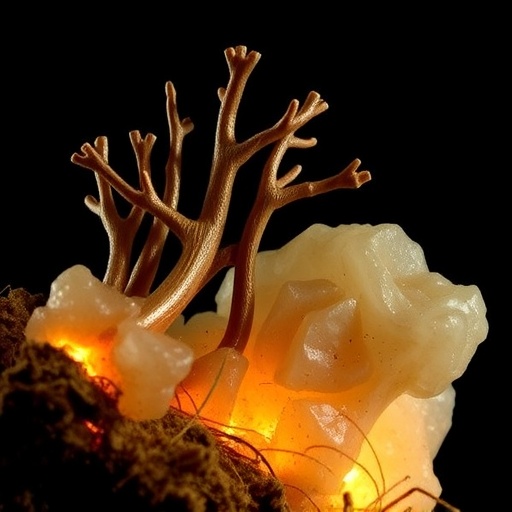
In a groundbreaking discovery, a team of researchers led by Chen, GY., Liu, JH., and Wang, HC. have unveiled the earliest known archaeological record of the Menispermaceae family from the mid-Pleistocene era at the Gantangqing site in central Yunnan, Southwest China. This finding not only enriches the archaeological narrative but also has profound implications for understanding the environmental conditions and plant diversity during this pivotal period in human history. By shedding light on the ancient ecosystem, the research offers vital clues about how early humans interacted with their environment and the resources available to them.
The study was meticulously conducted at the Gantangqing site, a location known for its rich archaeological deposits that date back to the mid-Pleistocene. This site harbors a wealth of information regarding the flora and fauna that existed during the time, serving as a natural laboratory for researchers attempting to reconstruct past environments. The significance of the Menispermaceae family, which includes plants commonly yielding medicinal compounds, underlies the critical role these species may have played in the survival and cultural practices of early human populations.
One of the most compelling aspects of this research is its emphasis on the environmental implications that stem from the discovery of Menispermaceae. The mid-Pleistocene was marked by climatic fluctuations, and understanding which species thrived during these times can inform us about ecosystem resilience. The presence of this plant family indicates that certain habitats were conducive to both biodiversity and human occupation, implying a dynamic interplay between environmental conditions and human adaptability.
The findings are not merely academic; they hold practical significance. As contemporary societies grapple with ecological challenges, examining how ancient populations utilized available resources can inform modern strategies for resource management and conservation. The Menispermaceae plants identified at Gantangqing may offer insights into sustainable practices that have been forgotten over millennia.
Furthermore, this research contributes to the broader discourse on human evolution and migration patterns. The ability of early humans to thrive in specific ecological niches likely played a fundamental role in their development. The Gantangqing site provides crucial evidence that enriches our understanding of the agricultural practices and survival strategies of our ancestors, suggesting they had a complex relationship with their surrounding environment.
In addition to providing valuable data points for archaeological and environmental studies, the study of Menispermaceae at Gantangqing opens new avenues for botanists and ecologists interested in the historical distribution of plant species. Understanding how these plants adapted to changing climates can reveal important information about how current species might respond to contemporary environmental challenges, such as climate change and habitat loss.
Moreover, the research touches on the interplay between humans and nature, prompting questions about the practices of foraging or possibly the cultivation of wild plants during the mid-Pleistocene. This could signify an early form of plant management, hinting at the nascent stages of agricultural development well before the advent of settled farming communities. The work challenges long-held assumptions about when humans began to actively engage with and shape their agrarian environments.
The archaeological record at Gantangqing enriches the narrative of human prehistory, particularly in terms of how environmental factors influenced social structures and behavioral adaptations. The ability to harness plant resources for dietary supplements, medicinal uses, or possibly for ritualistic purposes illustrates the intricate ties between plants and health, economy, and culture in early human societies.
As scientists delve deeper into the exploration of Menispermaceae at the Gantangqing site, they may also uncover additional insights about regional diversity among ancient human populations. This research highlights the need for comprehensive studies that not only focus on the artifacts but also on the ecological context in which these early populations lived.
The methodologies utilized in this research are noteworthy as well. By employing both traditional archaeological techniques and advanced analytical methods, the researchers have been able to draw robust conclusions about the presence and significance of Menispermaceae. The integration of paleobotanical analysis with archaeological context underscores the necessity for interdisciplinary approaches in understanding complex historical narratives.
The implications of the findings extend beyond merely documenting past life. They challenge us to consider contemporary environmental management through the lens of historical ecology. The lessons gleaned from the Gantangqing site serve as a reminder of the interconnectedness of human life and the environment—a principle that is increasingly relevant in today’s age of environmental crisis.
Ultimately, the discovery at the Gantangqing site offers a new perspective on the mid-Pleistocene epoch, encouraging a dialogue between the past and present in our understanding of human adaptation and survival. As the data continues to be scrutinized and analyzed, further revelations about the ecological and cultural significance of the Menispermaceae family are anticipated. This research reinforces the importance of archaeological studies in revealing the intricate tapestry of human history and environmental interaction.
As society seeks to bridge the past and present, the implications of the Gantangqing findings may resonate with modern environmental narratives, urging a reconsideration of historical practices in light of future sustainability efforts. Understanding the past may very well shape our future approaches to natural resources and biodiversity, marking a crucial step toward a more sustainable relationship with the world around us.
Through this unfolding story, we witness scientific exploration not only as a means of understanding yesterday but as a crucial framework for navigating the challenges of today. The Gantangqing site stands as a testament to the enduring pursuit of knowledge in archaeology and environmental science, paving the way for future discoveries that can illuminate our connection to the past.
In summary, the earliest archaeological record of Menispermaceae provides invaluable insights into the ecological and cultural landscapes of mid-Pleistocene Asia, reinforcing the idea that understanding our history could be fundamental to addressing our present and shaping a sustainable future.
Cite Scienmag News
Courtney Benton. (January 24, 2026). Ancient Menispermaceae Discovery Sheds Light on Pleistocene Environment. Scienmag. https://scienmag.com/ancient-menispermaceae-discovery-sheds-light-on-pleistocene-environment/
Courtney Benton. "Ancient Menispermaceae Discovery Sheds Light on Pleistocene Environment." Scienmag, 24 January 2026, https://scienmag.com/ancient-menispermaceae-discovery-sheds-light-on-pleistocene-environment/. Accessed 3 September 2026.
Courtney Benton. "Ancient Menispermaceae Discovery Sheds Light on Pleistocene Environment." Scienmag. January 24, 2026. https://scienmag.com/ancient-menispermaceae-discovery-sheds-light-on-pleistocene-environment/


