


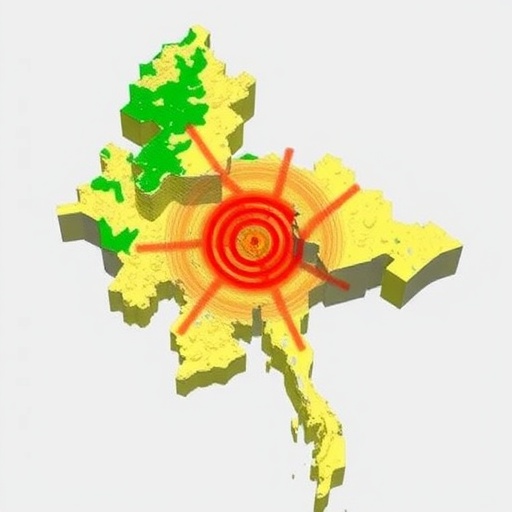
In the seismic research community, the analysis of earthquake phenomena is pivotal in understanding and mitigating the impacts of such devastating natural events. A recent study published in Earthquake Engineering and Engineering Vibration delves into the intricate details of the 2025 Myanmar earthquake, a significant seismic event that has drawn the attention of geophysicists and seismologists alike. This exceptional piece of research, led by a team including Diao, Ren, and Wen, focuses on the supershear rupture processes associated with this earthquake, paving the way for enhanced predictive models and better preparedness strategies.
The term “supershear” refers to a specific rupture velocity that exceeds the speed of seismic waves in the surrounding medium. Such rupture phenomena are relatively rare but can lead to exceptionally destructive quakes. In Myanmar, the 2025 event demonstrated these characteristics, marking a significant moment in both geological history and scientific inquiry. For researchers, determining the mechanics behind supershear ruptures offers invaluable insight, contributing to our broader understanding of tectonic movements and their potential ramifications.
Utilizing advanced seismic data analysis, the researchers employed joint inversion techniques to synthesize information from near-field and teleseismic waveforms. This methodology is crucial in earthquake studies, as it allows scientists to create a more accurate representation of the rupture process, overcoming the limitations posed by individual waveform analyses. By integrating diverse data sources, they can identify the rupture’s characteristics, including its initiation and propagation, thereby establishing a comprehensive picture of the earthquake dynamics.
One of the most compelling aspects of the 2025 Myanmar earthquake study is the application of joint inversion techniques. This approach essentially involves incongruent data sets that are harmonized through a mathematical framework to extract parameters that are not easily observable from distant sensors alone. The researchers leveraged this sophisticated method to piece together the event’s timeline, recognizing the various stages of the rupture and how these correlated with seismic waveforms observed far from the focus of the quake.
Through their analyses, Diao and colleagues noted the rapid acceleration of the rupture front, which characterized the supershear behavior evident during the event. Understanding the implications of such a rapid rupture is paramount, as it can greatly influence ground shaking outcomes and resultant damage patterns. This is particularly critical for densely populated regions, where the speed and intensity of seismic waves can lead to architectural failures and increased casualties.
The study also delves into the geological context of Myanmar, a region situated at the convergence of multiple tectonic plates. The interplay of these plates creates a dynamic environment, with stresses building up over time and occasionally releasing through seismic activity. By identifying the specific faults involved in the 2025 rupture, the research enhances our understanding of the underlying processes that lead to such catastrophic events, ultimately contributing to risk assessment and management efforts in the region.
Moreover, the implications of detecting supershear ruptures extend beyond individual earthquakes. As researchers continue to build a database of seismic events characterized by such behavior, patterns may emerge that could help predict future occurrences. The ability to foresee the likelihood of supershear ruptures—along with their associated hazards—can empower engineers and policy-makers to develop more resilient infrastructure and emergency response protocols.
This study not only serves to inform experts in the field but also engages the public by illustrating the profound impacts of geological phenomena. By disseminating the knowledge gleaned from the 2025 Myanmar earthquake, researchers aim to raise awareness about seismic risks and encourage community preparedness initiatives. The importance of public understanding cannot be overstated, as communities that are educated about earthquake risks are better equipped to respond to emergencies when they arise.
Additionally, the research underscores the role of technology in advancing seismic studies. The integration of data from various sources, including satellite measurements and ground-based sensors, highlights how modern innovations have revolutionized observational capabilities. This technological evolution is crucial not only for real-time monitoring of earthquakes but also for retrospective analyses that deepen our understanding of seismic behavior.
Human lives are invariably affected by earthquakes, and understanding their speed and mechanisms can significantly impact public safety. The findings from the 2025 Myanmar earthquake study contribute to an urgent discourse on disaster preparedness, urging stakeholders at all levels to prioritize seismic resilience. Such measures could mitigate potential losses when the next quake inevitably strikes, making proactive strategies even more vital.
In conclusion, the research conducted by Diao, Ren, Wen, and their colleagues represents a significant leap forward in the understanding of supershear rupture processes. By adopting state-of-the-art inversion techniques to analyze the 2025 Myanmar earthquake, they illuminate complex seismic behaviors that have profound implications for engineering, public safety, and our overall comprehension of tectonic mechanics. As we continue to unravel the mysteries of the Earth’s seismic activities, this study stands as a testament to human ingenuity and the quest for knowledge in the face of nature’s formidable power.
The findings from this seismic study might soon influence not only academic discourse but also policies related to urban planning and infrastructure development. As researchers strive to understand the implications of their work, the goal remains not only to document these events but, crucially, to apply this knowledge in ways that enhance societal resilience against the unpredictable forces of nature.
Diao, H., Ren, Y., Wen, R. et al. Supershear rupture process of the 2025 Myanmar earthquake as derived from joint inversion of near-field and teleseismic waveforms.
Earthq. Eng. Eng. Vib. 24, 917–925 (2025). https://doi.org/10.1007/s11803-025-2347-z
Cite Scienmag News
Violet Maxwell. (January 23, 2026). Supershear Dynamics Unveiled in 2025 Myanmar Earthquake. Scienmag. https://scienmag.com/supershear-dynamics-unveiled-in-2025-myanmar-earthquake/
Violet Maxwell. "Supershear Dynamics Unveiled in 2025 Myanmar Earthquake." Scienmag, 23 January 2026, https://scienmag.com/supershear-dynamics-unveiled-in-2025-myanmar-earthquake/. Accessed 4 September 2026.
Violet Maxwell. "Supershear Dynamics Unveiled in 2025 Myanmar Earthquake." Scienmag. January 23, 2026. https://scienmag.com/supershear-dynamics-unveiled-in-2025-myanmar-earthquake/


