


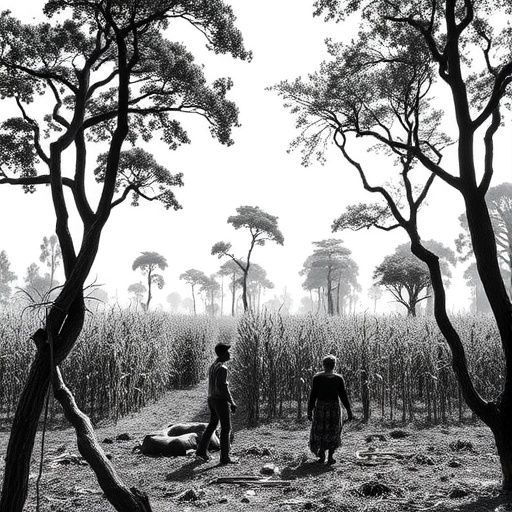
In the heart of southern China lies a narrative woven through the very fabric of its agricultural practices and ecological stability. The compelling research conducted by Yue, Yuan, Wang et al. sheds light on the intricate relationship between maize cultivation and the historical trajectory of forest ecosystems over the past five centuries. This exploration is not just a recounting of events, but a deep dive into how human activity, specifically agriculture, has shaped the environmental landscape, underpinning the pressing concerns regarding sustainability and biodiversity.
As China transitioned through various dynasties, the cultivation of maize emerged as a critical agricultural practice. This crop, originally introduced from the Americas, quickly garnered popularity due to its adaptability and high yields. The researchers meticulously traced the timeline of maize’s introduction and its subsequent spread across the rural countryside. As communities embraced this crop, the demand for arable land intensified, leading to the clearing of vast tracts of forest. The implications of such actions were profound, affecting not only the local ecosystem but also contributing to broader climatic changes.
The study reveals that the transformation of forested areas into agricultural land did not occur in isolation. It was a response to socio-economic pressures, including population growth and the need for food security. Detailed analyses indicated that as maize became a staple food, local farmers shifted their focus from traditional rotational cropping to monoculture practices. This decision, while initially beneficial in terms of short-term yields, laid the groundwork for long-term environmental degradation. The cycle of soil depletion and increased vulnerability to pests and diseases became evident, prompting concerns about agricultural resilience.
Furthermore, the research casts a critical lens on the subsequent forest collapse that paralleled the rise of maize cultivation. The degradation of once-thriving wooded areas resulted not just in loss of biodiversity, but also in heightened incidences of erosion and water scarcity. The researchers employed advanced modeling techniques to predict the ecological changes triggered by deforestation. They noted an alarming trend: the species composition in these areas shifted remarkably, favoring invasive species that thrived in disturbed conditions while native flora struggled to survive.
One striking finding of the study is the paved path of recovery that certain forested areas managed to undertake despite centuries of agricultural encroachment. The examination of recovery trajectories is pivotal in understanding how remnants of biodiversity can rebound given the right conditions. The researchers highlighted successful reforestation initiatives taken in recent decades as crucial examples of ecological rehabilitation. These initiatives, however, are not merely about planting trees; they involve holistic approaches that consider the socio-economic fabric of the communities involved.
In this complex interplay between agriculture and forestry, water management emerges as a critical factor influencing sustainability. The study illustrates how agricultural practices alter hydrology in ways that can exacerbate droughts or lead to flooding. Mismanagement of water resources has posed additional challenges to both crop production and forest conservation. Therefore, gaining insights into historical agricultural practices is essential for crafting future policies that adequately address these intertwined issues.
Public awareness and education play vital roles in bridging the gap between scientific research and community-driven efforts toward sustainability. Yue et al. emphasize the importance of engaging stakeholders through workshops and educational programs that highlight the historical context of maize cultivation. These programs can inspire a collective movement towards more sustainable agricultural practices, urging farmers to adopt diversified planting strategies rooted in ecological wisdom.
As the global community grapples with the challenges of climate change, the insights from southern China’s historical narrative are particularly salient. The erosion of forest cover due to maize agriculture serves as a cautionary tale about the potential risks of prioritizing immediate agricultural gains over long-term ecological health. It sheds light on the intricate connections that exist within ecosystems and offers a framework for understanding how policy and environmental stewardship must go hand in hand.
Emerging technologies also offer innovative solutions to the challenges outlined in this study. The researchers advocate for the integration of artificial intelligence in monitoring agricultural practices and forest health. By utilizing AI-driven tools, stakeholders can make informed decisions that harmonize agricultural productivity with environmental preservation. This synergy could be a game-changer, especially in regions where livelihoods depend heavily on both agriculture and forest resources.
Collaborative research is another keystone highlighted by Yue et al. Engaging interdisciplinary teams, including ecologists, agronomists, and social scientists, can drive forward thinking and multifaceted approaches to land use. Understanding the root motivations behind agricultural choices within local communities is vital for creating interventions that are both effective and culturally sensitive. The lessons learned from this study point to the significance of a mosaic of partnerships that transcend traditional academic silos.
In conclusion, the research encapsulated in the study by Yue, Yuan, Wang et al. is a clarion call for a balanced approach to agriculture that respects the historical context of land transformation. By acknowledging the legacies of maize cultivation, we can forge pathways toward regenerative practices that honor both ecological integrity and food security. This narrative is not an isolated case; it resonates with global agricultural trends, issuing a challenge to rethink the relationship between humans and nature in a rapidly changing world.
Ultimately, the findings presented in this research offer a blueprint for a sustainable future, one that recognizes the deep connections between our agricultural choices and the health of our planet. As we move forward, the lessons learned from the past can inform wiser practices that support both humanity and the ecosystems upon which we rely.
Yue, Y., Yuan, S., Wang, L. et al. Maize cultivation and forest collapse over five centuries in southern China.
Commun Earth Environ (2026). https://doi.org/10.1038/s43247-026-03224-5
Cite Scienmag News
Alan Morgan. (January 23, 2026). Five Centuries of Maize Farming and Forest Decline. Scienmag. https://scienmag.com/five-centuries-of-maize-farming-and-forest-decline/
Alan Morgan. "Five Centuries of Maize Farming and Forest Decline." Scienmag, 23 January 2026, https://scienmag.com/five-centuries-of-maize-farming-and-forest-decline/. Accessed 3 September 2026.
Alan Morgan. "Five Centuries of Maize Farming and Forest Decline." Scienmag. January 23, 2026. https://scienmag.com/five-centuries-of-maize-farming-and-forest-decline/


