


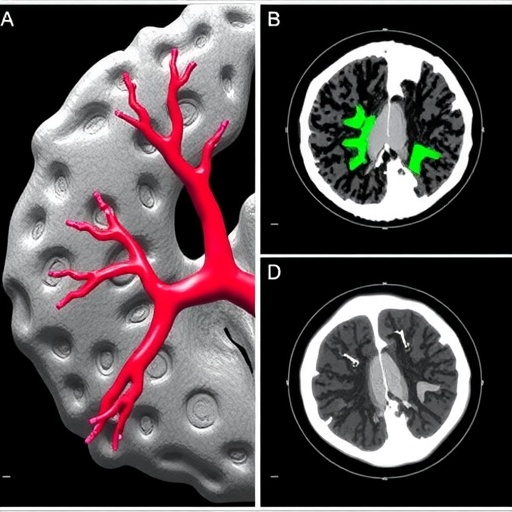
In an era where innovative applications of medical imaging and 3D printing are gaining traction, researchers Dell, Wist, and Grasshoff have uncovered significant insights into the uptake characteristics of MRI and CT contrast agents in 3D printing materials specifically designed for vascular phantoms. Their groundbreaking study, which appears in the latest edition of 3D Print Med, delves into the intricate relationships between imaging agents and 3D printing materials, paving the way for advancements in realistic and functional anatomical models used in education and medical practice.
The utilization of 3D printing in medicine has revolutionized the creation of patient-specific anatomical models, enhancing surgical planning and education. However, the fidelity of these models heavily relies on the materials employed, particularly when it comes to simulating vascular structures. The study addresses a critical gap in the field by investigating how various 3D printing materials interact with MRI and CT contrast agents, which are essential for achieving high-quality imaging of vascular phantoms.
Contrast agents play a vital role in enhancing the visibility of blood vessels during MRI and CT imaging, allowing for better diagnosis and intervention strategies. Dell and colleagues conducted a series of experiments to determine the extent to which these agents could be absorbed by different 3D printing materials. The results indicated that the absorption rates varied significantly among the materials tested, shedding light on the complex interplay between the physical properties of the printing substances and the chemical nature of the contrast agents.
One of the notable findings of this research is the disparity in absorption behavior exhibited by polymers commonly used in 3D printing. Specific materials demonstrated a higher affinity for certain types of contrast agents, which suggests that material selection could greatly influence the imaging quality of 3D-printed vascular models. This observation could lead to the optimization of printing materials to enhance their compatibility with the most frequently used imaging agents, ultimately improving the accuracy of simulated vascular studies.
Moreover, the study also explored the effects of environmental factors, such as temperature and time, on the uptake of contrast agents. By conducting tests under varying conditions, the researchers were able to ascertain how these factors influence the diffusion rate of the agents into the printing materials. Their findings could inform recommendations for practitioners on how to prepare and handle 3D-printed models to maximize the efficacy of imaging procedures.
The implications of this research extend beyond mere academic interest; they touch upon the future of personalized medicine. With the scalability of 3D printing technology and the growing archive of patient data, there is a potential for creating highly detailed, patient-specific vascular models that can be used for pre-operative planning. When these models are integrated with appropriate contrast agents, they could provide surgeons with unprecedented insights, leading to improved outcomes in complex vascular interventions.
The integration of medical imaging and 3D printing is an ongoing narrative in the healthcare industry, and studies like this are pivotal in shaping its future. The insights gained from Dell et al.’s research could inspire further exploration into other medical applications, including the development of phantoms for various organs and systems. Such advancements could enhance both training for medical professionals and assistance for patients through more accurate treatment simulations.
In light of the pivotal role that 3D printing is playing in the modern healthcare landscape, the study also raises essential questions about regulation and standardization in the field. As personalized 3D-printed models continue to proliferate, ensuring that they meet the required safety and quality standards will be paramount. Researchers and clinicians need to engage in discussions about best practices for the use of contrast agents in conjunction with 3D printing materials, ensuring that the benefits are maximized while minimizing any potential hazards.
The excitement generated by the potential of this research captures the essence of the current trajectory within the medical field, where interdisciplinary collaboration is leading to innovative solutions for complex problems. As Dell, Wist, Grasshoff, and their colleagues continue to explore these intersections, the future holds promise for the delivery of customized healthcare solutions that can adapt to the needs of individual patients.
With the publication of their findings, the research team invites further discussion and collaborative efforts within the scientific community. They encourage others to replicate their study and validate their findings, as this could lead to robust guidelines for the optimal use of specific 3D printing materials with various imaging agents. The synergy between academia and clinical practice remains a key driver in fostering advancements that are entirely patient-centered.
Moreover, the ethical implications of 3D printing in medicine must not be overlooked. As the technology becomes more accessible, it is vital that researchers and practitioners uphold ethical standards, ensuring that innovations benefit all patients equitably. The potential for bias in material selection, agent compatibility, and personalized model creation underscores the necessity for rigorous oversight and inclusive research practices.
Finally, as the medical community looks toward the future, the implications of this research are poised to reverberate across various healthcare settings. By addressing the nuances of contrast uptake in 3D printing materials, Dell and his team are not only advancing the field of medical imaging but also enhancing the quality of patient care through innovative solutions that redefine anatomical modeling and surgical preparation.
As these technologies evolve, the quest for knowledge and understanding continues, underlining the pivotal role that research plays in transpiring new pathways in healthcare excellence. With collaborative efforts and innovative thinking, the prospects for enhancing medical imaging and surgical techniques through the utilization of bespoke 3D-printed vascular phantoms appear boundless.
Dell, A.C., Wist, C., Grasshoff, H. et al. Uptake characteristics of MRI and CT contrast agents in 3D printing materials for vascular phantoms. 3D Print Med 11, 56 (2025). https://doi.org/10.1186/s41205-025-00309-3
Cite Scienmag News
Ophelia Keating. (January 23, 2026). Exploring MRI and CT Contrast in 3D Vascular Phantoms. Scienmag. https://scienmag.com/exploring-mri-and-ct-contrast-in-3d-vascular-phantoms/
Ophelia Keating. "Exploring MRI and CT Contrast in 3D Vascular Phantoms." Scienmag, 23 January 2026, https://scienmag.com/exploring-mri-and-ct-contrast-in-3d-vascular-phantoms/. Accessed 3 September 2026.
Ophelia Keating. "Exploring MRI and CT Contrast in 3D Vascular Phantoms." Scienmag. January 23, 2026. https://scienmag.com/exploring-mri-and-ct-contrast-in-3d-vascular-phantoms/


