


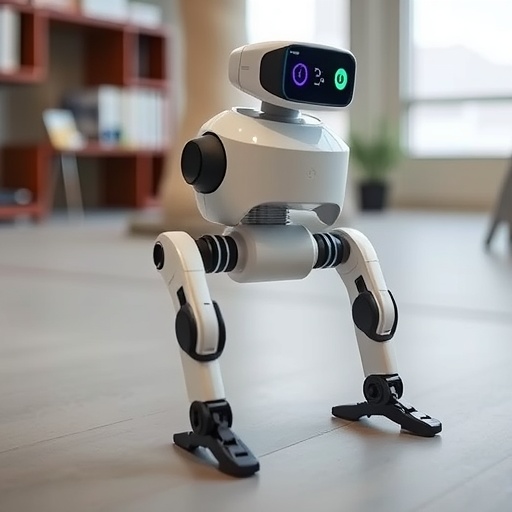
In an exciting development poised to enhance the capabilities of legged robots, researchers have introduced the LSF-planner, a groundbreaking visual local planner that integrates ground structure and feature information. This innovative technology is set to revolutionize the way robotic systems navigate complex terrains, significantly improving their efficiency and reliability. As robotics continues to advance, the ability of legged robots to intelligently traverse various landscapes is becoming increasingly important, not just for research purposes but also for real-world applications in search and rescue, exploration, and automated delivery systems.
The LSF-planner leverages cutting-edge algorithms and machine learning techniques to analyze the features of the ground in real-time. By assessing the structure of the terrain, robots equipped with this technology can make informed decisions about their movements, ensuring they can traverse obstacles with ease. This capability marks a significant departure from previous navigation methods that relied heavily on pre-mapped environments, often limiting the robot’s ability to adapt to dynamic or unforeseen changes in their surroundings.
One of the most notable advancements of the LSF-planner is its ability to process visual information and incorporate it into the decision-making process. The integration of visual cues allows the robot to understand its environment with a level of nuance that was previously unattainable. For example, the robot can recognize and respond to diverse ground materials such as mud, grass, or gravel, adjusting its gait and movement strategy accordingly. This adaptability is crucial in real-world settings where no two terrains are identical.
Moreover, the LSF-planner’s design emphasizes robustness, allowing it to function effectively across a wide range of environments. Whether navigating densely forested areas, rocky landscapes, or intricate urban settings, the planner’s versatility is a game-changer. This adaptability opens up new possibilities for legged robots, making them suitable for tasks in settings that require a deep understanding of the terrain’s dynamics.
The implications of this technology extend beyond mere navigation. The LSF-planner can enhance the safety and efficiency of legged robots, especially in environments that are hazardous for human intervention. For instance, during disaster response operations, robots utilizing this planner can autonomously assess the stability of ground surfaces to determine safe pathways. Such capabilities can save lives and streamline rescue efforts, as robots will be able to reach victims in situations that are otherwise too dangerous for human rescuers.
Additionally, by utilizing machine learning techniques, the LSF-planner continuously improves its performance over time. As robots encounter various terrains, they gather data that help refine the planner’s algorithms. This self-learning capability ensures that legged robots can become more proficient at navigation, reducing the need for constant human oversight and reprogramming.
The researchers behind the LSF-planner, led by prominent figures such as Zhang, Wang, and Zha, are pushing the boundaries of what is possible in robotic planning. Their work reflects a growing trend in the field of robotics: the integration of artificial intelligence with physical robotics. As robots become increasingly autonomous, the need for sophisticated navigation systems that can react in real-time to changing conditions becomes paramount.
Furthermore, there is a strong emphasis on the practical applications of the LSF-planner. The technology can facilitate more efficient agricultural practices where robots can navigate uneven agricultural landscapes with precision, thus enhancing crop management and harvesting processes. This application not only improves productivity but also provides farmers with tools that alleviate the manual labor traditionally associated with farming.
Collaboration across various sectors will be essential for the successful implementation and scaling of the LSF-planner. Industries ranging from logistics to healthcare stand to benefit significantly from the advancements in robotic navigation this technology promises. By refining legged robots’ capabilities, the LSF-planner helps pave the way for smarter, more capable autonomous systems that can assist in an array of tasks.
As researchers continue to develop and optimize the LSF-planner, the vision for a future where intelligent robotic systems seamlessly integrate into various sectors becomes clearer. The potential of these machines to not only coexist with humans but also complement their efforts heralds an exciting era in technological advancement.
In conclusion, the introduction of the LSF-planner marks a transformative moment in the realm of robotics. By addressing the challenges posed by complex environments and enabling robots to respond intelligently to diverse terrain features, this technological marvel serves as a strong foundation for future developments. As we continue to explore and define the capabilities of legged robots, innovations like the LSF-planner are critical in bridging the gap between human ingenuity and robotic intelligence.
In the age of robotics, where the potential seems limitless, the LSF-planner stands as a testament to the burgeoning capabilities of autonomous machines. The research contributes valuable insights and practical applications that will undoubtedly shape the landscape of robotic navigation for years to come, ensuring these machines can operate effectively in a world filled with unpredictable challenges.
With the LSF-planner, legged robots are not just tools; they are becoming integral partners capable of executing complex tasks that require a sophisticated understanding of their environments, thereby pushing the boundaries of what robotics can achieve. Continuing research and innovation in this field promise to unveil even more extraordinary capabilities of legged robots, solidifying their place in both everyday life and specialized applications.
This pioneering technology cements the importance of integrating feature and ground structure information into robotic planning, a critical aspect in designing robots that are efficient, intelligent, and adaptable to modern-day challenges. Thus, the research on the LSF-planner is not merely an academic exercise but a glimpse into the future of robotics, where machines enhance human potential and contribute to advancements in various fields.
Cite Scienmag News
Denise Maddox. (January 22, 2026). Visual Local Planner for Legged Robots Innovates Navigation. Scienmag. https://scienmag.com/visual-local-planner-for-legged-robots-innovates-navigation/
Denise Maddox. "Visual Local Planner for Legged Robots Innovates Navigation." Scienmag, 22 January 2026, https://scienmag.com/visual-local-planner-for-legged-robots-innovates-navigation/. Accessed 6 September 2026.
Denise Maddox. "Visual Local Planner for Legged Robots Innovates Navigation." Scienmag. January 22, 2026. https://scienmag.com/visual-local-planner-for-legged-robots-innovates-navigation/


