

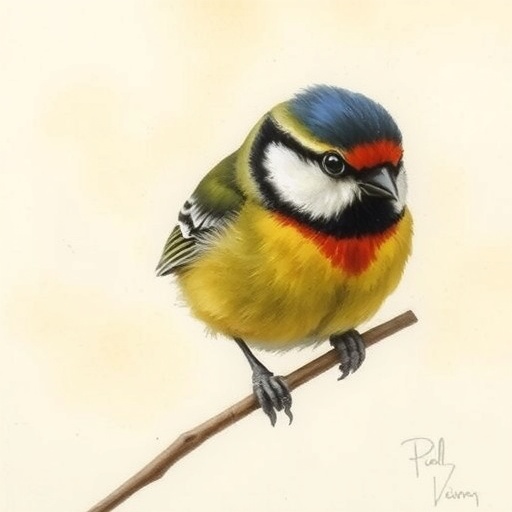
In a striking exploration of avian behavior, researchers have delved into the cognitive responses of coal tits, scientifically known as Periparus ater, when confronted with aversive food stimuli. This cutting-edge research addresses critical questions regarding the animals’ hoarding motivation and memory functions, providing insights that could revolutionize our understanding of avian cognitive processes. The investigation centers on how these small birds navigate challenges of food scarcity and aversive taste and the implications these behaviors have for their survival and ecology.
Coal tits are known for their remarkable ability to hoard food, a trait essential for their survival during colder months when food sources are limited. The research team adopted a rigorous experimental design to evaluate how these birds recognize, remember, and react to food they find unpalatable or potentially harmful. This aspect of their behavior reflects the complex interplay between sensory perception and cognitive assessments, as coal tits must balance immediate needs with long-term strategy in their foraging behavior.
Past studies have provided a foundation for understanding avian responses to food sources. However, the current research narrows in on the specifics of aversive food experiences. The experiment comprised offering the coal tits various food items, some of which were laced with aversive components. The key measures included the birds’ willingness to consume food after an unpleasant experience and their ability to recall locations where they had encountered these aversive foods.
Key findings revealed that coal tits displayed significant hesitation when approaching food they had previously associated with negative experiences. This behavioral aversion suggests an advanced level of memory recall, wherein the birds can link unpleasant sensations to specific food types or even locations. Such capabilities indicate a sophisticated cognitive architecture and highlight the adaptability of these birds to their ecological niches.
The memory aspect observed in this study brings forth intriguing discussions on the neural mechanisms underlying avian cognition. Researchers propose that the coal tits’ brain structure may facilitate complex memorization and problem-solving skills similar to those found in mammals. These findings raise critical questions about the evolutionary advantages of developing such cognitive traits and how they may relate to environmental pressures faced by these birds.
As the study unfolds, it becomes evident that these insights can transcend mere anecdotal observations. They provide substantial data regarding how coal tits manage their foraging strategies in the wild. The implications of understanding aversive food responses extend beyond individual survival tactics, influencing broader ecological dynamics, particularly in the context of food availability and species interactions.
Interestingly, the research also identifies variations between different populations of coal tits regarding their responses to aversive stimuli. This denotes potential for geographical or environmental factors shaping cognitive traits among avian species. Therefore, understanding how these local adaptations occur and their implications for resilience and survival can enhance conservation strategies, especially in rapidly changing ecosystems.
The role of memory in guiding behavioral decisions is monumental in establishing frameworks for animal behavior studies. Through the lens of this research on coal tits, scientists can further grasp how animals utilize past experiences to inform their current decisions. This insight echoes through other avian species and could potentiate further inquiry into how various animals perceive threats and opportunities based on lived experiences.
The methodology employed in the research is noteworthy. With a keen focus on isolating cognitive responses through controlled trials, the researchers could effectively simulate real-world scenarios, presenting a variety of food stimuli while observing the birds’ responses under varying conditions. This meticulous approach not only strengthens the validity of the findings but also sets a benchmark for future cognitive research on related species.
Moreover, the implications of aversive responses extend into the realms of animal welfare and environmental management. If certain food sources could induce long-term aversions, this might affect feeding behaviors and survival rates in wild populations. Conservationists and ecologists can utilize this information to predict and analyze how population dynamics might shift in response to environmental changes, including food resource availability and quality.
Fostering a nuanced understanding of avian cognition opens new avenues in the study of behavioral ecology. The findings suggest that coal tits may employ a unique mix of learned aversive responses and instinctual behaviors, showcasing their impressive adaptability to varying challenges. Observing such adaptability can shed light on how other species, including those faced with harsher environmental changes, might also adjust their behaviors over time.
As this research finds its way into broader scientific discussions, it emphasizes the importance of interdisciplinary dialogues between cognitive science, ecology, and evolutionary biology. The fascinating behaviors exhibited by coal tits in response to adverse food experiences might indeed serve as a microcosm of broader ecological principles that underline survival and interface between organisms and their environments.
In conclusion, the exploration surrounding coal tit responses to aversive food provides a compelling narrative within behavioral research and cognitive studies on avian species. The implications of harnessing memory and adapting to adverse stimuli could resonate across various fields, hinting that these small birds possess a maze of cognitive strategies crucial for their survival. As we delve deeper into the intricate lives of these remarkable birds, scholars are encouraged to broaden their inquiries into how these lessons might apply to other species facing the challenges of a rapidly changing world.
O’Hagan, D.D., Donley, D., Yeung, S.W.Y. et al. Correction: Responses of coal tits (Periparus ater) to aversive food: insights into hoarding motivation and memory.
Anim Cogn 28, 71 (2025). https://doi.org/10.1007/s10071-025-01986-7
Cite this news
SCIENMAG. (January 22, 2026). Coal Tits’ Aversive Food Responses: Hoarding and Memory. https://scienmag.com/coal-tits-aversive-food-responses-hoarding-and-memory/
SCIENMAG. "Coal Tits’ Aversive Food Responses: Hoarding and Memory." Scienmag, 22 January 2026, https://scienmag.com/coal-tits-aversive-food-responses-hoarding-and-memory/. Accessed 28 August 2026.
SCIENMAG. "Coal Tits’ Aversive Food Responses: Hoarding and Memory." Scienmag. January 22, 2026. https://scienmag.com/coal-tits-aversive-food-responses-hoarding-and-memory/


