


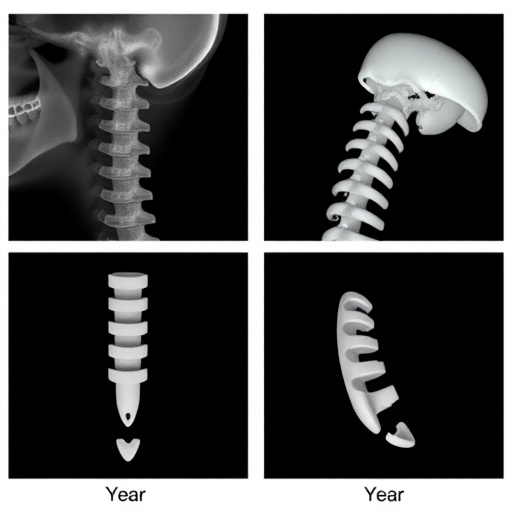
In a groundbreaking study published in the journal 3D Print Med, researchers, led by Aleinikov et al., have conducted a comprehensive evaluation of three-dimensional (3D) printed personalized vertebral implants that have been developed to address the significant challenges faced in spinal surgeries, particularly after a total En-Bloc spondylectomy. This innovative approach marries advanced biomedical engineering with clinical practice, potentially revolutionizing the surgical landscape for patients suffering from complex spinal disorders.
The study focused on a two-year follow-up of patients who received these personalized implants, reflecting not only on their biomechanical properties but also on their clinical outcomes. Traditional methods of spinal implant design often follow a one-size-fits-all model, which can lead to complications such as improper fit, insufficient stability, and increased rates of revision surgeries. However, with the advent of 3D printing technology, there has emerged an opportunity to create customizable implants tailored to the anatomical and biomechanical needs of individual patients.
The research team first highlighted the importance of employing precise imaging techniques such as MRI and CT scans for creating a 3D model of the patient’s vertebral anatomy. This patient-specific modeling is crucial since it allows the implants to not only fit the unique curvatures and dimensions of the spine but also address the load-bearing requirements dictated by each patient’s physical activity and overall health status. By integrating these factors, the implants can enhance the affinity towards integration with host tissues and reduce the time required for healing.
Once the personalized designs were finalized, the team employed state-of-the-art 3D printing technology to fabricate the implants using biocompatible materials. These materials were chosen for their mechanical properties, which must mirror that of natural bone to foster a successful osseointegration. The researchers were meticulous in ensuring mechanical testing was performed to validate the implants’ strength and durability prior to clinical application. Such rigorous preclinical evaluations are not only standard practice but essential for ensuring patient safety.
Following the surgical procedure, the clinical evaluation was centered on understanding both the efficacy of the implants and their long-term performance. Patients were monitored for complications such as infection, implant displacement, or any signs of tissue rejection. Satisfaction scores were also systematically collected to gauge the postoperative quality of life. Notably, the researchers observed low rates of complication among those with personalized implants compared to historical controls who received off-the-shelf solutions.
Another significant aspect of this study was the evaluation of the biomechanical performance of these implants over time. Using both radiological assessments and biomechanical modeling, the researchers tracked the overall integration of the implants with the host vertebral structure and the surrounding tissue. Such analysis not only proves the viability of these implants but also serves as a diagnostic tool for assessing future patients’ needs in similar contexts.
Patient feedback was overwhelmingly positive, with many reporting enhanced mobility and pain reduction compared to their pre-surgery status. This improvement in clinical outcomes is indicative of the potential benefits of personalized medicine in spinal surgeries. The authors emphasized the need for ongoing research to explore the long-term outcomes of these implants, which will help further solidify their role in surgical interventions.
For many patients, the prospect of having a personalized implant may mitigate the psychological burdens associated with traditional spinal surgeries that often evoke fears of inadequacy in the healing process. The study’s findings encourage a shift in the narrative surrounding spinal surgeries, focusing on innovative solutions that advocate for patient-centered care while leveraging advancements in technology.
In addition to clinical workflows, this study also opens avenues for collaboration among various disciplines. Engineers, surgeons, and material scientists can play integral roles in advancing the future of personalized implants, exploiting multi-faceted approaches to design, manufacture, and evaluate advancements in spinal surgery techniques. Interdisciplinary research is essential as solutions to complex medical problems often reside at the intersection of multiple fields.
Moreover, the implementation of 3D printing technology in hospitals for on-demand production of implants could transform resource management within surgical units. It could reduce costs, enhance surgical preparedness, and significantly decrease the time required for patients to receive necessary interventions. As hospitals gear up for the future of spine surgery, the adoption of personalized implants offers tangible solutions to lingering challenges in patient outcomes and surgical efficacy.
In summary, Aleinikov et al.’s pioneering study on 3D-printed personalized vertebral implants not only contributes to the existing body of knowledge but reinforces the notion that customized medical solutions can lead to markedly improved patient outcomes. The ongoing assessment of these implants will be crucial in shaping future guidelines and ensuring that innovations in biomedical engineering continue to translate into meaningful clinical advances.
The findings of this research encapsulate a hopeful narrative in the realm of medical technology. As more studies emerge, the potential for enhanced surgical success and improved patient quality of life becomes increasingly tangible. The field stands at the brink of a new era, where engineering precision can directly influence surgical responsibility, ultimately transforming the patient experience.
Cite Scienmag News
Ophelia Keating. (January 22, 2026). Two-Year Outcomes of 3D-Printed Vertebral Implants. Scienmag. https://scienmag.com/two-year-outcomes-of-3d-printed-vertebral-implants/
Ophelia Keating. "Two-Year Outcomes of 3D-Printed Vertebral Implants." Scienmag, 22 January 2026, https://scienmag.com/two-year-outcomes-of-3d-printed-vertebral-implants/. Accessed 6 September 2026.
Ophelia Keating. "Two-Year Outcomes of 3D-Printed Vertebral Implants." Scienmag. January 22, 2026. https://scienmag.com/two-year-outcomes-of-3d-printed-vertebral-implants/


