


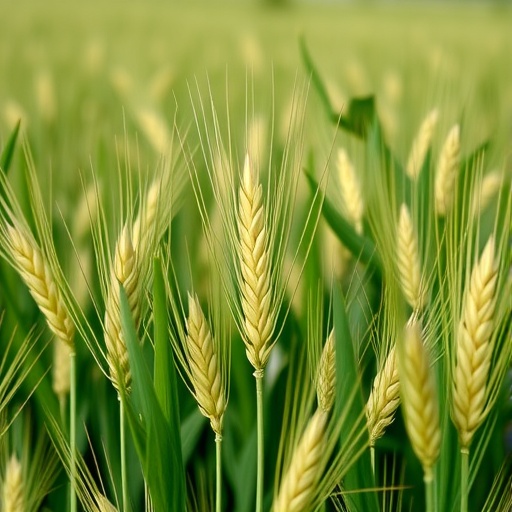
In a groundbreaking study published in Nature Food, researchers have unveiled critical insights into the agronomic management of wheat, especially in the high-yielding environments of northwest Europe. This research is particularly timely as concerns mount about the stagnation of wheat yields that threaten global food security. The findings suggest that innovative agricultural practices are pivotal to overcoming the yield plateau that has persisted despite advancements in agricultural technology.
The authors, led by Silva, J.V., along with Rijk, B. and Berghuijs, H.N.C., conducted extensive field studies across various growing seasons, examining different agronomic techniques and their effects on wheat production. The study highlights how specific management practices, including crop rotation, soil health improvement, and precise nutrient application, can significantly enhance yield outcomes. As the understanding deepens, these practices could be essential in shaping the future of wheat cultivation in regions facing similar challenges.
Central to the researchers’ findings is the observation that traditional agronomic methods are becoming inadequate in maximizing wheat yields. The scientists argue that the implications of climate change, alongside the pressure of rising global populations, necessitate a reassessment of existing agricultural methodologies. By employing advanced statistical analyses and long-term field experiments, the team was able to document the positive impacts of agronomic innovations on crop productivity.
Part of the study’s success hinges on its focus on high-yielding environments, where the implementation of tailored agronomic practices resulted in notable yield increases. These environments, characterized by optimized growing conditions, provide a unique opportunity for researchers to explore the full potential of wheat varieties. The study emphasizes that while high initial yields can be achieved, sustaining those yields requires ongoing innovation in farming techniques.
In discussing the crop management strategies examined, the research identifies soil health as a cornerstone of successful wheat production. The importance of integrating cover crops, diverse rotations, and reduced tillage is underscored. These practices improve soil structure, enhance nutrient availability, and promote microbial health, all of which are essential for maintaining high yields over time.
Moreover, the research delves into precision agriculture techniques, which utilize technology to optimize input use. This includes employing sensors and data analytics to monitor soil conditions and plant health, guiding more efficient resource application. The authors highlight how these approaches not only bolster productivity but also contribute to sustainable farming by minimizing waste and reducing environmental impacts.
The significance of applied research in advancing agricultural practices cannot be overstated. The study by Silva et al. serves as an important reminder that continuous learning and adaptation are vital components of successful farming. It calls upon farmers, agronomists, and policymakers to embrace research-backed strategies to mitigate the risks associated with stagnant yields.
Another key aspect highlighted by the study is the economic feasibility of implementing new agronomic techniques. The researchers provide insights into the cost-benefit dynamics of these practices, suggesting that, in most cases, the initial investment pays off through increased yields and lower operational costs over time. Farmers are likely to be more open to adopting new methods if they can clearly see the potential for profit.
Additionally, the study contributes to the broader discourse on food security and sustainable agriculture. By addressing the complexities of high-yield wheat production, Silva and colleagues offer pathways for increasing food availability in a world where demand is ever-increasing. The implications are particularly significant for developing nations, where agricultural productivity is vital for economic stability and individual livelihoods.
As the agricultural community looks to the future, the insights from this study will serve as a motivational framework for researchers and practitioners alike. Understanding that yield plateaus can be addressed through informed agronomic practices fosters a sense of hope and possibility. The collaborative efforts between science and agriculture are paramount as they seek to secure food sources for coming generations.
The impacts of this research extend beyond wheat; they lay foundational knowledge that can be applied across other crops faced with similar yield challenges. This research thus encourages an interdisciplinary approach to agriculture, whereby lessons learned from wheat cultivation can guide innovations in the production of other staple crops.
Future research in this domain will likely focus on other environmental factors, such as climate variability and pest management, that impact yield outcomes. By continuing to explore these interconnected aspects, the agricultural sector can more effectively combat the challenges that contribute to yield stagnation.
In conclusion, the comprehensive research conducted by Silva and his team illuminates the path forward for high-yield wheat farming in northwest Europe. By embracing innovative agronomic practices and fostering a culture of experimentation, the agricultural community can strive not only to overcome yield plateaus but to ensure a secure food supply amid global changes.
As the findings from this pivotal study resonate across agricultural sectors, they remind us that the boundaries of innovation in farming are still being defined. With each new study, the possibilities for increasing productivity, enhancing sustainability, and ultimately securing the future of food grow increasingly tangible.
Cite Scienmag News
Alan Morgan. (January 20, 2026). Optimized Agronomy Sustains Wheat Yields in Northwest Europe. Scienmag. https://scienmag.com/optimized-agronomy-sustains-wheat-yields-in-northwest-europe/
Alan Morgan. "Optimized Agronomy Sustains Wheat Yields in Northwest Europe." Scienmag, 20 January 2026, https://scienmag.com/optimized-agronomy-sustains-wheat-yields-in-northwest-europe/. Accessed 4 September 2026.
Alan Morgan. "Optimized Agronomy Sustains Wheat Yields in Northwest Europe." Scienmag. January 20, 2026. https://scienmag.com/optimized-agronomy-sustains-wheat-yields-in-northwest-europe/


