


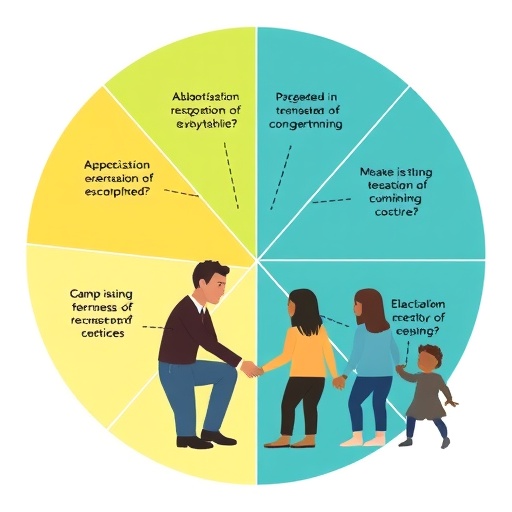
In a groundbreaking new study set to reshape our understanding of adolescent development, researchers E. Işık and B. Yılmaz Alıcı delve deeply into the intricate web of family influence and its pivotal role in shaping adolescent well-being. Their work, published in the esteemed journal BMC Psychology in 2026, offers a rigorous empirical test of the career construction model of adaptation, revealing how familial dynamics underpin the psychological resilience and adaptability of young people navigating critical transitional phases.
Adolescence represents a uniquely turbulent period characterized by rapid biological, cognitive, and emotional changes. Against this backdrop, the family emerges as the primary microsystem within which young individuals negotiate their evolving identities and aspirations. Işık and Yılmaz Alıcı’s research explicitly frames family influence not just as a contextual factor but as a dynamic force that impacts the construction of career and life trajectories—core components of adaptive functioning according to the career construction model.
The career construction model—originally proposed by Savickas—posits that career development is an adaptive process through which individuals impose meaning on their vocational experiences, shaping identity and future orientation. The key innovation in this study lies in its extension of this model into the psychosocial domain of adolescence, testing whether family influence serves as a catalyst or hindrance in the adaptive cycle. By integrating psychosocial well-being metrics with career construction variables, the researchers provide a sophisticated multidimensional analysis rarely found in adolescent psychology studies.
Their methodology employed a longitudinal design that tracked a diverse cohort of adolescents over multiple years, incorporating quantitative assessments of family cohesion, parental support, and adolescent psychosocial health variables. This design allowed for the disentangling of causal pathways and temporal patterns, shedding light on how family interactions dynamically influence adaptive career construction processes over time. The robustness of the data was further enhanced by sophisticated statistical modeling that accounted for covariates such as socioeconomic status and educational background.
One of the striking findings from this research is the differentiated impact of various family factors on adolescent well-being through the lens of career adaptation. Warmth and support from parents emerged as strong positive predictors not only of higher career adaptability but also of subjective well-being—highlighting that emotional availability in family environments acts as a foundational resource that buffers stress and promotes positive identity formation. Conversely, familial conflict and lack of support substantially undermined adaptive capacities, correlating with increased psychological distress and career indecision.
Moreover, Işık and Yılmaz Alıcı’s inquiry reveals how these family influences intersect with adolescents’ developmental tasks, such as exploring vocational interests and establishing autonomy. Adaptation is shown to be optimized when family environments strike a delicate balance—offering guidance and encouragement while respecting the adolescent’s growing need for independence. This nuanced view challenges earlier paradigms that viewed parental involvement in adolescence as potentially overbearing or detrimental, instead showing that strategically supportive family dynamics are critical for healthy psychosocial adaptation.
From a neuropsychological perspective, the research draws connections between family-mediated stress regulation mechanisms and cognitive flexibility needed for career construction. Adolescents experiencing positive family interactions exhibited more adaptive executive functioning patterns, facilitating better decision-making and problem-solving abilities essential for navigating the emerging challenges of educational and occupational pathways. These findings contribute to a growing literature linking social and emotional support systems with neurodevelopmental outcomes critical in adolescence.
The implications of this study are vast for educational policy, clinical interventions, and family systems approaches. By underscoring the role of family influence as a modifiable factor in adolescent well-being and career development, the authors advocate for integrated intervention frameworks that simultaneously target family dynamics and individual adaptive strategies. Such approaches could prove transformative in mitigating risk factors for mental health disorders while empowering youth trajectories toward fulfilling adult roles.
Perhaps most compellingly, this research harnesses the career construction model as a theoretical backbone to unify disparate strands of adolescent psychological research, infusing a systemic and longitudinal perspective into the field. This synergy between developmental psychology, career counseling, and family studies marks a paradigm shift, positioning career adaptability as both a product and a process of familial interaction and resilience building.
Işık and Yılmaz Alıcı also highlight the need for culturally sensitive models of family influence, recognizing that familial roles and expectations vary significantly across cultural contexts, which in turn modulate the pathways through which career construction processes occur. Their sample, drawn from a multicultural demographic, allowed preliminary exploration of these nuances, pointing to fertile grounds for future cross-cultural research.
Furthermore, the study addresses the pressing global challenge of adolescent mental health crises by elucidating mechanisms of protective family influence. As mental health disorders continue to rise worldwide in young populations, identifying family-based levers to enhance resilience and adaptive capacity presents a vital public health opportunity.
In their conclusive remarks, the authors contend that promoting family cohesion and supportive parenting practices can have cascading positive effects on adolescent career development and holistic well-being. This integrative perspective advocates for collaborative efforts among educators, mental health professionals, and policymakers to design youth-centered programs that emphasize family engagement as a core component.
The innovative use of longitudinal and multidimensional metrics in this study sets a new benchmark for research quality in the field. It inspires future investigations to incorporate similarly rigorous designs to unpack the complex interplay between individual agency and social context in adolescent adaptation processes.
Ultimately, this seminal research not only expands theoretical understanding but also offers practical pathways for enhancing adolescent well-being by leveraging the family system. As societies grapple with rapid social changes and uncertainties introduced by technological and economic transformations, equipping youth with adaptive capabilities rooted in strong family support systems has perhaps never been more critical.
As this article gains traction within psychology and social science communities, its viral potential lies in resonating with a universal audience—parents, educators, clinicians, and young people themselves—who recognize the powerful influence of family as a cornerstone of human flourishing in an increasingly complex world.
Cite Scienmag News
Gavin Prescott. (January 20, 2026). Family Impact on Teen Well-Being: Career Adaptation Tested. Scienmag. https://scienmag.com/family-impact-on-teen-well-being-career-adaptation-tested/
Gavin Prescott. "Family Impact on Teen Well-Being: Career Adaptation Tested." Scienmag, 20 January 2026, https://scienmag.com/family-impact-on-teen-well-being-career-adaptation-tested/. Accessed 3 September 2026.
Gavin Prescott. "Family Impact on Teen Well-Being: Career Adaptation Tested." Scienmag. January 20, 2026. https://scienmag.com/family-impact-on-teen-well-being-career-adaptation-tested/


