


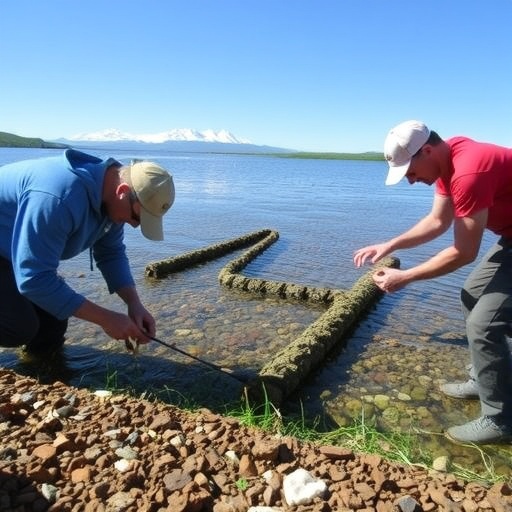
In a groundbreaking study that promises to transform the landscape of environmental science, researcher R. Kornijów has delved into the intricate methodologies surrounding the sampling and maintenance of sediment cores in mesocosm experiments. This research holds immense significance, given the crucial role of sediment in aquatic ecosystems and the potential impacts of anthropogenic activities on these environments. Understanding the nuances of sediment dynamics can pave the way for developing sustainable practices and effective strategies to mitigate pollution and habitat degradation.
Sediment cores serve as essential records of historical environmental conditions. They encapsulate layers of sediment that have accumulated over time, providing insights into past ecological states, biogeochemical transformations, and the impacts of climate change. Kornijów emphasizes the necessity of obtaining intact sediment cores to ensure the fidelity of the samples during experiments. This precise methodology is critical for accurately interpreting the complex interactions between sediment and the surrounding aquatic environment.
One of the primary challenges in collecting sediment cores is the potential disturbance that occurs during the sampling process. Disturbances can lead to alterations in the physical and chemical properties of the sediment, thereby skewing the results of subsequent experiments. Kornijów outlines various techniques that minimize these disturbances. By employing specialized coring devices and following strict protocols, researchers can successfully extract sediment cores with minimal disruption, preserving the natural structure and composition of the sediment.
The maintenance of sediment cores post-sampling is another pivotal aspect that Kornijów addresses in this vital research. Often, cores are transported and stored in a manner that compromises their integrity. The study advocates for controlled environmental conditions during transport, including temperature regulation and protection from light exposure. These factors are vital to maintaining the biological communities and chemical signatures present within the cores, which are essential for conducting meaningful experiments.
In addition to the technical aspects of sampling and maintenance, Kornijów’s research highlights the importance of employing diverse experimental designs within mesocosm studies. This approach affords scientists the opportunity to model various environmental scenarios and assess potential impacts more comprehensively. By integrating multiple variables, including nutrient levels and exposure to pollutants, researchers can simulate real-world conditions more effectively, leading to a more profound understanding of how ecosystems respond to change.
Moreover, the findings presented in Kornijów’s study also have broader implications for policy and management strategies regarding environmental conservation. As scientists uncover the intricate links between sediment dynamics and ecosystem health, policymakers can make informed decisions that prioritize the sustainability of aquatic environments. The research ultimately aims to bridge the gap between scientific inquiry and practical action, fostering a more environmentally conscious society.
Kornijów also points to the pressing need for interdisciplinary collaboration in sediment research. Involving experts from various fields, including geology, ecology, and environmental science, can lead to holistic approaches in addressing the challenges facing our water bodies. By pooling knowledge and resources, researchers can develop innovative solutions tailored to local ecosystems, thus enhancing the efficacy of conservation efforts.
The study additionally emphasizes the significance of engaging with local communities in the research process. By involving stakeholders, scientists can better understand the socio-economic factors that influence sediment management practices. This collaborative effort not only fosters community stewardship but also ensures that research outcomes are relevant and applicable to real-world situations.
As researchers continue to unravel the complexities of sediment dynamics, Kornijów’s work serves as an indispensable guide for those venturing into mesocosm experiments. Its comprehensive overview of sampling and maintenance techniques, coupled with an emphasis on maintaining ecological integrity, sets a new standard within the field. There is a growing recognition that effective sediment management is integral to the conservation of aquatic ecosystems, and Kornijów’s study is a critical stepping stone in this vital area of research.
Future research inspired by this work will likely seek to explore the long-term effects of sediment disturbances, evaluate the resilience of aquatic ecosystems, and develop advanced technologies for sediment monitoring and analysis. The insights gained from Kornijów’s research could lead to groundbreaking innovations that enhance our understanding of ecological processes and ultimately benefit global environmental health.
In conclusion, Kornijów’s study highlights the significance of meticulous sampling and maintenance practices in sediment core research, elucidating the relationship between sediments and ecosystem health. With an eye toward fostering sustainable practices and advancing scientific inquiry, this research underlines the importance of sediment studies in formulating effective environmental management strategies. As the scientific community digests these findings, it is evident that the path forward lies in collaborative, innovative, and practical approaches to sediment research.
Kornijów, R. Sampling and maintenance of intact sediment cores for mesocosm experiments. Environ Sci Pollut Res (2026). https://doi.org/10.1007/s11356-026-37422-7
Cite Scienmag News
Violet Maxwell. (January 20, 2026). Capturing Intact Sediment Cores for Mesocosm Research. Scienmag. https://scienmag.com/capturing-intact-sediment-cores-for-mesocosm-research/
Violet Maxwell. "Capturing Intact Sediment Cores for Mesocosm Research." Scienmag, 20 January 2026, https://scienmag.com/capturing-intact-sediment-cores-for-mesocosm-research/. Accessed 4 September 2026.
Violet Maxwell. "Capturing Intact Sediment Cores for Mesocosm Research." Scienmag. January 20, 2026. https://scienmag.com/capturing-intact-sediment-cores-for-mesocosm-research/


