


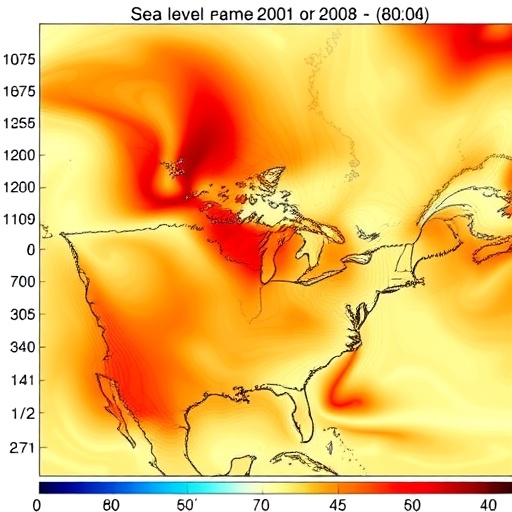
Climate change poses a pressing challenge to our understanding of environmental dynamics, particularly as sea levels continue to rise due to an array of factors. The intricate interplay between climate measurements and regional mean sea level has become a focal point for researchers aiming to predict future scenarios and formulate effective responses. A recent study conducted by Elnabwy, Kaloop, and Elbeltagi offers valuable insights into this domain, utilizing a cutting-edge technique known as stacked ensemble modeling to enhance the accuracy of sea level predictions. This meticulous research effort underscores the importance of leveraging advanced methodologies to yield reliable outcomes in the face of uncertainty.
The study examines how regional mean sea levels are influenced by various climate variables, including temperature fluctuations, precipitation patterns, and atmospheric pressure. Understanding the connections between these factors is crucial for effective climate modeling. As global temperatures rise, the melting of polar ice caps and glaciers, coupled with thermal expansion of seawater, exacerbates the rise in sea levels. By integrating these elements within their stacked ensemble model, the researchers aim to create a more robust framework for predicting mean sea levels in specific regions.
One of the key innovations in their approach is the implementation of a stacked ensemble technique, a method that combines multiple predictive models to improve forecast accuracy. This strategy allows researchers to utilize the strengths of different algorithms while mitigating the weaknesses inherent in any single model. By aggregating predictions from varied models, they can achieve a consensus forecast that better reflects the complexities of environmental systems. The stacked ensemble model was employed on a wealth of climatic datasets, allowing for comprehensive analysis and nuanced understanding.
The ensemble method involves training several base models, each of which generates independent predictions based on the input variables. These predictions are then aggregated using a meta-model, which optimally weighs the contributions of each base model. This layered approach not only enhances predictive performance but also enables the identification of patterns and relationships within the data that may otherwise remain obscured in traditional modeling frameworks. Such advances in modeling techniques signal a significant evolution in how climate data can be interpreted and used.
Furthermore, the research emphasizes the critical role of accurate climate datasets in forming the foundation of reliable sea level forecasts. The researchers meticulously curated a comprehensive dataset, combining long-term climate data with regional observations to enhance the fidelity of their analysis. This integration is vital for capturing the diverse influences on sea level changes across different geographic locales, which can exhibit markedly different trends due to local climatic conditions. By grounding their work in robust data, the study bolsters the credibility of its findings and recommendations.
The ramifications of this research extend beyond academic circles; they hold practical implications for policymakers and urban planners in coastal regions. As sea levels continue to rise, thousands of communities worldwide face the immediate threat of flooding, erosion, and habitat loss. Accurate predictions of regional mean sea levels empower decision-makers to craft informed strategies regarding land use, infrastructure development, and disaster preparedness. By equipping stakeholders with reliable data, researchers can help mitigate the adverse effects of climate change and enhance resilience among vulnerable populations.
In addressing the potential implications of their findings, the researchers note that their model’s accuracy can significantly help forecast future scenarios under various climate change trajectories. With projections indicating that sea levels may rise by several feet by the end of the century, understanding the dynamics of these changes at a regional level becomes increasingly critical. The ability to simulate different climate scenarios allows for targeted responses, enabling communities to prioritize initiatives that directly address their unique risks and vulnerabilities.
Moreover, the study also highlights the need for ongoing research and collaboration across disciplines as a means of enriching the understanding of climatological impacts on sea levels. As climate change is a multifaceted challenge, insights derived from fields such as oceanography, meteorology, and geography must be synthesized for a holistic perspective. Collaborative efforts can foster innovation in modeling techniques while bringing forth diverse expertise that can enhance the interpretative capacity of environmental data.
In summary, the research conducted by Elnabwy, Kaloop, and Elbeltagi advocates for the integration of sophisticated modeling practices in the pursuit of accurate sea level forecasting. Their stacked ensemble approach presents a valuable tool for deciphering the complex relationships between climatic variables and mean sea levels while providing actionable insights for those mitigate the impending impacts of climate change. As global temperatures continue to fluctuate and reshape the planet’s environments, this research represents a crucial step towards understanding and addressing the challenges posed by rising sea levels.
As we look to the future, maintaining momentum in this area of research will be paramount. With the stakes so high, ongoing advancements in predictive modeling can play a significant role in safeguarding our coasts and communities from the emerging threats of climate change. By harnessing the insights of such studies, we can better equip ourselves to face the environmental crises that lie ahead, ultimately fostering resilience and sustainability in the face of an uncertain world.
In conclusion, the endeavor outlined in this research not only contributes to the scientific community’s understanding of sea level changes but also serves as a clarion call for action. The fight against climate change necessitates a well-informed populace and proactive innovators willing to push the envelope of what’s achievable within our understanding of environmental science. Collaborative research like this sets the stage for future breakthroughs that could fundamentally alter how humanity interacts with its environment, emphasizing the importance of adaptable strategies to foster long-term viability in the face of climate change.
Ultimately, the urgency of addressing rising sea levels has never been more pronounced. As communities grapple with the direct consequences of climate change, leveraging reliable predictive modeling becomes an essential part of the toolkit for adaptation and resilience. The innovative work of Elnabwy and colleagues holds promise not only for advancing scientific understanding but also for guiding practical solutions that can protect vulnerable populations in a warming world.
Elnabwy, M.T., Kaloop, M.R., Elbeltagi, E. et al. Modeling regional mean sea level based on climate measurements using a stacked ensemble approach.
Environ Monit Assess 198, 147 (2026). https://doi.org/10.1007/s10661-026-14981-3
Cite Scienmag News
Violet Maxwell. (January 19, 2026). Stacked Ensemble Method Predicts Regional Sea Level Changes. Scienmag. https://scienmag.com/stacked-ensemble-method-predicts-regional-sea-level-changes/
Violet Maxwell. "Stacked Ensemble Method Predicts Regional Sea Level Changes." Scienmag, 19 January 2026, https://scienmag.com/stacked-ensemble-method-predicts-regional-sea-level-changes/. Accessed 9 November 2026.
Violet Maxwell. "Stacked Ensemble Method Predicts Regional Sea Level Changes." Scienmag. January 19, 2026. https://scienmag.com/stacked-ensemble-method-predicts-regional-sea-level-changes/




