


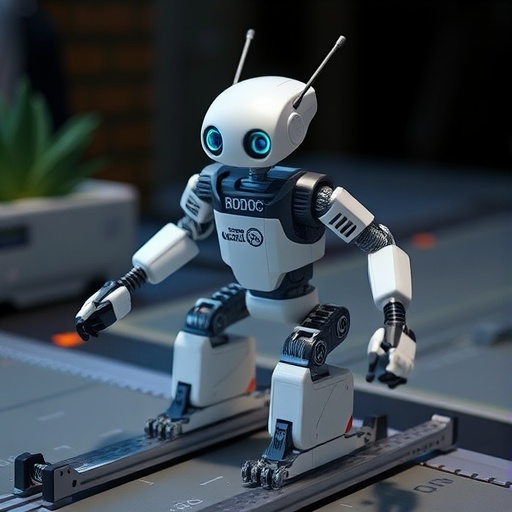
Innovations in robotics have paved the way for advanced systems that promise to transform industries, enhance automation, and augment human capabilities. In the forefront of this movement is the recent work by Scheide, Best, and Hollinger, who delve into the intricacies of synthesizing compact behavior trees specifically tailored for probabilistic robotics domains. Their research, slated for publication in the forthcoming issue of Autonomous Robots, invites both curiosity and excitement across the fields of artificial intelligence and robotics.
A central tenet of their findings is the concept of behavior trees, which have emerged as a popular architectural framework for guiding decision-making processes in robotic systems. Unlike traditional state machines, behavior trees offer a hierarchical structure that is both modular and extensible. In essence, they allow robots to conduct complex tasks by breaking them down into simpler actions while maintaining adaptability in unpredictable environments. As robots increasingly engage in real-world applications, the ability to synthesize compact behavior trees presents an intriguing solution to challenges posed by probabilistic uncertainties.
The synthesis process described in the paper showcases a novel approach that integrates the principles of decision-theoretic planning with hierarchical task networks. The authors meticulously outline the algorithms used to construct compact behavior trees that effectively manage uncertainties. The crux of their methodology lies in leveraging probabilistic reasoning to guide robots through environments where uncertainty is the norm rather than the exception. Such an innovation is not merely academic; it has profound implications for the deployment of robots across various sectors such as manufacturing, healthcare, and disaster response.
One of the remarkable aspects of their research is its focus on compactness. In a field often laden with complexity, the quest for succinct yet effective representations of behavior has far-reaching implications. Compact behavior trees are essential when considering resource-limited environments where computational efficiency is paramount. The authors argue that their proposed synthesis method not only reduces the computational overhead but also facilitates faster decision-making, thereby enhancing the overall performance of robotic systems.
In drawing comparisons with existing frameworks, Scheide and colleagues provide critical insights into how their synthesized behavior trees outperform traditional models. Through a series of simulations and practical applications, their synthesis technique demonstrates superior robustness and adaptability. The ability to manage a diverse range of tasks while maintaining efficiency is showcased in various scenarios, underscoring the potential of their approach across multiple domains.
Probabilistic robotics actively embraces the need for systems that can operate in uncertain environments. The authors’ synthesis method directly addresses this by enabling robots to adjust their behaviors based on real-time feedback from their surroundings. This feedback loop creates a dynamic interaction model where robots autonomously refine their decision-making processes, leading to improved outcomes in complex tasks. This autonomy is critical for applications that require a high degree of reliability and can significantly impact sectors where human oversight is limited or impractical.
Furthermore, the implications of compact behavior trees extend beyond operations. Such innovations signal a shift towards more intelligent, agile robotic systems capable of learning from experience. The authors present a compelling argument for the integration of machine learning techniques with robotic decision-making frameworks. As robots learn and adapt their behavior over time, the potential for enhancing productivity in industrial applications grows exponentially. For instance, in warehouse automation, a robot leveraging compact behavior trees can navigate through dynamic environments while optimizing its routes to minimize delays.
As the demand for sophisticated robotic systems continues to surge, the work of Scheide, Best, and Hollinger highlights the necessity of developing frameworks that cater to specific domain requirements. The effectiveness of their synthesized behavior trees can be attributed to their scalability, which allows them to be tailored for varying complexities of tasks. By teaching robots to manage both high-level goals and low-level actions seamlessly, their approach provides a blueprint for the future of robotic decision-making.
Moreover, the extensive theoretical background and practical validation presented in their research contribute to the growing body of knowledge in the field of robotics. By sharing their methodologies and findings, the authors encourage further exploration and experimentation within the research community. This openness not only fosters collaboration but also accelerates the pace of innovation, ensuring that the latest advancements in robotics benefit from collective insights and diverse experiences.
As we venture into an era where robots play increasingly prominent roles in everyday life, understanding the nuances of behavior synthesis becomes increasingly critical. The work presented by Scheide et al. speaks to a broader trend of interdisciplinary research that combines robotics with the principles of cognitive science and artificial intelligence. Their insights into behavior trees reflect a rich understanding of how robots can be designed to interact more naturally with their environments, thus paving the way for applications that bring forth human-robot collaboration to new heights.
In conclusion, the synthesis of compact behavior trees for probabilistic robotics, as outlined in this groundbreaking research, highlights the potential to revolutionize how robots operate in uncertain environments. By combining algorithmic efficiency with robust decision-making capabilities, this work marks a significant milestone in the quest for smarter, more autonomous robotics. As we continue to push the boundaries of what is possible with technology, the implications of this research will undoubtedly shape the future trajectories of robotic applications across various sectors.
Strong academic discourse backed by empirical data renders this work not merely an academic exercise but a stepping stone toward tangible advancements in robotic technology. The authors’ forward-looking approach demonstrates a deep commitment to advancing the field, igniting interest and fostering a spirit of innovation among researchers and practitioners alike. Ultimately, the synthesis of behavior trees not only represents a technical breakthrough but also embodies the essence of interdisciplinary collaboration that is essential for addressing the complex challenges of the modern world.
Cite Scienmag News
Denise Maddox. (January 19, 2026). Streamlining Behavior Trees for Probabilistic Robotics. Scienmag. https://scienmag.com/streamlining-behavior-trees-for-probabilistic-robotics/
Denise Maddox. "Streamlining Behavior Trees for Probabilistic Robotics." Scienmag, 19 January 2026, https://scienmag.com/streamlining-behavior-trees-for-probabilistic-robotics/. Accessed 4 September 2026.
Denise Maddox. "Streamlining Behavior Trees for Probabilistic Robotics." Scienmag. January 19, 2026. https://scienmag.com/streamlining-behavior-trees-for-probabilistic-robotics/


