


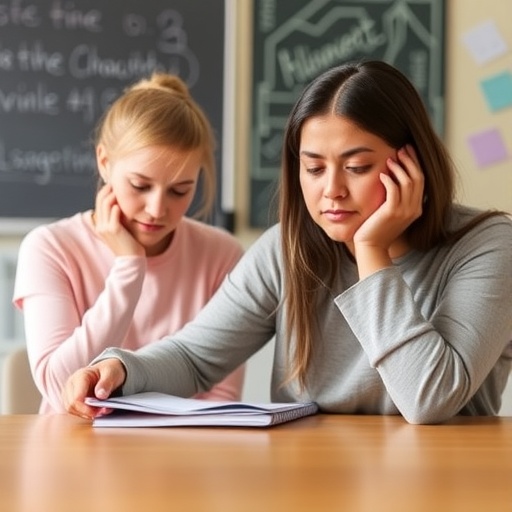
In an increasingly digital educational landscape, a new study sheds light on the intricate connections between teacher support and academic anxiety among high school students in China. The research, conducted by Li, Zhu, and Zhao, delves into the sequential mediating roles of self-efficacy and social media use, proving that the emotional and psychological facets of learning are as critical as the cognitive ones. As students navigate the pressures of academia, the support they receive from educators can significantly influence their mental health, a finding that resonates deeply with educational stakeholders.
The authors begin by establishing the foundational premise that teacher support plays a pivotal role in shaping students’ emotional and academic experiences. A supportive educational environment can foster resilience, inspire motivation, and reduce anxiety levels among students. However, the complexity arises when trying to understand how this support translates into tangible outcomes in students’ academic performance and psychological well-being. This study methodically examines the pathways through which teacher support can alleviate academic anxiety, emphasizing the roles of self-efficacy and social media as mediators.
According to the researchers, self-efficacy, defined as an individual’s belief in their capabilities to perform tasks and achieve goals, is a crucial interim step in this process. The findings reveal that when teachers offer support, they enhance students’ self-efficacy, which enables them to tackle academic challenges with greater confidence. This newfound confidence can help mitigate anxiety, allowing students to focus better on their studies. The authors argue that fostering self-efficacy should be a core aim for educational institutions, as it can act as a buffer against stressors associated with academic demands.
Simultaneously, the research discusses the dual-edged sword of social media use among students. While social media can serve as a platform for social interaction and additional educational resources, it can also exacerbate feelings of inadequacy and anxiety. The authors point out that the way students engage with social media is intricately linked to their self-efficacy and overall academic experience. As the present generation of high school students integrates social media into their daily lives, educators must recognize its potential impact on students’ mental health and academic performance.
The study’s methodology involved a comprehensive analysis of data collected from a diverse pool of Chinese high school students. By employing advanced statistical techniques, the researchers were able to investigate the relationships among teacher support, self-efficacy, social media use, and academic anxiety. The results indicate significant correlations, suggesting that students who receive robust support from their teachers typically report higher self-efficacy and lower levels of academic anxiety, regardless of their social media habits.
Interestingly, the findings also suggest that the mediating role of social media is not uniform. The impact of social media on academic anxiety varies based on how students use these platforms. For instance, students who use social media primarily for academic discourse tend to experience lower anxiety levels than those who engage in passive consumption or negative social comparison. This nuance is essential for educators and policymakers as they devise strategies to leverage social media positively in educational contexts.
One compelling aspect of this research is its focus on a population that often grapples with societal and educational pressures. In China, where academic success is often viewed as a primary pathway to future opportunities, the pressure on high school students can be overwhelming. The authors emphasize the importance of teacher support in this unique context, highlighting that a nurturing environment can significantly diminish the academic anxiety that plagues many students.
Moreover, this study offers a timely perspective as mental health issues among youth escalate globally. By unpacking the dynamics of teacher support, self-efficacy, and social media, educators and mental health professionals can better understand the factors influencing students’ mental health. This understanding is crucial not only for developing interventions but also for creating educational environments that prioritize the overall well-being of students.
Interestingly, the implications of this research extend beyond the classroom. It invites a broader conversation about the role of social systems in supporting young people. The researchers underscore that collaboration among teachers, parents, and mental health professionals is vital to combat academic anxiety effectively. This interconnected approach can create a more supportive ecosystem that enhances students’ resilience, emotional health, and academic success.
As educators consider their strategies and approaches, the findings of this study highlight the need for a balanced educational ideology that values emotional intelligence equally with intellectual capability. By cultivating supportive relationships with students, educators can empower them to engage with both academic content and social media in constructive ways.
The study concludes with a call to action for further research in this domain. While this study offers valuable insights, the complexities of the fast-evolving educational landscape demand ongoing investigation. Additional research can help to further dissect the nuances of these relationships, potentially informing how teacher training, systemic support, and policy changes can coalesce to create healthier educational environments.
In summary, Li, Zhu, and Zhao’s research contributes significantly to our understanding of the multifaceted relationship between teacher support, self-efficacy, and academic anxiety within the context of modern educational challenges. The compelling evidence illustrates that in order to effectively mitigate academic anxiety, stakeholders must not only reinforce teacher relationships but also critically engage with the role of social media as an educational tool, ensuring that it serves to enhance rather than hinder academic achievement and mental well-being.
Li, W., Zhu, X. & Zhao, H. Unpacking the Pathway from Teacher Support to Academic Anxiety: Sequential Mediation by Self-Efficacy and Social Media use Among Chinese High School Students.
Child Psychiatry Hum Dev (2025). https://doi.org/10.1007/s10578-025-01938-9
Cite Scienmag News
Glenn Wilkins. (January 19, 2026). Teacher Support’s Role in Academic Anxiety Unveiled. Scienmag. https://scienmag.com/teacher-supports-role-in-academic-anxiety-unveiled/
Glenn Wilkins. "Teacher Support’s Role in Academic Anxiety Unveiled." Scienmag, 19 January 2026, https://scienmag.com/teacher-supports-role-in-academic-anxiety-unveiled/. Accessed 3 September 2026.
Glenn Wilkins. "Teacher Support’s Role in Academic Anxiety Unveiled." Scienmag. January 19, 2026. https://scienmag.com/teacher-supports-role-in-academic-anxiety-unveiled/


