


In a groundbreaking advancement that challenges long-held conventions in transition metal chemistry, researchers have successfully isolated and characterized cobalt(IV)-oxo species, surmounting the so-called “oxo wall.” This barrier, historically considered a formidable obstacle for stabilizing high-valent oxo species in late transition metals, has restricted the scope of catalytic processes that leverage such reactive intermediates. The pioneering work, carried out by Tian, Zhang, Liu, and colleagues, reveals the remarkable catalytic efficiency of these elusive Co(IV)-oxo species when nanoconfined within a cerium-cobalt (Ce-Co) lamellar membrane, thus redefining both fundamental and applied aspects of transition metal oxide chemistry.
The concept of the “oxo wall,” originally derived from molecular orbital theories, describes a sharp decline in the stability of metal-oxo multiple bonds as one moves from early to late transition metals within the periodic table. Early transition metals such as manganese and iron readily form stable, high-valent oxo species instrumental in oxidative catalysis. However, the densely filled d orbitals of later metals like cobalt and nickel render their high-valent oxo counterparts exceedingly reactive and thus difficult to stabilize. Overcoming this limitation has been a long-standing challenge, as visible through decades of synthetic attempts and computational studies.
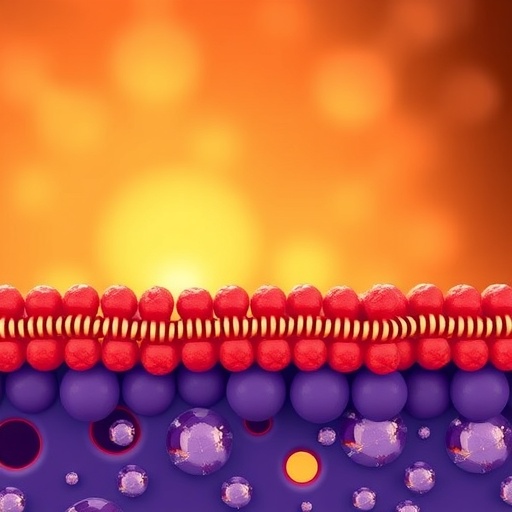
The research team tackled this challenge by exploiting a unique nanoconfined environment provided by the Ce-Co lamellar membrane structure. This two-dimensional layered material functions as a molecular scaffold that tightly controls the spatial arrangement and electronic environment around the cobalt centers. By confining the Co(IV)-oxo units within such a nanoscale architecture, the system harnesses steric and electronic stabilizations that suppress undesirable side reactions and promote the longevity of highly reactive species. The profound influence of nanoconfinement significantly alters the electronic structure of cobalt, enhancing its ability to sustain high oxidation states.
Spectroscopic evidence combined with density functional theory (DFT) calculations confirmed the formation of discrete Co(IV)-oxo species within the lamellar membrane. These observations challenge preconceived notions regarding metal-oxo stability and corroborate the hypothesis that physical confinement can redefine bonding paradigms in heavy transition metals. Notably, advanced X-ray absorption spectroscopy unveiled distinctive features consistent with robust multiple bonding between cobalt and oxygen, while electron paramagnetic resonance spectroscopy provided fingerprints of the high-spin state characteristic of Co(IV).
The catalytic implications of stabilizing Co(IV)-oxo species are immense considering that cobalt-based catalysts are typically more earth-abundant and cost-effective than their noble metal counterparts. The study demonstrated outstanding catalytic performance in oxidation reactions, including alkane hydroxylation and water oxidation, processes crucial for sustainable chemical synthesis and energy conversion. The Ce-Co membrane system outperforms conventional homogeneous and heterogeneous catalysts by combining high activity with remarkable selectivity under mild conditions.
This discovery signals a paradigm shift by bridging molecular and materials chemistry, whereby tuning the host matrix at the nanoscale facilitates access to unprecedented oxidation states and reactivity patterns. Such strategies might be broadly extended to other transition metals struggling to achieve similarly reactive intermediate species, opening pathways to novel catalytic cycles previously deemed inaccessible. This serves as a vivid example of how carefully engineered confinement effects can transcend traditional electronic and steric limitations.
The intricate balance between oxidation state stabilization and catalytic function represents the crux of this breakthrough. Whereas previous efforts have focused primarily on ligand design to enforce high-valent metal-oxo species stability, the current approach capitalizes on physical encapsulation in lamellar structures to achieve analogous control without extensive chemical modification. This could dramatically simplify synthetic routes and scalability of advanced oxidation catalysts for industrial applications involving selective functionalization of hydrocarbons and oxygen evolution reactions.
Beyond catalysis, the insights derived from this work extend to other fields such as environmental chemistry and energy storage. High-valent metal-oxo species are implicated in numerous biological processes, including enzymatic oxidation reactions essential for life. Enhancing our understanding of cobalt-oxo chemistry in constrained environments thus holds promise for biomimetic catalyst development and artificial photosynthetic devices. Moreover, the lamellar membrane itself offers tunable properties that might be exploited for sensor technologies and transition metal oxide electronics.
The interdisciplinary nature of this research, combining synthetic inorganic chemistry, materials science, spectroscopic characterization, and theoretical modeling, exemplifies the collaborative efforts needed to address complex chemical challenges. It underscores how modern analytical techniques coupled with innovative material design can accelerate discovery in seemingly intractable areas of chemistry. The successful observation and utilization of Co(IV)-oxo species herald a new horizon in transition metal oxide chemistry, inspiring further exploration into the delicate interplay between structure, oxidation state, and reactivity.
In addition to sustained catalytic performance, the durability and recyclability of the Ce-Co lamellar membrane catalyst highlight practical advantages. The robust architecture maintains structural integrity and oxidation state under repeated catalytic cycles, an essential attribute for industrial deployment. The comparatively facile synthesis of the lamellar membrane further increases its attractiveness as a scalable platform for advanced catalytic materials.
The theoretical underpinnings elucidated by the authors reveal fundamental changes in the electronic landscape when Co(IV)-oxo is embedded within the lamellar framework. Calculations indicate that confinement perturbs frontier orbital energies to facilitate strong metal-oxygen multiple bonding and restrict deleterious electron transfer processes that normally degrade such species. This nurtured electronic environment effectively lowers reaction energy barriers and enhances reaction kinetics, accounting for the observed enhanced catalytic rates.
Looking ahead, this seminal work opens numerous avenues of scientific inquiry, including exploration of similar confinement strategies for other challenging transition metal states and the design of heterostructured membranes to modulate catalytic pathways dynamically. The modular nature of lamellar membranes allows fine-tuning of interlayer spacing, composition, and functionality, providing powerful levers to optimize catalytic selectivity and efficiency tailored to specific chemical transformations.
The study’s robust mechanistic insights and compelling experimental validation establish a new benchmark for metal-oxo chemistry. It challenges researchers to rethink the “oxo wall” as not an insurmountable boundary but rather a dynamic frontier that can be negotiated through innovative molecular engineering and nanotechnology. As these design principles permeate broader catalysis research, we can anticipate accelerated development of sustainable catalytic systems that exploit late transition metal oxo species for green chemical synthesis and clean energy technologies.
In summary, Tian and colleagues have achieved a landmark accomplishment by synthesizing, characterizing, and applying Co(IV)-oxo species stabilized through nanoconfinement within a Ce-Co lamellar membrane. Their trailblazing strategy transcends traditional electronic limitations, enabling vibrant catalysis with earth-abundant metals that were previously relegated to less reactive roles. This research not only redefines core concepts in inorganic chemistry but also propels us closer toward environmentally friendly catalytic processes required for a sustainable future.
Cite Scienmag News
Bethany Barker. (January 16, 2026). Breaking Co(IV)-Oxo Barriers in Ce-Co Membranes. Scienmag. https://scienmag.com/breaking-coiv-oxo-barriers-in-ce-co-membranes/
Bethany Barker. "Breaking Co(IV)-Oxo Barriers in Ce-Co Membranes." Scienmag, 16 January 2026, https://scienmag.com/breaking-coiv-oxo-barriers-in-ce-co-membranes/. Accessed 4 September 2026.
Bethany Barker. "Breaking Co(IV)-Oxo Barriers in Ce-Co Membranes." Scienmag. January 16, 2026. https://scienmag.com/breaking-coiv-oxo-barriers-in-ce-co-membranes/


