


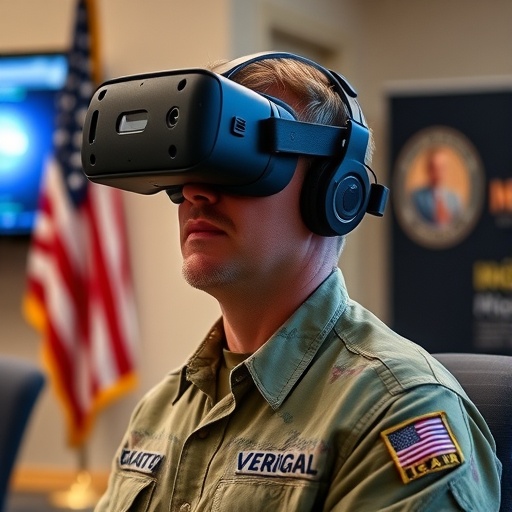
In an innovative research endeavor, a team led by Conroy et al. has ventured into the burgeoning field of virtual reality (VR) to address a pressing concern among an aging population: cognitive decline and motor function impairment in older Veterans. Their study, which is described as a “single-arm pilot study,” aims to explore the feasibility and initial effects of a unique form of non-immersive virtual reality motor-cognitive treadmill training. As the scientific community continues to seek solutions to combat aging-related issues, this research highlights the potential of blending technology with health intervention strategies.
The primary objective of this study is to determine whether non-immersive virtual reality can offer a practical and effective avenue for improving cognitive and motor functions in older adults. With the increase in the number of older individuals experiencing conditions that inhibit movement and cognitive abilities, the importance of such studies cannot be overstated. This pilot study involved older Veterans, a demographic that often faces unique physical and psychological challenges, making it crucial to develop tailored interventions that resonate with their specific needs.
To conduct this study, the researchers adopted a motor-cognitive training program that uniquely blends treadmill exercise with virtual reality tasks. Participants engaged in various activities on a treadmill while being immersed in a virtual environment that required them to complete cognitive tasks simultaneously. The non-immersive nature of this VR experience was particularly significant, as it allowed participants to engage with the technology without the complete immersion that often accompanies conventional VR experiences. This approach aims to make the training more accessible while still captivating enough to provoke cognitive engagement.
The rationale behind this study is grounded in the increasing evidence linking physical exercise with cognitive health. The researchers postulated that treadmill training, when augmented by cognitive tasks presented in a virtual setting, could enhance both motor skills and cognitive functions. Older adults are often hesitant to engage in physical activities due to concerns about their safety and efficacy, hence the non-immersive format serves to mitigate such concerns while promoting active participation.
Participant recruitment was a critical phase of the study, with a focus on older Veterans who were evaluated for eligibility based on physical and cognitive health criteria. The inclusion of Veterans in particular adds a layer of context to the study, as this demographic can display unique cognitive and physical health patterns shaped by their service. Each participant underwent pre-training assessments to establish baseline measures of their cognitive and motor functions, which were then compared to outcomes following the intervention.
Throughout the training sessions, participants were exposed to a series of progressively challenging VR tasks that required them to perform cognitive functions while maintaining locomotion on the treadmill. This dual-task methodology is noted for reflecting real-world challenges, where individuals often have to multitask in their daily lives. By simulating such scenarios, the researchers hoped to assess whether engaging in this form of training could enhance the cognitive reserve of older adults and reduce the risk of cognitive decline.
Initial findings from the pilot study suggest promising outcomes concerning both feasibility and effectiveness. Participants reported high levels of engagement and enjoyment with the VR tasks, which is critical in ensuring adherence to such interventions over time. Adherence is often a barrier to successful exercise interventions, particularly among older adults, thus positive participant experiences are a crucial component of future scalability.
Furthermore, preliminary analysis indicated improvements in cognitive test scores post-intervention, suggesting that this non-immersive VR training could potentially stimulate cognitive functioning. These results align with existing literature that emphasizes the benefits of combining physical and cognitive training, although the small sample size and limited duration of this pilot study necessitate further investigation to validate the findings.
Interestingly, the use of technology in health interventions opens up avenues for accessibility that were not previously imaginable. With the ongoing development of VR technology, older adults can practice their cognitive and physical skills in a safe environment, reduce feelings of isolation, and engage with their peers. This communal aspect could foster improved social well-being, an often overlooked dimension of cognitive health in older populations.
Safety remained a top priority throughout the study, as the researchers adopted measures to ensure participants could safely navigate both the treadmill and the VR tasks. Adjustable treadmill speeds and stepwise progression in task difficulty were integral components of the training. This personalized approach meant the training could be tailored to the individual capabilities of participants, thereby ensuring they received an experience tailored to their specific needs.
Moreover, the broader implications of such studies can revolutionize how health care for the elderly is approached. As populations age, innovative interventions that blend technology with traditional training hold the potential to alleviate the financial burdens on healthcare systems by promoting self-efficacy and independence among older adults. The prospect of deploying non-immersive VR as a standard practice in geriatric care could soon be on the horizon if subsequent studies support these initial findings.
In closing, the research conducted by Conroy et al. marks a notable step forward in the intersection of technology and geriatric health. By exploring the preliminary effects of non-immersive virtual reality motor-cognitive treadmill training, this study encompasses an essential inquiry into viable options for preserving cognitive and motor functions among older adults. As further research unfolds, the potential for virtual reality to transform our approach to health and well-being for our aging population becomes increasingly tangible.
In summary, while the results are preliminary, the hope is that this research will pave the way for larger-scale studies that substantiate these findings and help refine VR interventions for older adults across various settings. The fusion of physical exercise and cognitive training in a non-immersive format could very well represent a frontier in geriatric rehabilitation and preventative care, ushering in a new era of healthcare technology.
Conroy, S.S., Stookey, A., Beamer, B.A. et al. Feasibility and preliminary effects of non-immersive virtual reality motor-cognitive treadmill training in older Veterans: a single-arm pilot study.
BMC Geriatr (2026). https://doi.org/10.1186/s12877-025-06914-5
Cite Scienmag News
Ophelia Keating. (January 15, 2026). Non-Immersive VR Training Boosts Motor-Cognitive Skills in Veterans. Scienmag. https://scienmag.com/non-immersive-vr-training-boosts-motor-cognitive-skills-in-veterans/
Ophelia Keating. "Non-Immersive VR Training Boosts Motor-Cognitive Skills in Veterans." Scienmag, 15 January 2026, https://scienmag.com/non-immersive-vr-training-boosts-motor-cognitive-skills-in-veterans/. Accessed 5 September 2026.
Ophelia Keating. "Non-Immersive VR Training Boosts Motor-Cognitive Skills in Veterans." Scienmag. January 15, 2026. https://scienmag.com/non-immersive-vr-training-boosts-motor-cognitive-skills-in-veterans/


