


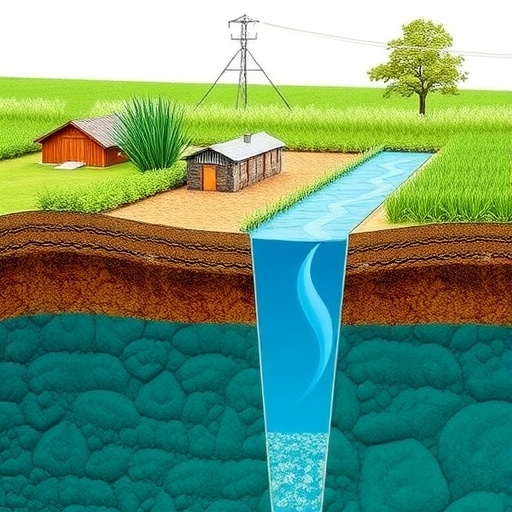
In the arid landscapes of Peru, the intersection of natural geology and human intervention presents complex challenges and opportunities for water management and slope stability. A groundbreaking numerical study published in Environmental Earth Sciences by Howell and Dugan dives deep into these dynamics, focusing on the Majes irrigation project—a monumental effort that has reshaped local hydrology and topography. Their research explores how hydraulic conductivity and irrigation practices influence the formation of perched aquifers and the consequential impacts on slope stability, revealing critical insights with wide-ranging implications for environmental engineering and sustainable agricultural practices.
Perched aquifers, which are layers of groundwater trapped above the main water table by impermeable rock or soil layers, are particularly sensitive to changes in moisture flow and soil permeability. These geological features can act as reservoirs in otherwise dry regions, but they also pose hazards by potentially triggering slope failures. The study zeroes in on how irrigation water, when added systematically through large-scale agricultural projects like Majes, interacts with the subsurface environment to develop these perched water bodies. Using numerical models, the researchers simulate how variations in hydraulic conductivity—the ease with which water moves through porous media—shape the size, timing, and persistence of perched aquifers.
This is more than an academic exercise. The Majes project represents a massive human alteration of a fragile environment where irrigation technology has transformed barren lands into productive fields. Yet, this transformation introduces risks. Water infiltration into unstable soils can saturate subsurface layers, causing a loss of cohesion and increasing the likelihood of landslides. Howell and Dugan’s work meticulously demonstrates that hydraulic conductivity controls not only the extent of perched aquifer formation but importantly, also governs when and how these perched waters intensify slope instability. Their simulations reveal that even subtle shifts in subsurface permeability can drastically alter how water accumulates, creating perched aquifers that may persist for months or even years, dramatically increasing landslide vulnerability.
By coupling hydrological modeling with geotechnical analysis, the research uncovers the nuanced feedback between irrigation practices and slope mechanics. In mountainous terrains like those near the Majes project, water injected via irrigation canals or fields doesn’t merely percolate downwards. Instead, it intersects with layers of varying permeability and geological discontinuities, leading to perched water bodies perched above deeper aquifers. This vertical heterogeneity creates complex flow regimes that can both aid in water conservation and destabilize hillslopes, underscoring a crucial trade-off faced by irrigation engineers and planners.
The numerical case studies encapsulated in the paper employ advanced computational methods that account for the heterogeneity and anisotropy of subsurface materials. These models integrate soil hydraulic properties, variable irrigation schedules, and climatic inputs to simulate real-life scenarios as closely as possible. Through sensitivity analyses, Howell and Dugan show that strategic management of irrigation timing and volume can mitigate the buildup of perched aquifers, potentially reducing the risk of catastrophic slope failures. This offers actionable insights into adaptive irrigation management that balances agricultural productivity with geological safety.
Even more fascinating is the temporal aspect of perch aquifer formation explored in the study. The authors demonstrate that perched aquifers do not form uniformly or instantaneously. Rather, their development is episodic, influenced by seasonal irrigation cycles and antecedent moisture conditions. These dynamics highlight the importance of real-time monitoring and flexible management protocols that can anticipate and respond to periods of heightened subsurface saturation, thereby preventing destabilizing conditions before they manifest as landslides.
Holistic consideration of slope stability necessitates understanding not just water quantity but the distribution and movement of moisture through soil layers of differing permeability. Howell and Dugan’s insights bring to light that hydraulic conductivity is not a uniform factor but varies spatially and temporally within the landscape. Such variability can result in localized perched water zones that act as slip planes or zones of weakness, triggering slope failure. Their research paves the way for precision modeling that integrates geotechnical risk with hydrological data to forecast instability hotspots with remarkable accuracy.
One compelling implication of this work is its relevance to other semi-arid and mountainous regions worldwide undergoing expansion of irrigation infrastructure. As global water demand rises and climate patterns shift, many areas face similar challenges balancing water provision with ecological and geomechanical stability. The methodologies and findings from the Majes project model are readily transferable, offering a blueprint for risk assessment and sustainable water management strategies in vulnerable terrains globally.
Importantly, the authors acknowledge the limitations of purely numerical modeling, advocating for integrated field measurements to validate and refine their simulations. Understanding perched aquifer dynamics requires ground-truth data such as soil moisture profiles, piezometric levels, and geotechnical surveys to capture actual subsurface conditions. Such combined approaches will enhance the predictive power of irrigation impact assessments and inform engineering interventions tailored to site-specific risks.
The study also touches on the socio-economic dimensions of slope stability in irrigated agricultural zones. Given that landslides not only destroy property and infrastructure but disrupt livelihoods, proactive management informed by this research is crucial for sustaining rural communities reliant on stable terrain and reliable water supplies. By elucidating the subsurface processes linking irrigation to slope failure, the paper provides a scientific foundation for policies that protect both the land and its people.
Future research directions stemming from this investigation are promising. Incorporation of climate change scenarios into hydrological-geotechnical models could shed light on how altered rainfall regimes and increased evaporation might influence perched aquifer behaviors. Additionally, expanding modeling frameworks to include vegetation dynamics and soil-plant-atmosphere interactions would deepen understanding of ecosystem influences on slope stability under irrigation stress.
This timely research not only advances theoretical hydrology and geotechnical science but also demonstrates the vital role interdisciplinary approaches play in solving complex environmental challenges. Howell and Dugan’s work serves as a clarion call for integrating engineering, geology, hydrology, and agriculture toward sustainable land-use practices that respect the delicate balance of natural systems while supporting human development objectives.
Their numerical study from the Majes project is a vivid reminder that beneath the visible transformation of landscapes by irrigation lies a hidden interaction of water and soil behavior that dictates land resilience. The control exerted by hydraulic conductivity on perched aquifer formation—and thus on slope failure potential—must be reckoned with in any effort to harness water resources sustainably. As regions worldwide grapple with similar issues, this research establishes a new standard for understanding and managing the geotechnical consequences of irrigation.
In sum, Howell and Dugan’s investigation into perched aquifer development under irrigation stresses the critical need for nuanced hydrological and engineering analytics in water-scarce agricultural zones. By illuminating the unseen conduits and reservoirs of subsurface water that drive slope instability, their study not only informs safer irrigation design but also contributes profoundly to global efforts to harmonize human activity with geological realities. This pioneering work exemplifies cutting-edge science with direct application to contemporary environmental challenges, making it a must-read for scientists, engineers, and policymakers alike.
Cite Scienmag News
Violet Maxwell. (January 13, 2026). Hydraulic Conductivity and Irrigation Impact Perched Aquifers. Scienmag. https://scienmag.com/hydraulic-conductivity-and-irrigation-impact-perched-aquifers/
Violet Maxwell. "Hydraulic Conductivity and Irrigation Impact Perched Aquifers." Scienmag, 13 January 2026, https://scienmag.com/hydraulic-conductivity-and-irrigation-impact-perched-aquifers/. Accessed 3 September 2026.
Violet Maxwell. "Hydraulic Conductivity and Irrigation Impact Perched Aquifers." Scienmag. January 13, 2026. https://scienmag.com/hydraulic-conductivity-and-irrigation-impact-perched-aquifers/


