


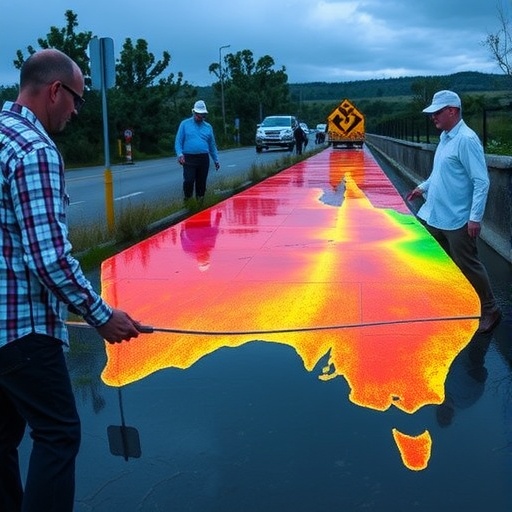
In a groundbreaking study addressing the critical challenge of flood prediction in South-East Australia, researchers have deployed an innovative suite of machine learning models to unravel the complex patterns of regional flood frequency. The team, led by Pan, X., Yildirim, G., Rahman, A., and colleagues, explored the predictive prowess of generalized additive models (GAM), random forest (RF), and extreme gradient boosting (XGBoost) techniques, ushering in a new era of hydrologic forecasting that could significantly enhance flood risk management in vulnerable regions.
Flooding, a natural hazard with devastating consequences for human settlements and ecosystems alike, continues to perplex scientists due to its inherent variability and sensitivity to changing climatic and land-use conditions. Traditional hydrological models often fall short in capturing nonlinear dependencies and the multifaceted influences of environmental predictors. This study stands out by integrating sophisticated statistical and machine learning frameworks that learn from large datasets with minimal assumptions about variable relationships, thereby offering a finer resolution into flood dynamics.
The research focused specifically on South-East Australia, a region notorious for its susceptibility to episodic flooding events influenced by complex meteorological drivers, including intense precipitation and catchment characteristics. By coupling regional hydrometeorological data with advanced computational modeling, the team aimed to enhance the accuracy of flood frequency analyses — a cornerstone for disaster mitigation planning, infrastructure design, and policy formulation.
Generalized additive models, one of the principal methods employed, provide a flexible approach to modeling flood occurrences by allowing nonlinear relationships between predictors and flood response variables. Through smooth functions, GAMs adapt to the data’s underlying structure without predefining the form of interactions, making them particularly suited to environmental variables whose influences do not follow simple linear trends.
Meanwhile, random forests leveraged in the study are ensemble learning methods that enhance prediction stability and accuracy by constructing multiple decision trees and aggregating their outputs. This approach inherently manages high-dimensional data and complex variable interactions, addressing issues of overfitting prevalent in single-tree models. In flood frequency modeling, RFs offer robustness to noisy data while maintaining interpretability, thus presenting a practical tool for hydrologists.
Extreme gradient boosting, the third algorithm under investigation, represents a cutting-edge boosting technique that sequentially builds predictive models to minimize error with remarkable speed and precision. Its ability to handle missing data and incorporate regularization terms to prevent overfitting makes it exceptionally powerful for modeling extreme hydrologic events, which often manifest as outliers in flood datasets.
By applying these three methods concurrently, the research delineated comparative strengths and limitations inherent to each model within the context of flood frequency estimation. The GAMs demonstrated strong conceptual interpretability and highlighted nonlinear environmental effects on flood magnitudes, whereas random forests excelled in capturing intricate variable interactions. XGBoost, with its fine-tuned learning algorithms, outperformed others in predictive accuracy, especially in extreme flood quantification.
Data utilized encompassed extensive hydrological records spanning multiple catchments, meteorological parameters such as rainfall intensity and duration, topographic indices, and soil moisture metrics. Such richness in data permitted the examination of multifaceted drivers and their temporal variability, thereby deepening the understanding of flood-generating processes under different atmospheric and land surface conditions.
Moreover, the study’s methodological rigor included cross-validation schemes, hyperparameter optimization, and uncertainty quantification, ensuring robust model evaluation and enhancing confidence in the predictive outcomes. These methodological choices reflect a meticulous approach to overcoming common challenges in environmental modeling, such as data scarcity, noise, and model overfitting.
One of the most compelling outcomes of the investigation was the enhanced spatial resolution of flood frequency estimates, enabling more localized risk assessments. This granularity is crucial for communities, urban planners, and emergency management agencies, who require precise information to design resilient infrastructure, allocate resources efficiently, and implement timely mitigation strategies.
The implications of this study extend beyond the boundaries of South-East Australia. The fusion of statistical and machine learning frameworks offers a replicable blueprint for flood prediction in other regions facing similar hydrological uncertainties influenced by climate change and anthropogenic alterations. Such methodological advances are vital for adapting to a future where extreme weather events are projected to increase in frequency and intensity.
Beyond predictive gains, the research contributes valuable insights into the interpretability of complex models governing flood risk. Understanding which variables most strongly influence flood frequency facilitates targeted environmental policies and informs the design of early warning systems that can save lives and reduce economic losses.
Furthermore, the integration of extreme gradient boosting into hydrologic modeling signals a burgeoning relationship between artificial intelligence and environmental sciences. This interdisciplinary approach heralds a transformative shift where AI not only complements but elevates traditional analytical methods, pushing the boundaries of what is achievable in environmental risk assessment.
The compelling juxtaposition of advanced modeling techniques in this study underscores an essential theme in contemporary environmental science: embracing complexity through computational innovation leads to more nuanced and actionable knowledge. As climate variability continues to shape disaster landscapes, such pioneering research stands at the forefront of equipping society with better tools to anticipate and respond to natural hazards.
In delivering these findings, the researchers emphasize the importance of continued data collection and model refinement. They advocate for collaborative efforts combining hydrological expertise, climate science, and data analytics to create adaptive systems capable of evolving alongside environmental changes.
This landmark study offers a pivotal example of how modern data-driven approaches can revolutionize our understanding of flood phenomena. By harnessing the power of generalized additive models, random forests, and extreme gradient boosting, it charts a promising pathway toward more resilient and informed flood risk management strategies worldwide.
As flood risks mount under accelerating climatic shifts, the insights from Pan, Yildirim, Rahman, and colleagues resonate with urgency and hope, spotlighting the fusion of technology and science as a beacon for safeguarding vulnerable communities in an uncertain future.
Cite Scienmag News
Violet Maxwell. (January 13, 2026). Advanced Flood Forecasting Models Transform South-East Australia. Scienmag. https://scienmag.com/advanced-flood-forecasting-models-transform-south-east-australia/
Violet Maxwell. "Advanced Flood Forecasting Models Transform South-East Australia." Scienmag, 13 January 2026, https://scienmag.com/advanced-flood-forecasting-models-transform-south-east-australia/. Accessed 6 September 2026.
Violet Maxwell. "Advanced Flood Forecasting Models Transform South-East Australia." Scienmag. January 13, 2026. https://scienmag.com/advanced-flood-forecasting-models-transform-south-east-australia/


