


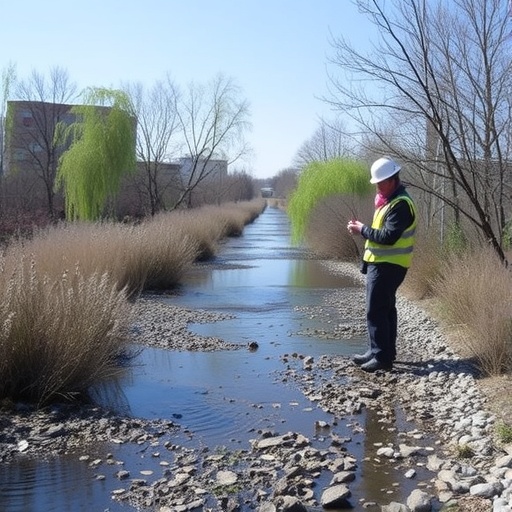
In urban settings worldwide, the challenge of managing water quality continues to gain prominence, especially as cities grapple with pollution stemming from a combination of sources. Among these, black and odorous water has emerged as a critical issue, a byproduct of human activities that not only affects the aesthetic qualities of urban rivers but also has severe implications for public health and the environment. A recent study led by Zheng, Wang, and Zhang explores a sophisticated methodology to identify sources of this pollution with a focus on remediation strategies that can effectively restore urban water bodies.
The study utilizes the QUAL2Kw model, a widely recognized tool for assessing water quality in rivers and streams. QUAL2Kw is an extension of the classic QUAL2K model, which has been adapted to incorporate enhanced hydrology, sediment transport, and water quality dynamics, thereby offering a more comprehensive analysis of aquatic environments. By applying this model, the researchers aimed not only to identify the root causes of black and odorous water but also to develop actionable strategies to mitigate the impact of pollution sources.
One of the critical findings of Zheng et al.’s research is the identification of key anthropogenic activities that contribute to the deterioration of water quality in urban river systems. These include untreated sewage discharge, industrial effluents, and non-point source pollution from agricultural runoff. The study emphasizes the need for a multi-faceted approach to remediation that addresses these various sources of pollution while considering the unique socio-economic conditions of urban areas.
Equipped with data from qualitative assessments and hydrological modeling, the team implemented several case studies to highlight the efficacy of different remediation strategies. This process involved simulating how alterations in urban planning and pollution control measures could improve the water quality in selected rivers. The results underscored not only the immediate benefits of such interventions but also the long-term advantages of sustainable water management practices.
For urban planners and environmental policymakers, the implications of this research are profound. By utilizing a model such as QUAL2Kw, cities can perform scenario analyses that inform better decision-making. This allows for proactive measures to be employed before issues escalate to crisis levels. It also plays an essential role in community engagement, as stakeholders can visualize the potential outcomes of various remediation efforts.
Zheng and colleagues’ research further underscores the importance of integrated water resource management, which involves collaboration among different sectors including agriculture, industry, and urban development. The findings suggest that without cooperative efforts aimed at reducing the sources of pollution, even the most advanced water treatment technologies will struggle to keep urban rivers from being overwhelmed by contaminants.
Moreover, the study raises critical questions about public health, as black and odorous water represents not just an aesthetic issue but also a direct threat to the well-being of urban populations. Contaminated waterways can serve as breeding grounds for pathogens, thereby heightening the risk of disease transmission. Consequently, the intersection of environmental health and public policy is a recurrent theme in the research, calling for more stringent regulations around water quality and pollution control.
The researchers recognize that while advanced model simulations provide valuable insights, real-world applications require continuous monitoring and adaptive management strategies. The need for robust data collection on the components of urban aquatic systems cannot be overstated. Longitudinal studies that track improvements in water quality over time will be fundamental in assessing the effectiveness of implemented strategies and adapting them as necessary.
Interestingly, the study acknowledges the role of public awareness in fostering environmental stewardship. Educating urban residents about the impact of their behaviors on water quality is crucial in mitigating pollution at the source. Outreach programs that promote responsible wastewater disposal practices and highlight the significance of maintaining clean waterways can generate community support for larger environmental initiatives.
Through the lens of technological advancements, the research also touches on the integration of remote sensing and data analytics in understanding urban water quality issues. These approaches allow for real-time monitoring of pollution levels and the efficacy of remediation strategies. Harnessing the power of technology in environmental management will be pivotal in future efforts to sustain urban ecosystems.
As cities continue to expand, the challenge of managing water resources will only compound, especially as climate change introduces new variables into the equation. The research led by Zheng et al. stands as a clarion call for innovative thinking and collaborative action. As we further investigate the complex interactions between urban development and environmental sustainability, prioritizing the integrity of our waterways will be essential for creating resilient cities.
Ultimately, the ongoing research into black and odorous water serves not merely as a study of pollution but a reflection of the broader societal values we hold regarding our environment. The pressing need for clean, healthy waterways is not just an issue for scientists and policymakers; it is a shared responsibility that requires the engagement of every urban resident. As we look ahead, fostering a culture that prioritizes environmental health will be essential in shaping the future of urban water management.
The implications of Zheng et al.’s findings extend beyond mere academic insights; they influence critical policy decisions and community actions that can substantially enhance urban resilience and ecological integrity. Aiming for cleaner, more sustainable urban waterways is not just an aspiration, but a necessity for cities aiming to thrive in the 21st century.
In conclusion, the fight against black and odorous water in urban environments requires innovative solutions, a comprehensive understanding of the sources of pollution, and a collaborative effort from all stakeholders involved. Only through concerted action, informed by thorough research and data, can we hope to revitalize our urban rivers, ensuring they remain vibrant and healthy for generations to come.
Zheng, E., Wang, Y., Zhang, Y. et al. QUAL2Kw-based source identification and remediation strategy assessment for black and odorous water in urban river. Environ Monit Assess 198, 119 (2026). https://doi.org/10.1007/s10661-025-14962-y
Cite Scienmag News
Violet Maxwell. (January 12, 2026). Assessing Urban River Remediation with QUAL2Kw. Scienmag. https://scienmag.com/assessing-urban-river-remediation-with-qual2kw/
Violet Maxwell. "Assessing Urban River Remediation with QUAL2Kw." Scienmag, 12 January 2026, https://scienmag.com/assessing-urban-river-remediation-with-qual2kw/. Accessed 4 September 2026.
Violet Maxwell. "Assessing Urban River Remediation with QUAL2Kw." Scienmag. January 12, 2026. https://scienmag.com/assessing-urban-river-remediation-with-qual2kw/


